The 2026 implementation of the UK’s mandatory licensing scheme means that thousands of practitioners must now prove their clinical competency through rigorous, regulated pathways or risk being unable to practice. Choosing the right aesthetic courses is no longer just a matter of learning a new technique; it’s a strategic decision to protect your professional future within the framework established by the Health and Care Act 2022. You likely feel the pressure of choosing between CPD-accredited certificates and OFQUAL-regulated diplomas, especially when the wrong choice could mean your insurance premium triples or your qualification becomes obsolete by next season.
It’s natural to feel a sense of urgency as the industry moves toward a more sophisticated, medicalised model. We’re here to provide the clarity you deserve, offering a definitive roadmap that balances clinical excellence with the bespoke, luxury artistry your clients expect. You’ll learn exactly how to meet the new licensing requirements, gain the confidence to handle complex complications, and build a career that’s both resilient and refined. This guide explores every milestone of your journey, from foundational Level 4 training to the advanced mastery required for harmonious, natural-looking results.
Key Takeaways
- Understand the 2026 regulatory shift and why OFQUAL-regulated qualifications have become the essential gold standard for any aspiring practitioner in the UK.
- Navigate the educational ladder from Level 4 through to the Level 7 Diploma, ensuring you select the right aesthetic courses to build a safe and highly respected clinical practice.
- Gain clarity on the structured pathways available for both medical professionals and beauty therapists, allowing you to transition into aesthetics with confidence and legal certainty.
- Identify the non-negotiable hallmarks of elite training, from the necessity of hands-on experience with live models to the long-term benefits of a bespoke professional mentorship.
Understanding Aesthetic Courses: Regulation and Requirements in 2026
The transition from traditional beauty therapy to clinical injectables marks a pivotal moment in a practitioner’s professional evolution. Aesthetic medicine now demands a rigorous academic foundation that mirrors the precision and safety of surgical disciplines. By 2026, the UK’s regulatory environment has matured, moving decisively away from short, unaccredited workshops toward formalised, clinical pathways. Choosing the right aesthetic courses isn’t just about learning a new technique; it’s about establishing a legacy of safety and refinement in your practice.
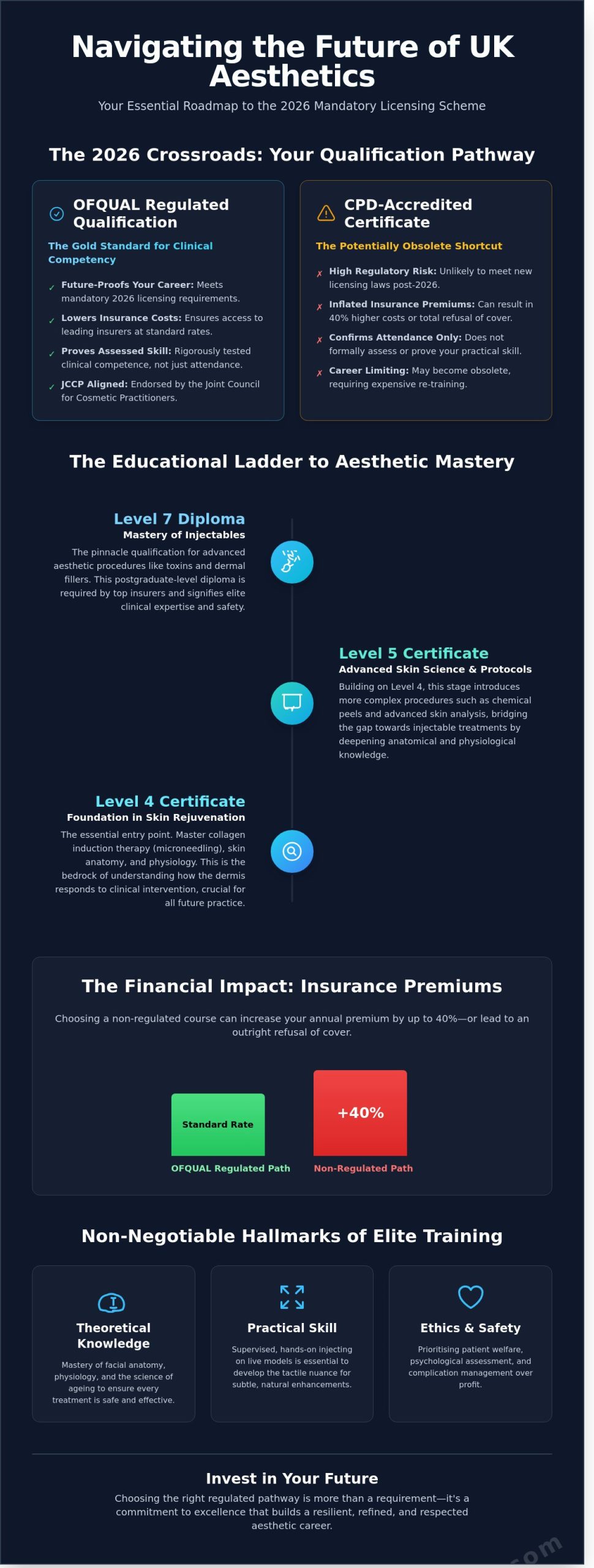
The Health and Care Act 2022 paved the way for the mandatory licensing scheme that now defines our industry. OFQUAL regulated qualifications have emerged as the non-negotiable gold standard for new entrants. While Continuing Professional Development (CPD) points remain valuable for seasoned practitioners to stay updated, they don’t replace the ‘regulated competence’ provided by a formal framework. A CPD certificate often confirms you were in the room; an OFQUAL qualification proves you possess the assessed skill to perform the procedure safely.
The Joint Council for Cosmetic Practitioners (JCCP) acts as the primary guardian of these standards. Aligning your education with JCCP recommendations ensures your career is future-proofed against further legislative changes. It transforms your professional identity from a technician into a trusted clinical artisan who prioritises patient safety. This commitment to excellence is what separates a boutique specialist from a high-volume provider.
Why Regulation Matters for Your Insurance
Securing professional indemnity insurance is the first hurdle for any new practitioner. By 2026, leading UK insurers like Hamilton Fraser and Cosmetic Insure have tightened their criteria, often requiring proof of a Level 7 Diploma for injectable treatments. Opting for ‘cheap’ or ‘fast-track’ aesthetic courses might save £500 initially, but it frequently results in annual insurance premiums that are 40% higher, or a total refusal of cover. Investing in a regulated Level 4, 5, or 7 framework ensures your business remains protected, reputable, and profitable in the long term.
The Core Pillars of Aesthetic Education
A truly bespoke education rests on three foundational pillars that ensure you deliver natural-looking, harmonious results. These include:
- Theoretical knowledge: Mastering facial anatomy, physiology, and the intricate science of ageing to understand every needle placement.
- Practical skill: The necessity of supervised live model injecting to develop the tactile nuances required for subtle enhancements.
- Ethics and safety: Prioritising patient welfare and psychological assessment over profit to ensure a safe, supportive journey.
Focusing on these pillars allows you to guide your clients toward the best version of themselves with quiet confidence and artistic discernment.
The Educational Ladder: From Foundation to Level 7 Diploma
Building a successful career in aesthetics requires more than just a keen eye for symmetry; it demands a structured, academic approach to clinical safety and skin health. The path to becoming an elite practitioner is defined by a clear educational hierarchy. This ladder ensures you develop the technical proficiency and anatomical knowledge needed to deliver the harmonious, natural-looking results that modern clients expect. Choosing the right aesthetic courses is the first step in this transformative process.
Starting with Level 4 Skin Needling
Level 4 serves as the critical entry point for any aspiring aesthetician looking to move beyond traditional beauty therapy. This qualification focuses on the science of skin rejuvenation, specifically mastering collagen induction therapy through microneedling. You’ll gain a deep understanding of skin anatomy and physiology, learning how to trigger the body’s natural healing response to create a more radiant and refined complexion. It’s the essential foundation for understanding how the dermis responds to clinical intervention.
Transitioning from basic facials to clinical skin health is a significant shift. At this stage, you’ll learn to manage the skin’s integrity with precision. Mastery of these techniques allows you to address concerns like fine lines and acne scarring with confidence. Establishing this baseline of clinical excellence ensures your clients feel safe and pampered as they begin their journey toward skin health. Many practitioners find that starting here provides the necessary confidence to later explore a bespoke training journey tailored to their specific career goals. For those specifically interested in mastering the foundational skills of skin rejuvenation, a professional microneedling course provides the regulated Level 4 training essential for 2026 compliance.
Level 5 acts as the bridge, expanding your repertoire into advanced skin treatments and peels. It deepens your understanding of the chemical and physical processes that underpin aesthetic practice. This stage is where you refine your consultation skills, learning to design comprehensive treatment plans that prioritise long-term skin health over quick fixes.
Mastering Injectables with the Level 7 Diploma
The Level 7 Diploma in Clinical Aesthetic Injectable Treatments represents the pinnacle of aesthetic education. It’s widely recognised as the Master’s equivalent qualification in the industry. This level is designed for those who wish to be viewed as elite practitioners, offering a level of depth that far exceeds standard foundation days. The curriculum is rigorous, typically requiring 275 hours of total learning and a minimum of 40 supervised clinical observations and treatments.
The programme is divided into comprehensive modules that cover both Botulinum Toxin and Dermal Fillers. You’ll study facial anatomy in minute detail, learning how neurotoxins can create a refreshed appearance and how fillers can restore lost volume with subtle precision. As the UK government moves toward a new licensing scheme for non-surgical cosmetic procedures, achieving a Level 7 qualification in aesthetics ensures you’re prepared for the mandatory standards expected by 2026. This qualification isn’t just about learning to inject; it’s about mastering the art of the consultation and the science of complication management.
- Botulinum Toxin: Focuses on upper face rejuvenation and the prevention of dynamic wrinkles.
- Dermal Fillers: Covers mid-face volumisation and the enhancement of natural facial contours.
- Clinical Oversight: Ensures every procedure is conducted with meticulous attention to safety and hygiene.
Once you’ve secured your foundation, specialist masterclasses allow you to refine your artistry. These short, intensive aesthetic courses focus on high-demand areas like lip augmentation filler, jawline contouring, and non-surgical rhinoplasty. These sessions are where the science of medicine meets the intuition of art, allowing you to provide truly personalised enhancements that celebrate the best version of your clients.
Medical vs. Non-Medical Pathways: Finding Your Route
The aesthetics industry is undergoing its most significant transformation since the inception of dermal fillers. The Health & Care Act 2022 set a new trajectory for the UK market, introducing a framework that prioritises patient safety above all else. By 2026, the government intends to implement a mandatory national licensing scheme for all practitioners in England. This shift leads many to ask if the door is closing for non-medics. It isn’t. Instead, the path is simply becoming more defined and professional. Understanding Aesthetic practitioner licensing in the UK is now a prerequisite for anyone entering the field, ensuring that every injector, regardless of their background, meets a gold standard of clinical excellence.
Whether you’re a registered nurse or a dedicated beauty therapist, the goal remains the same: creating harmonious, natural-looking results. The industry is moving away from the “wild west” era toward a sophisticated, tiered system. This evolution benefits everyone. Clients feel more secure, and practitioners gain the professional respect they deserve. You’ll find that the journey to becoming a trusted expert requires dedication, but the rewards of a bespoke aesthetics career are unparalleled. It’s about blending the precision of science with the vision of an artist.
The Pathway for Non-Medical Students
If you’re coming from a beauty background or a complete career change, your journey starts with a rigorous academic foundation. You’ll move through Level 4 and Level 5 qualifications, which act as a vital bridge. These aesthetic courses cover essential anatomy, physiology, and skin health before you ever touch a syringe. At Beauty Worx Aesthetics, we support this transition with intensive mentorship. We focus on building your clinical credibility so you can offer treatments with total confidence. It’s a structured route that transforms passion into professional mastery, ensuring you’re fully prepared for the 2026 regulatory shifts.
Aesthetics for Healthcare Professionals
For doctors, nurses, and dentists, the transition to aesthetics is often about translation. You already possess the clinical skills; now you must refine your aesthetic eye. The focus shifts from treating pathology to enhancing radiance and youthfulness. You’ll need to adapt to the “art” of facial balancing, ensuring results are subtle and refreshed rather than “done”. Prescribing requirements are a key consideration here. If you aren’t a prescriber, you’ll need to establish a partnership with one to maintain legal oversight. This collaborative approach ensures your practice remains safe, ethical, and meticulously professional at every stage of the patient journey.
Bridging the gap between these two pathways is a commitment to shared clinical standards. A complication doesn’t care if the person holding the needle has a degree or a Level 5 diploma; it only cares about the response. That’s why we insist on a unified approach to emergency protocol and complication management. By the time you complete your training, the distinction between “medic” and “non-medic” fades behind the title of “Aesthetic Practitioner”. You’ll emerge as a specialist who views every face as a unique canvas, dedicated to helping clients achieve the best version of themselves through safe, luminous, and expertly delivered treatments.
What to Look for in an Aesthetic Training Academy
Choosing the right environment for your professional development is a decision that shapes your entire career trajectory. Not every academy offers the same level of clinical rigour or artistic mentorship. When researching aesthetic courses, look for a provider that prioritises intimacy over volume. A training session with 20 students to one tutor leaves too much room for error and missed nuances. At Beauty Worx, we maintain a strict 1:4 tutor-to-student ratio, ensuring your hand is guided by an expert during every injection. This level of supervision is vital for building the muscle memory required for subtle, natural-looking results.
The background of your educator matters immensely. A tutor should be a licensed medical professional, such as an NMC-registered nurse or GMC-registered doctor, with a minimum of 5 years of active experience in aesthetic medicine. They must be able to explain the intricate anatomy of facial nerves and vasculature with the precision of a specialist. This clinical authority provides the safety net you need when you transition from student to practitioner. A 2023 survey by the Joint Council for Cosmetic Practitioners (JCCP) revealed that 72% of new practitioners felt underprepared for real-world scenarios if their training lacked direct, high-level clinical supervision.
This principle of seeking proven, specialized expertise isn’t unique to aesthetics. In any field where nuanced understanding is key—from financial advising to complex behavioral training—the quality of the instruction determines the outcome. For instance, even in a seemingly unrelated area like canine behavior, professionals rely on structured, science-based programs to achieve reliable results, a concept detailed at iwuffyoudogtraining.com. The core idea is the same: mastery comes from learning from true experts, not from shortcuts.
The Importance of Live Model Practice
Practising on silicone mannequin heads is a useful starting point, but it cannot replicate the physiological response of human tissue. Real skin has varying thicknesses; it moves, reacts, and occasionally bruises. It’s impossible to learn the “feel” of different dermal layers without a living patient. Beauty Worx organises a minimum of 6 unique live models for every practical session, allowing you to experience diverse facial structures and skin types. This exposure is essential for understanding how to tailor a bespoke treatment plan. You’ll learn to manage patient expectations and the psychology of a consultation, which are skills a mannequin simply cannot teach.
Complications Management and Aftercare
Safety is the cornerstone of our philosophy. While we strive for luminous, harmonious results, we prepare for every eventuality. Our aesthetic courses place a heavy emphasis on identifying and managing vascular occlusions, infections, and delayed hypersensitivity. A 2022 industry report noted that while major complications occur in fewer than 0.05% of filler treatments, a practitioner’s true skill is revealed in their ability to handle these rare events with calm professionalism. We teach the full Hyalase protocol and emergency dissolution techniques. Enrolling in a dedicated complications management course transforms that lingering clinical anxiety into the unwavering composure that defines a master aesthetician. Building this confidence ensures you aren’t just an injector, but a safe, responsible medical professional who prioritises patient welfare above all else.
A quality academy doesn’t disappear once the certificate is handed over. You should look for a programme that offers ongoing mentorship and a clear path for advanced learning. Whether it’s a dedicated WhatsApp support group or a follow-up shadowing day, this continued connection is what separates a “certificate mill” from a true centre of excellence. We believe in an ongoing partnership that supports your growth as you master the art of facial rejuvenation.
Ready to begin your journey with an academy that prioritises clinical safety and artistic excellence? Explore our professional aesthetic courses and secure your place in our next small-group intake.
Beyond the Certificate: Launching Your Aesthetic Career
Completing one of our aesthetic courses is just the beginning of your professional evolution. At the Lancashire Academy, we provide a sanctuary for learning, set within a luxury, boutique environment that mirrors the high-end standards your future clients will expect. You aren’t just learning in a sterile classroom; you’re immersed in a clinical space that feels like a high-end spa. This atmosphere is intentional. It prepares you for the psychological shift from student to professional artisan, ensuring you carry yourself with the quiet confidence needed to deliver harmonious, natural-looking results. We believe the environment dictates the quality of your education, which is why our training takes place in a setting that prioritises both medical precision and sensory comfort.
Mentorship and Ongoing Support
The Beauty Worx Mentorship provides a safety net for the critical first six months when you’re treating your own clients. You gain access to a private community of practitioners who share advice on injection techniques or managing rare complications. This long-term guidance is the secret to aesthetic success, ensuring you never feel isolated in your clinical decisions. It transforms a certificate into a sustainable, safe career path.
We also offer dedicated shadowing days where you observe a real clinic for a full eight-hour shift. Seeing 10 to 12 diverse cases in a single day provides a level of insight that manual study cannot replicate. Observing how an expert manages client expectations and handles different skin types is invaluable for your confidence. This exposure helps you understand the rhythm of a successful clinic before you open your own doors.
Setting Up Your Aesthetic Clinic
Turning your new skills into a profitable business requires more than just clinical talent. We provide specific guidance on securing medical malpractice insurance, which typically costs between £400 and £800 annually for new practitioners. You’ll learn how to open accounts with reputable UK pharmacies like Church Pharmacy or Med-FX to source genuine neurotoxins and dermal fillers for your patients.
While many aesthetic courses focus solely on the injection, we prioritise the long-term success of your business. We help you design a brand that reflects ‘the best version of you’ while creating a bespoke client journey. This path starts from the very first consultation and continues through to the 14-day follow-up appointment. This methodical approach ensures safety and builds the trust required for a luxury brand. Discover your bespoke training pathway at Beauty Worx Aesthetics to begin this transition.
Your clinic’s reputation hinges on the bespoke experience you offer. This starts with the initial consultation, where you learn to listen to a client’s emotional journey toward self-confidence rather than just identifying wrinkles. We teach you how to conduct a thorough skin analysis and facial mapping that leads to a refreshed, luminous outcome. Marketing your clinic isn’t about aggressive jargon; it’s about building a brand that reflects your commitment to safety and artistry. We provide templates for consent forms and advice on social media strategies that attract high-value clients who value quality over discounts. By focusing on enhancement and restoration, you create a loyal client base that views you as their trusted, expert guide. Understanding the nuances of facial aesthetics and non-surgical enhancement techniques is essential for delivering the subtle, natural results that discerning clients seek. As the industry evolves toward holistic wellness, many practitioners are also expanding their services to include vitamin B12 injection training for professional wellness certification, offering clients a comprehensive approach to both aesthetic enhancement and internal vitality.
Step Into Your Future as a Trusted Aesthetic Specialist
The landscape of facial rejuvenation is shifting. By 2026, the UK industry demands a higher standard of clinical precision and ethical practice. Your transition from an aspiring practitioner to a respected artisan begins with navigating the regulated pathways that now define our profession. Success requires more than a basic certificate; it demands a mastery of the Level 7 Diploma and a deep understanding of how to achieve harmonious, natural-looking results for every client.
Choosing your training partner is the most vital step in protecting your future reputation. At BeautyWorx Aesthetics, we provide a sophisticated environment where science meets artistry. We’re a dedicated OFQUAL Regulated Level 4, 5, and 7 provider, offering a curriculum that includes over 25 CPD accredited specialist aesthetic courses. Our mentorship-led training takes place in our luxury Lancashire academy, ensuring you receive the meticulous guidance needed to flourish. It’s time to refine your skills and embrace a career built on safety, elegance, and expert discernment.
Explore Our OFQUAL Regulated Aesthetic Courses
We look forward to supporting your journey toward professional excellence and clinical mastery.
Frequently Asked Questions
Do I need to be a nurse or doctor to do aesthetic courses in the UK?
No, you don’t need a medical degree to begin your journey in this field, although specific entry requirements apply to maintain high standards of safety. Most reputable providers of aesthetic courses require a Level 3 Beauty Therapy qualification or a background in healthcare to enrol in advanced injectables. This ensures you possess the foundational anatomical knowledge required to deliver safe, luminous results. While the UK government is currently refining the 2024 licensing framework, non-medics remain a vital part of the industry.
What is the difference between a CPD course and an OFQUAL regulated diploma?
An OFQUAL regulated diploma is a nationally recognised qualification that sits on the Regulated Qualifications Framework, providing a standardised level of prestige and academic rigour. In contrast, a CPD course focuses on shorter bursts of learning to maintain your professional skills and keep your knowledge current. While CPD hours are essential for annual insurance renewals, an OFQUAL Level 7 qualification represents the gold standard of clinical excellence. It offers a more robust, academic pathway for those seeking a bespoke career in facial rejuvenation.
How long does it take to complete a Level 7 Aesthetics Diploma?
Completing a Level 7 Aesthetics Diploma typically requires 6 to 18 months of dedicated study and clinical practice. This timeframe allows you to master complex procedures like neurotoxin injections and dermal fillers while building a portfolio of 40 observed and performed treatments. Your progress depends on your prior experience and the frequency of your clinical mentoring sessions. It’s a deliberate, sophisticated journey designed to ensure you emerge as a confident, expert artisan capable of enhancing natural beauty.
Can I get insurance as a non-medic after completing an aesthetics course?
Yes, you can secure comprehensive professional indemnity insurance as a non-medic through specialist providers such as Hamilton Fraser or Insync. These insurers generally require proof of a Level 3 Beauty qualification or 12 months of needle experience before they cover advanced injectables. Expect annual premiums to start around £600 for a basic policy that protects both you and your clients. Having the right coverage is a non-negotiable step in protecting your professional reputation as you help clients achieve their aesthetic goals.
What are the most popular aesthetic courses for beginners?
The most sought-after aesthetic courses for beginners include Foundation Anti-Wrinkle Injections and Dermal Filler training. These sessions provide the essential skills needed to create harmonious, subtle enhancements for the lips and upper face. Many students also start with skin rejuvenation techniques like microneedling or chemical peels. These treatments offer an accessible entry point into the world of clinical skincare, allowing you to deliver a refreshed, radiant glow to your very first clients. Practitioners who wish to specialise further can explore the artistry of lip augmentation filler techniques to master one of the most in-demand aesthetic treatments.
Is there a specific ‘fast-track’ to Botox and filler for non-medics?
Fast-track pathways exist for those without traditional medical or beauty backgrounds, typically starting with an intensive Level 3 Anatomy and Physiology module. These programmes bridge the gap in roughly 4 to 6 weeks, providing the prerequisite knowledge needed for injectable training. However, we recommend a steady, meticulous approach to learning because mastery takes time. Rushing through the foundations can compromise the artistic discernment required to achieve the best version of your clients during their transformation.
How much can I realistically earn as an aesthetic practitioner?
A self-employed aesthetic practitioner can realistically earn between £30,000 and £100,000 per year depending on their client volume and clinic location. With the average cost of a 30-minute dermal filler treatment sitting at £250, seeing just 10 clients a week can generate a gross annual revenue of £130,000. Your income reflects your skill and the luxury experience you provide to your community. High-end practitioners who prioritise safety and bespoke results often see a 70% client retention rate.
What happens if I encounter a complication during my training?
If a complication occurs during your training, your expert mentor will intervene immediately to manage the situation safely and professionally. Every clinical session is equipped with an emergency kit containing Hyaluronidase to dissolve fillers if necessary. Learning to handle these rare events is a crucial part of your journey toward becoming a trusted specialist. We prioritise transparency and safety, ensuring you feel supported as you learn to navigate the delicate balance between medical science and aesthetic art. Practitioners who wish to deepen their crisis-management expertise beyond initial training can benefit enormously from a structured aesthetic complications management course that builds the clinical composure needed to respond with precision and confidence.











 Reviews