By 2026, the era of the unregulated injector will be a memory, as the UK Department of Health and Social Care finalises a mandatory licensing scheme that marks the most transformative shift in the history of the non-surgical sector. You’ve likely felt the weight of these impending changes, perhaps worrying if your passion for skin health will be sidelined by new legislative hurdles. It’s natural to feel anxious when the distinction between “fast-track” courses and legitimate aesthetics training for non-medics uk feels increasingly blurred.
We’re here to transform that uncertainty into a clear, sophisticated path toward clinical excellence. This guide provides the definitive roadmap for your transition into a professional Aesthetic Practitioner, ensuring you meet the JCCP-aligned standards required to thrive in a regulated market. We’ll explore the transition from Level 3 foundations to Level 7 clinical mastery, securing your future in an industry projected to reach a £3.6 billion valuation by the end of the year. You’ll discover how to blend safety with artistry, creating the bespoke, natural-looking results your future clients crave while building a career defined by financial independence and professional prestige.
Key Takeaways
- Navigate the transition from CPD to OFQUAL-regulated qualifications to ensure your professional journey aligns with the 2026 UK government licensing standards.
- Master the step-by-step pathway from foundational Anatomy and Physiology to advanced clinical treatments, creating a sophisticated base for your career.
- Explore how elite aesthetics training for non-medics uk bridges the safety gap through intensive complications management and meticulous clinical protocols.
- Uncover the vital importance of live-model training in a boutique environment to develop the artistic discernment required for natural-looking, luminous results.
What is Aesthetics Training for Non-Medics in the UK?
Entering the world of Aesthetic medicine as a non-medic is a journey toward becoming a highly skilled professional in a multi-billion pound industry. Since the UK government initiated the move toward a national licensing scheme in 2023, the standard for aesthetics training for non-medics uk has shifted from basic beauty certificates to rigorous clinical pathways. It’s no longer just about applying a product. It’s about understanding the complex anatomy of the human face and the science of dermal restoration.
A non-medical aesthetic practitioner operates within a space that bridges the gap between traditional salons and surgical clinics. You aren’t just a technician. You’re a specialist who uses advanced technology and medical-grade injectables to restore volume, smooth fine lines, and enhance facial harmony. Choosing a training centre that prioritises clinical safety over “fast-track” certificates is vital for your longevity. In 2026, the industry rewards those who invest in 300 plus hours of guided learning rather than those who seek weekend shortcuts. Professional aesthetics training for non-medics uk ensures you possess the quiet confidence of a specialist who views every procedure as both a science and an art form.
Aesthetician vs. Aesthetic Practitioner: Knowing the Difference
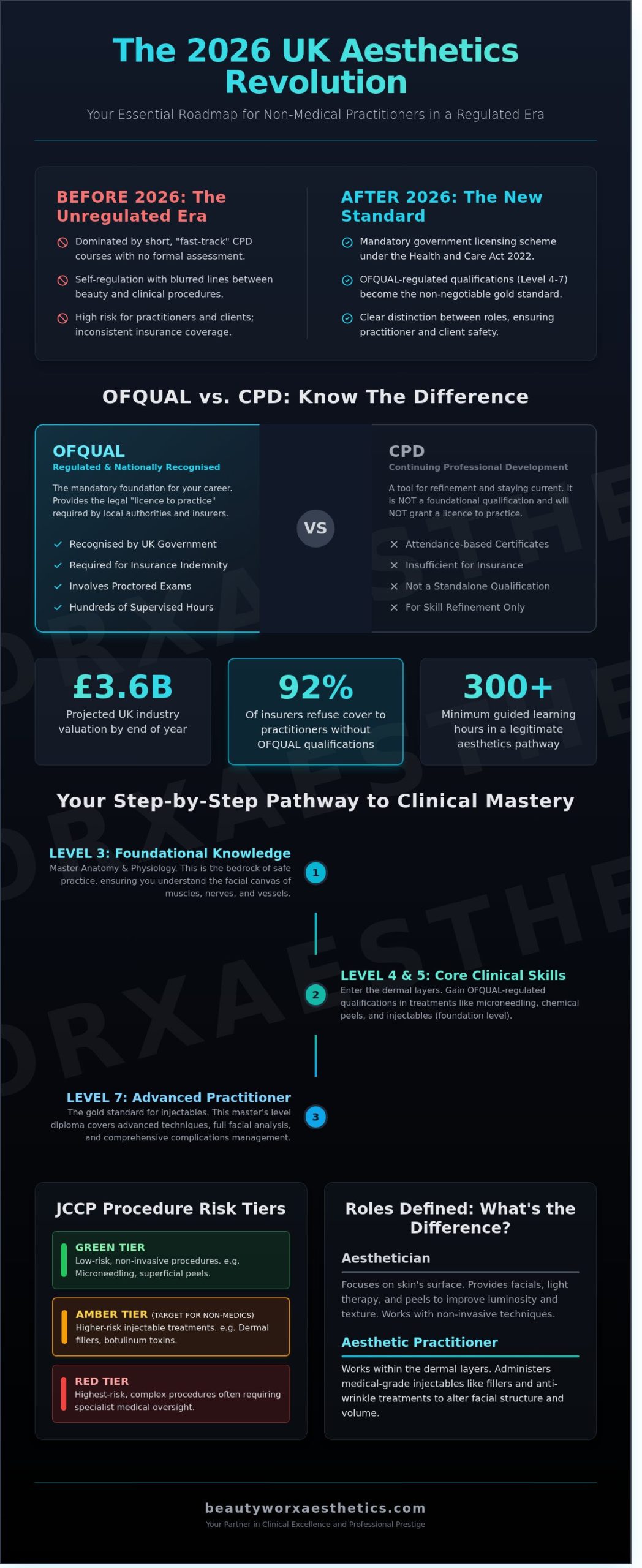
Aestheticians focus on the skin’s surface, providing essential care through facials, chemical peels, and non-invasive light therapies. Their goal is luminosity and texture. An aesthetic practitioner steps into the dermal layers. They administer anti-wrinkle injections and fillers to alter facial structure and volume. This distinction is critical for your insurance premiums and professional standing. High-level insurers now require specific Level 4 to Level 7 qualifications to cover practitioners for injectable treatments.
The Emotional Journey: From Beauty Enthusiast to Clinical Expert
The transition requires a profound shift in mindset. You’re moving from a hospitality-focused role to an expert artisan persona where clinical precision meets artistic discernment. It’s a balance of science and soul. You’ll learn to see the face as a canvas of muscles and vessels, ensuring every needle placement is safe and intentional. A bespoke consultation ensures every treatment plan is as unique as the individual’s skeletal structure and personal aspirations.
Navigating the 2026 Regulatory Landscape: OFQUAL vs. CPD
The UK aesthetic industry has moved beyond the era of self-regulation, entering a period where clinical precision and academic accountability are paramount. Under the framework established by the Health and Care Act 2022, the government has implemented a mandatory licensing scheme that fundamentally changes how practitioners enter the field. For those researching aesthetics training for non-medics uk, it’s vital to understand that the “attendance-based” culture of the past has been replaced by a structured, regulated hierarchy.
The regulation of non-surgical cosmetic procedures now dictates that CPD (Continuing Professional Development) is a tool for refinement, not a foundation for practice. While CPD helps you stay current with the latest injection techniques or product launches, it doesn’t provide the legal “licence to practice” that local authorities now require. Only OFQUAL-regulated qualifications offer the security needed to build a sustainable business in 2026.
Why OFQUAL Regulation is Non-Negotiable in 2026
Regulated qualifications at Level 4, 5, and 7 are the current gold standard for non-medic practitioners. These programmes are far more than simple workshops; they’re comprehensive educational journeys that include proctored exams and hundreds of hours of supervised clinical practice. This rigour is essential because 92% of specialist aesthetic insurers in the UK now refuse to provide indemnity cover to new practitioners who lack an OFQUAL-mapped diploma. By choosing a regulated path, you’re protecting your career against future legislative shifts that may further restrict who can perform high-risk procedures like liquid rhinoplasty or jawline contouring.
Understanding the JCCP and Future Licensing
The Joint Council for Cosmetic Practitioners (JCCP) has worked alongside the government to implement a “Red, Amber, Green” system that categorises procedures by their complexity and risk. Most non-medic practitioners aim for the “Amber” tier, which includes dermal fillers and botulinum toxins. To operate in this tier, a Level 5 or Level 7 diploma is often the minimum requirement to satisfy local council licensing officers. It’s a structured way to ensure that every practitioner possesses a deep understanding of facial anatomy and complication management.
- Verify the Awarding Body: Ensure the academy is linked to recognised bodies like VTCT, CIBTAC, or Qualifi.
- Check the Register: Use the OFQUAL Register of Regulated Qualifications to confirm the course code is legitimate.
- Insurance Approval: Confirm with an insurer like Hamilton Fraser that the specific course meets their 2026 underwriting criteria.
Your journey toward becoming a trusted artisan in this field starts with choosing a bespoke training experience that prioritises safety and clinical excellence. This meticulous approach ensures you’re not just a technician, but a qualified professional capable of delivering the harmonious, natural results that define modern luxury aesthetics.
The Safety Debate: Can Non-Medics Safely Administer Injectables?
The conversation surrounding non-medic practitioners often centres on a binary choice between medical degrees and aesthetic skill. However, safety isn’t a byproduct of a title alone; it’s the result of rigorous, specialised education and obsessive attention to detail. Professional aesthetics training for non-medics uk has evolved into a sophisticated pathway that mirrors the precision found in clinical environments. True expertise comes from understanding the science behind every needle placement, ensuring each client’s journey toward a refreshed appearance is as secure as it is transformative.
As highlighted in the UK Parliament report on cosmetic procedure regulation, the industry is moving toward a mandatory licensing scheme to ensure uniform safety standards across the board. This shift validates the belief that a practitioner’s ability to manage risks is the ultimate benchmark of their professionalism. It isn’t just about the injection; it’s about the clinical judgment that precedes it.
Mastering Complications: The Non-Medic’s Safety Net
A practitioner’s true value is revealed when things don’t go as planned. Every high-tier course now prioritises complications management as its most vital pillar. You must be prepared to identify and act upon specific clinical emergencies:
- Vascular Occlusion: Recognising the immediate signs of a blocked blood vessel and knowing exactly how to use hyaluronidase to dissolve filler.
- Anaphylaxis: Mastering the immediate administration of adrenaline in the rare event of a severe allergic reaction.
- Infection Control: Maintaining a sterile, clinical environment that exceeds the basic requirements of a standard beauty salon to prevent biofilm formation.
For treatments involving prescription-only medicines, such as botulinum toxin, you’ll work alongside a dedicated prescribing partner. This creates a dual layer of safety. A medical professional assesses the client’s suitability, while you focus on the artistic execution of the bespoke treatment plan.
Anatomy and Physiology: The Foundation of Every Injection
You can’t create a harmonious, natural look without knowing what lies beneath the skin. Understanding the intricate map of facial musculature and the placement of fat pads is the only way to avoid “danger zones” like the supraorbital artery. This deep dive into the face’s architecture ensures results are subtle and safe. A Level 3 Anatomy and Physiology qualification serves as the mandatory gateway for any reputable aesthetics training for non-medics uk.
Knowing when to say “no” is the hallmark of an expert artisan. If a client’s goals aren’t achievable or if their health history suggests a risk, a professional practitioner provides a compassionate referral rather than proceeding. This integrity builds lasting trust and protects the reputation of your boutique practice. Safety is a choice you make every single day.
The Step-by-Step Pathway into Clinical Aesthetics
Your journey into clinical excellence begins with a robust understanding of human biology. Most successful practitioners start with a Level 3 Anatomy and Physiology qualification or a recognised beauty background. This foundation ensures you understand the biological canvas before you apply the art. It’s the essential prerequisite for obtaining professional indemnity insurance from specialist UK brokers like Hamilton Fraser or Cathedral. Without this grounding, the more advanced stages of aesthetics training for non-medics uk remain out of reach.
Level 4 and 5: Building Your Clinical Confidence
Level 4 Skin Needling moves your practice beyond surface-level treatments. You’ll master precise needle depths, typically ranging from 0.5mm to 2.5mm, to trigger controlled collagen induction. This stage is where you learn to read skin response in real-time. Transitioning into Level 5, the focus shifts to comprehensive skin health and complex rejuvenation techniques like deep chemical peels. These levels are crucial because they provide the 40+ clinical hours many insurers now demand. You’re not just learning a skill; you’re building a verifiable portfolio of safety and clinical competence.
Level 7: Achieving Master-Level Status
The Level 7 Diploma in Clinical Aesthetic Injectable Treatments represents the pinnacle of the profession. It’s a postgraduate-level qualification that aligns with the latest JCCP standards. The curriculum is rigorous, involving 277 hours of total qualification time, including 40 observed treatments and 10 supervised procedures. Beauty Worx specialises in this high-level delivery for ambitious practitioners who refuse to settle for the bare minimum. You’ll study the subtle harmony of facial architecture and the complex management of complications, ensuring your results are always luminous and safe. This qualification marks your transition from a technician to a trusted, expert artisan.
A certificate shouldn’t be the end of your education. Data from 2024 indicates that 85% of practitioners who maintain a long-term mentorship stay in the industry longer than those who work in isolation. Having a specialist to review your first complex cases prevents errors and builds the quiet confidence required for high-end clinical practice. It’s about a partnership in self-care that evolves as the industry does.
Ready to begin your journey toward becoming a master-level practitioner? Explore our bespoke training pathways at Beauty Worx Aesthetics and start your clinical evolution today.
Choosing Your Academy: Why Beauty Worx Aesthetics Leads the Way
Selecting the right environment for your professional development is the most significant decision you’ll make as you enter the industry. The Beauty Worx Aesthetics training centre in Burscough is designed to be both sophisticated and reassuring, moving away from the sterile atmosphere of traditional classrooms. This luxury boutique setting allows you to immerse yourself in the high-end clinical experience that your future clients will expect. It’s a space where clinical excellence meets artistic discernment.
The curriculum at Beauty Worx is built on a foundation of 25+ CPD-accredited courses and regulated OFQUAL pathways. This ensures your education aligns with the 2026 standards for aesthetics training for non-medics uk. We believe that true mastery comes from practical application, which is why we prioritise live model training over synthetic alternatives. You’ll work directly with human skin under the guidance of expert artisan mentors who treat aesthetic medicine as both a science and a craft. This hands-on approach ensures you develop the precision and tactile sensitivity required for refined results.
- Access to 25+ CPD courses and OFQUAL Level 4, 5, and 7 pathways.
- Hands-on experience with live models in every practical module.
- Mentorship from lead educators with years of clinical success.
- A training environment that mirrors a premium boutique clinic.
The Beauty Worx Difference: Beyond the Classroom
We don’t view graduation as the end of our relationship. Our academy operates on a long-term partnership model, providing ongoing mentorship that supports you as you navigate the complexities of starting a business. Every module we teach is rooted in a philosophy of natural-looking results. You’ll learn how to create a refreshed and harmonious appearance for your clients, avoiding the “overdone” look that many fear. This focus on subtle enhancement ensures your work remains undetectable and elegant, helping you build a loyal client base that values quality and safety.
Your Next Steps: Enrolling in Your Future
Starting your aesthetics training for non-medics uk is a transformative step toward professional independence. We invite you to book a bespoke career consultation to discuss your specific goals and map out a tailored learning journey. To ensure our elite tuition is accessible, we offer flexible finance options for all professional fees. This allows you to invest in your future without immediate financial strain. View this academy as the first chapter in your own self-confidence journey; a place where you’ll gain the skills to empower others while building a career that is as rewarding as it is luminous.
Elevate Your Professional Artistry for 2026
The landscape of the UK beauty industry is shifting toward a future where clinical precision and artistic vision are inseparable. Navigating the 2026 regulatory changes requires a strategic mindset; you’ll need a partner that understands every nuance of the OFQUAL framework to ensure your business thrives. By investing in high-calibre aesthetics training for non-medics uk, you’re securing a foundation of safety and trust that defines your professional reputation. Success in this competitive field demands more than basic theory. It requires the hands-on mastery and bespoke philosophy that modern, discerning clients expect from their practitioners.
Beauty Worx Aesthetics provides the definitive bridge between ambition and excellence. As an OFQUAL Regulated Training Centre, we offer over 25 CPD Accredited Courses alongside an Advanced Clinical Mentorship Programme to guide your transition into a specialist role. We’ve designed our pathway to be as seamless as the results you’ll soon provide. Your evolution into a trusted artisan starts with an education that prioritises both your growth and client safety. Start your bespoke career journey with Beauty Worx Aesthetics training courses and step into the most rewarding chapter of your professional life.
Frequently Asked Questions
Is aesthetics training for non-medics legal in the UK in 2026?
Yes, aesthetics training for non-medics uk remains legal in 2026, provided you adhere to the mandatory licensing requirements introduced by the Department of Health and Social Care. Under the 2023 Health and Care Act, practitioners must hold a personal licence and operate from a licensed premises. This ensures every treatment, from dermal fillers to skin boosters, meets the rigorous safety standards required to protect your clients and your professional reputation.
How much can a non-medic aesthetic practitioner earn annually?
A dedicated non-medic aesthetic practitioner can expect to earn between £35,000 and £55,000 in their first year of full-time practice. As your artistry develops and your client base expands, established practitioners often see annual revenues exceeding £100,000. These figures depend on your location and the bespoke nature of your service menu. High-end treatments like facial contouring offer higher margins compared to basic skin rejuvenation procedures, enhancing your overall profitability.
What is the ‘Fast Track’ to aesthetics, and is it recommended for beginners?
The ‘Fast Track’ route combines foundational beauty therapy with advanced injectable training, though we recommend a more measured approach for those seeking true mastery. While these courses allow you to begin your journey in as little as six months, the most successful artisans prioritise depth of knowledge over speed. Investing extra time into your initial education ensures you possess the quiet confidence needed to deliver subtle, harmonious results from your very first consultation.
Do I need a prescribing partner if I am a non-medic?
You must secure a prescribing partner if you intend to offer treatments involving prescription-only medicines, such as botulinum toxin. Since non-medics cannot legally prescribe, you’ll collaborate with a qualified prescriber who performs a face-to-face consultation with your client first. This partnership is a vital safety layer. It ensures every luminous transformation is underpinned by medical oversight, allowing you to focus entirely on the artistic application of the product and the client’s comfort.
Which insurance providers cover non-medics for dermal fillers?
Specialist providers like Hamilton Fraser, Cosmetic Insure, and Insync currently offer comprehensive indemnity cover for non-medic practitioners performing dermal fillers. Annual premiums typically start from £600 to £900, depending on your qualifications and the specific procedures you perform. Maintaining robust insurance is an essential step in your professional journey. It provides a safety net that allows you to practice your craft with total peace of mind, knowing your business is fully protected.
How long does it take to complete a Level 7 Aesthetics Diploma?
Completing a Level 7 Aesthetics Diploma typically requires 12 to 24 months of dedicated study and clinical practice. This postgraduate-level qualification is the gold standard for those pursuing aesthetics training for non-medics uk, as it mirrors the depth of medical school modules. The extended timeframe allows you to refine your technical skills and anatomical understanding. You’ll emerge not just as a practitioner, but as a specialist who understands the science behind every radiant result.
Can I train in aesthetics if I have no previous beauty experience?
You can certainly begin your career in aesthetics without prior beauty experience by enrolling in a regulated ‘Pathway’ programme. These courses bridge the gap by teaching essential skin physiology and health and safety before moving to advanced injectables. Most students spend 300 hours gaining foundational knowledge before they touch a needle. This structured entry ensures you build the technical expertise required to create the best version of your clients in a safe, clinical environment.
What happens if a government licensing scheme is introduced while I am training?
If a government licensing scheme is fully implemented during your training, you’ll likely need to prove your competency through an Ofqual-regulated qualification. The 2023 Health and Care Act outlines that practitioners must meet specific educational benchmarks to receive their practitioner licence. Choosing a course that aligns with JCCP standards now protects your future. It ensures your transition into the new regulatory landscape is seamless, professional, and entirely free from unnecessary stress or career interruptions.











 Reviews