What if the secret to commanding premium rates isn’t a new marketing strategy, but the quiet confidence of clinical mastery? You’ve likely felt the growing pressure of the UK’s shifting regulatory landscape, particularly following the Department of Health and Social Care’s 2024 consultation on a national licensing scheme. It’s natural to feel a sense of urgency about your professional standing and ask: is level 7 aesthetics worth it? You deserve a career that feels secure, prestigious, and deeply rooted in patient safety.
We agree that the transition from a technician to a medical artisan requires more than just basic certification; it demands a commitment to the highest standards of clinical governance. This guide explores how the Level 7 Diploma transforms your practice from a series of treatments into a bespoke, luminous journey for your clients. You’ll discover how this qualification future-proofs your business against the Health and Care Act 2022. We’ll examine the tangible ROI of the investment, the upcoming legislative changes, and the specific clinical edge that allows you to manage complications with the poise of a true specialist.
Key Takeaways
- Navigate the evolving regulatory landscape to understand why the Level 7 Diploma is the definitive pathway to meeting the 2026 DHSC licensing standards.
- Evaluate the financial ROI of your education and discover why the question is level 7 aesthetics worth it is best answered by the “Premium Practitioner” effect on your lifetime client value.
- Master the delicate balance between clinical expertise and artistic flair, ensuring your practice delivers the luminous, natural-looking results today’s sophisticated clients demand.
- Gain clarity on the professional requirements for doctors, nurses, and dentists, separating fast-track myths from the rigorous academic reality of postgraduate-level training.
- Discover how a bespoke training experience can elevate your consultations, transforming technical procedures into an aspirational journey of self-confidence for your clients.
What is a Level 7 Aesthetics Qualification?
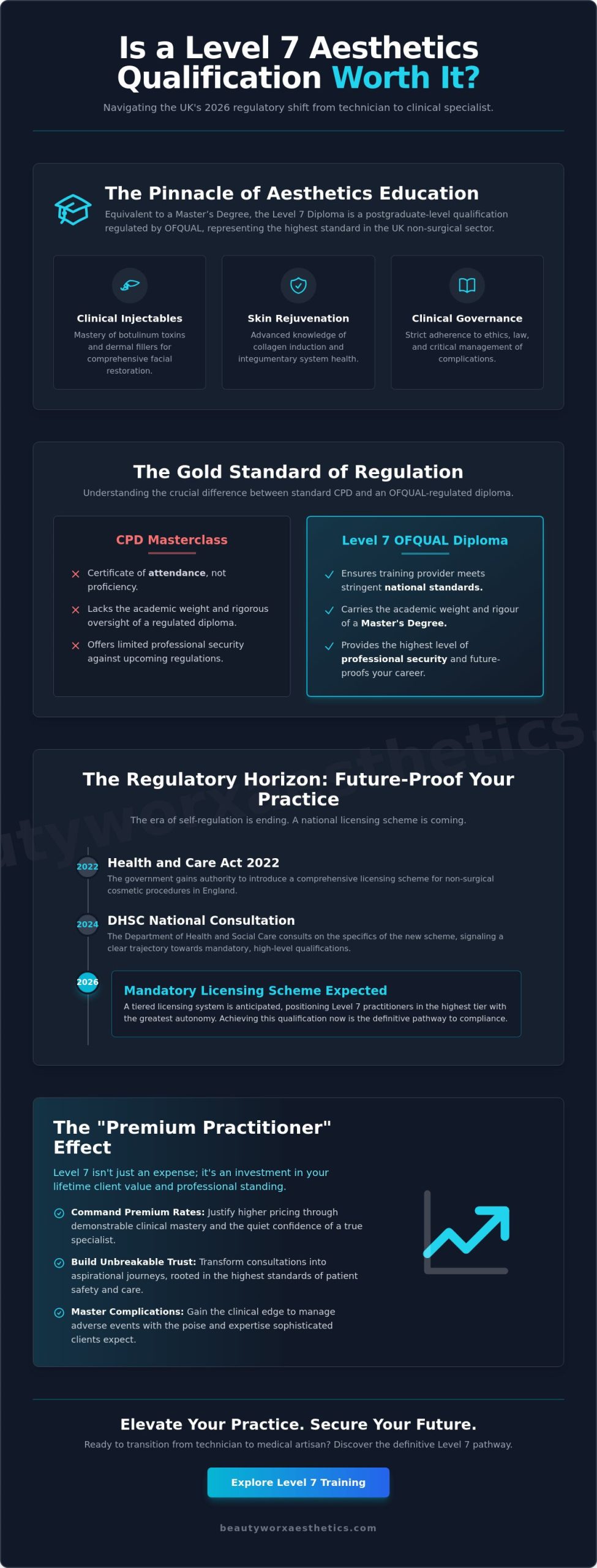
The Level 7 Diploma represents the pinnacle of educational achievement within the UK’s non-surgical sector. It is a postgraduate-level qualification, regulated by OFQUAL, that carries the same academic weight and rigour as a Master’s degree. For practitioners questioning if is level 7 aesthetics worth it, the answer often lies in the depth of the curriculum. Unlike introductory certificates, this qualification demands a comprehensive understanding of three core pillars: clinical injectables, advanced skin rejuvenation, and clinical governance. It transforms the practitioner from a technician into a specialist capable of delivering harmonious, refreshed results through evidence-based practice.
The industry is currently undergoing a significant transition. Since the 2016 Health Education England (HEE) report on cosmetic procedure training, there has been a steady move away from short-term, unregulated workshops. Professionals now seek regulated frameworks that offer a structured path to mastery. This qualification ensures that every aspect of Aesthetic medicine is handled with meticulous care, focusing on patient safety and the management of complex clinical cases rather than just the technicality of the injection itself.
- Clinical Injectables: Mastery of botulinum toxins and dermal fillers for facial restoration.
- Skin Rejuvenation: Advanced knowledge of collagen induction and integumentary health.
- Clinical Governance: Strict adherence to ethics, law, and emergency complication management.
The Distinction Between CPD and OFQUAL Regulation
A standard 1-day masterclass often provides a certificate of attendance, but it lacks the academic weight and oversight of a regulated diploma. OFQUAL regulation ensures that the training provider meets stringent national standards for educational quality and assessment. While CPD points are helpful for ongoing learning, they don’t offer the same level of professional security as a regulated framework. The Level 7 Diploma is the UK’s highest academic standard for non-surgical injectables.
Aesthetic Medicine as a Science and an Art
True beauty is found in the balance between scientific precision and artistic discernment. The shift in modern training focuses on managing a clinical case rather than simply performing a treatment. A deep, granular understanding of facial anatomy is the essential prerequisite for achieving the subtle, luminous results that clients desire. By viewing the face as a dynamic, living canvas, practitioners can provide bespoke enhancements that honour the individual’s natural character. You can explore these pathways further in our guide to aesthetic courses. When considering if is level 7 aesthetics worth it, remember that this level of education provides the quiet confidence needed to guide clients safely through their aesthetic journey.
The Regulatory Landscape: Is Level 7 Mandatory in 2026?
The aesthetics industry is undergoing its most significant transformation since the inception of non-surgical treatments. Under the Health and Care Act 2022, the government gained the authority to introduce a comprehensive licensing scheme for practitioners in England. This UK government licensing scheme aims to ensure that every patient receives care that’s safe, ethical, and clinically sound. While the Department of Health and Social Care (DHSC) continues to refine the details following the September 2023 consultation, the trajectory is clear; the era of self-regulation is ending. For many practitioners asking is level 7 aesthetics worth it, the answer lies in the peace of mind that comes with being prepared for these legislative shifts before they become mandatory.
Understanding the Licensing Scheme Proposals
Current proposals suggest a tiered licensing system designed to categorize procedures based on their complexity and potential risk. Level 7 practitioners are positioned to occupy the highest tier, which allows them to perform advanced injections with a high degree of autonomy. This qualification aligns perfectly with the Joint Council for Cosmetic Practitioners (JCCP) standards, which emphasize the necessity of clinical supervision and academic rigor. By achieving this gold standard now, you effectively future-proof your career against “grandfathering” clauses that might restrict those without formal, postgraduate-level training. It’s about moving beyond basic proficiency to embrace the meticulous artistry that defines a true specialist.
The role of clinical supervision is also evolving. In the new regulatory era, having a Level 7 qualification demonstrates that you’ve met the rigorous standards required to operate safely within a medical framework. It transitions your practice from a simple service to a professional clinical offering, ensuring your patients feel both pampered and protected. This shift isn’t just about compliance; it’s about elevating the entire “journey” of aesthetic medicine to match the high-end luxury your clients expect.
Insurance and Clinical Accountability
Insurers are no longer satisfied with one-day workshop certificates. Major providers are tightening their requirements, often demanding proof of regulated training to offer comprehensive professional indemnity coverage. When you consider is level 7 aesthetics worth it, you must factor in the risk of becoming uninsurable. Demonstrating “competence” in a legal framework requires more than just a steady hand; it demands a deep understanding of facial anatomy and emergency protocols. This is why a complications management course is integrated as a core component of Level 7 safety. It ensures you can protect your patients and your professional reputation with the quiet confidence of an expert artisan.
- Level 7 provides a recognized academic benchmark that satisfies the most stringent insurance underwriters.
- It establishes a clear audit trail of your education, making you more resilient in a legal or clinical dispute.
- The qualification fosters a culture of safety that prioritizes the patient’s emotional and physical wellbeing.
By investing in this level of education, you aren’t just ticking a box; you’re committing to a partnership in self-care with your clients. If you’re ready to refine your skills and join the elite tier of practitioners, you can explore our professional training pathways to begin your journey toward clinical excellence.
The Financial Case: Calculating the ROI of Your Diploma
Investing in a Level 7 Diploma is a strategic move that transcends the initial tuition fee. When you evaluate whether is level 7 aesthetics worth it, the answer often lies in the lifetime value of a loyal, high-spending client base. Practitioners with advanced qualifications frequently report a 25% to 35% increase in their average treatment price within the first 12 months of certification. This isn’t just about charging more; it’s about delivering a level of clinical precision that justifies a premium fee structure.
The “Premium Practitioner” effect creates a virtuous cycle for your business. By mastering complex facial anatomy, you reduce the likelihood of costly complications. A single adverse event or vascular occlusion can cost a clinic thousands in emergency supplies, lost chair time, and irreparable reputation damage. Refined techniques lead to superior, natural-looking results, which naturally drives client retention. According to data from the Harvard Business Review, a 5% increase in client retention can boost profits by 25% to 95%. In aesthetics, your expertise is the primary driver of this loyalty.
- Increased Treatment Velocity: Advanced mapping techniques allow for more efficient, effective appointments.
- Reduced Product Waste: Precise injection depths mean you use the optimal amount of dermal filler for a harmonious result.
- Lower Insurance Premiums: Some specialist insurers offer preferential rates to Level 7 qualified clinicians.
Positioning Your Clinic as a High-End Destination
Discerning clients don’t search for the lowest price; they search for the highest safety profile. Your Level 7 status allows you to exit the “race to the bottom” where unregulated injectors compete on cost alone. By aligning your practice with the standards set by the Joint Council for Cosmetic Practitioners (JCCP), you provide a level of transparency that affluent clients demand. The psychology of the luxury client is rooted in trust. They’re looking for a bespoke journey toward self-confidence, and they’re willing to pay a premium for a practitioner who views aesthetic medicine as both a science and an art form.
Career Longevity and Teaching Opportunities
The UK aesthetics market is rapidly consolidating around quality and regulation. A 2023 government consultation on licensing suggests that the industry is moving toward mandatory high-level qualifications. Securing your diploma now ensures long-term stability in a changing landscape. It also opens doors to lucrative secondary income streams. With a Level 7, you’re eligible to become a clinical lead or a trainer at prestigious academies. If you ever choose to sell your clinic, a business backed by a gold-standard qualification holds a significantly higher market valuation. It’s an asset that proves your clinic operates at the pinnacle of professional care, making the question of is level 7 aesthetics worth it a simple matter of long-term business health.
Medics vs. Non-Medics: Who Should Pursue Level 7?
The decision to pursue advanced training often depends on your professional starting point. For many practitioners, determining if is level 7 aesthetics worth it comes down to future-proofing their career against impending UK regulations. Whether you are a seasoned medical professional or an ambitious aesthetician, the path to excellence requires a commitment to formal validation.
The Pathway for Healthcare Professionals
Doctors, nurses, and dentists already possess a deep understanding of human anatomy. However, translating a sterile hospital environment into the nuanced world of facial aesthetics requires a different lens. While a medical degree provides the foundation, medical councils such as the GMC and NMC increasingly advocate for postgraduate training that specifically addresses cosmetic procedures. Building a clinical portfolio through a Level 7 program ensures your work stands up to the most rigorous scrutiny. It transforms a clinical skill set into an artistic craft, focusing on harmonious, natural-looking results rather than just medical intervention. This structured approach allows medics to refine their “eye” for symmetry while mastering the delicate balance of neurotoxins and dermal fillers.
The Non-Medic Journey to Clinical Excellence
For non-medical practitioners, the landscape is shifting rapidly. The Health and Care Act 2022 paved the way for a national licensing scheme expected to be fully active by 2026. This means the “fast-track” myths of the past are disappearing. Non-medics must now bridge the knowledge gap through Level 4 and Level 5 foundations before reaching Level 7. This journey is about establishing clinical parity with medical peers and ensuring client safety remains the priority. A Level 7 diploma provides the theoretical depth and practical mastery needed to manage complications and understand skin physiology at a cellular level. Experience is valuable, but qualification is the only currency the regulator accepts.
A common objection arises from those who have practiced for years without a formal diploma. If you have spent 10 years in the industry, you might feel a new qualification is redundant. This is a misconception that could prove costly. The aesthetics industry in 2024 is vastly different from 2014. Modern clients seek the reassurance of a “Gold Standard” practitioner who holds regulated credentials. When you consider is level 7 aesthetics worth it, remember that it validates your decade of experience with a formal seal of excellence. It protects your business from being sidelined by new licensing laws that do not recognize “years in the job” as a substitute for regulated learning.
- Regulatory Compliance: Aligning with the 2026 licensing requirements.
- Clinical Parity: Closing the gap between medical and non-medical backgrounds.
- Complication Management: Gaining the confidence to handle adverse events with medical-grade precision.
- Client Trust: Offering a bespoke, safe, and sophisticated experience that justifies premium pricing.
Discover how our bespoke training pathways can elevate your professional journey by visiting BeautyWorx Aesthetics today.
The BeautyWorx Approach: Why Our Level 7 is Different
Choosing the right training provider is the final, most critical step when deciding is level 7 aesthetics worth it for your career. At BeautyWorx, we’ve moved away from the sterile, factory-style training models that dominate the industry. Instead, we offer a sophisticated blend of clinical rigour and high-end luxury. Our students learn within an environment that mirrors the premium clinics they aspire to run. We believe that a practitioner’s surroundings influence their standards of care; therefore, our training spaces are designed to feel like a boutique sanctuary rather than a cold classroom.
Our curriculum prioritizes the art of the bespoke consultation. We teach you to look beyond the surface, identifying the unique anatomical markers and emotional motivations of every client. This focus on “Natural-Looking Results” ensures that you graduate with the ability to provide refreshed, harmonious enhancements that never appear overdone. You’ll master the delicate balance of science and aesthetics, ensuring your patients leave feeling like the best version of themselves.
- Clinical Excellence: Training that meets the highest UK standards for safety and ethics.
- Boutique Luxury: An aspirational learning environment that prepares you for the high-end market.
- Live Practice: Extensive hands-on experience with live models under 1:1 supervision from clinical leads.
- Bespoke Methodology: Moving beyond “cookie-cutter” templates to create tailored treatment plans.
Beyond the Syllabus: The Artisan Mentorship
Mastering the technical skill of where to place a needle accounts for only 20% of a successful practitioner’s journey. The remaining 80% is found in the development of an “artistic eye.” Our mentorship program is led by expert artisans who currently manage high-volume, successful clinics. They don’t just teach theory; they share the real-world nuances of facial restoration and restoration of light and shadow on the skin. You’ll learn how to assess facial harmony with the precision of a sculptor, ensuring every treatment supports the client’s long-term aging journey. Additionally, our graduates gain access to an ongoing support network, providing a safety net for those rare, complicated cases that require expert second opinions.
Your Journey to Becoming the Best Version of You
We view your education as a transformation rather than a transaction. The transition from a hesitant student to a trusted aesthetic specialist requires more than just a certificate; it demands a shift in confidence and professional identity. We support your emotional and professional growth at every stage, helping you build the quiet authority that clients find so reassuring. By the time you complete your pathway, you’ll have the discernment to guide patients through their options without pressure, acting as a knowledgeable partner in their self-care. If you’re ready to elevate your professional standing and master the gold standard of injectable medicine, book a consultation to discuss your Level 7 pathway and take the first step toward your new future.
Securing Your Future in the Evolving Aesthetic Landscape
Choosing to advance your career is a pivotal decision that balances professional integrity with commercial growth. With the UK government’s 2026 licensing mandate approaching, the industry is shifting toward a more regulated, clinical framework. This transition ensures that practitioners who hold an OFQUAL Regulated Level 7 Diploma aren’t just prepared; they’re preferred by a discerning clientele. When asking is level 7 aesthetics worth it, the answer lies in the longevity of your practice and the safety of your patients.
Our JCCP approved training program combines rigorous academic standards with the artistry of bespoke, natural-looking results. You’ll gain expert mentorship and comprehensive complications management training, ensuring you possess the quiet confidence of a master artisan. We’re here to guide you through every step of this transformative journey toward clinical excellence. Explore our OFQUAL Regulated Level 7 Diploma and begin your path to becoming a trusted leader in the field today. Your expertise deserves a foundation as luminous as the results you create.
Frequently Asked Questions
Is Level 7 aesthetics mandatory for all practitioners in the UK?
Level 7 aesthetics isn’t currently a legal requirement for UK practitioners, but it remains the industry’s gold standard for safety and clinical excellence. The Health and Care Act 2022 has paved the way for a new licensing scheme that will likely favor those with high-level qualifications. Choosing this path now ensures your practice meets the highest possible standards of artistic discernment and patient care.
How much does a Level 7 aesthetics course typically cost?
A Level 7 aesthetics course typically costs between £6,000 and £10,000 according to leading JCCP-accredited training providers. This investment covers extensive theoretical study and the supervised clinical practice required to master complex injectable treatments. You’re investing in a sophisticated education that transforms a medical background into the skill set of a trusted, expert artisan.
Can non-medics complete a Level 7 Diploma in injectables?
Most JCCP-accredited Level 7 programs are reserved for registered healthcare professionals like doctors, nurses, and dentists. This entry requirement ensures that every practitioner possesses the deep anatomical knowledge necessary to deliver safe, luminous results. It protects the client’s emotional journey by guaranteeing their treatment is performed by someone with recognized medical authority and clinical expertise.
How long does it take to complete the Level 7 aesthetics training?
It typically takes between 12 and 24 months to complete the full Level 7 Diploma. This timeframe allows you to complete the required 275 hours of learning and document 40 supervised cases of botulinum toxin and dermal filler treatments. This steady, rhythmic progression ensures you have ample time to refine your technique and develop a bespoke approach to facial harmony.
What is the difference between a Level 7 and a standard Botox course?
A Level 7 diploma is a comprehensive postgraduate-level qualification, while a standard Botox course is often a short, foundational workshop lasting only two days. When asking is level 7 aesthetics worth it, consider that the diploma requires 40 supervised treatments to ensure clinical mastery. Standard courses offer basic technical skills, but Level 7 fosters the artistic discernment needed for truly bespoke rejuvenation.
Will Level 7 help me get cheaper aesthetics insurance?
Holding a Level 7 qualification often leads to lower insurance premiums from major providers like Hamilton Fraser or Cosmetic Insure. Insurers recognize that graduates of these rigorous programs represent a lower risk due to their advanced training in complication management and clinical safety. This reduction in overhead costs adds a practical financial benefit to your professional journey toward becoming a specialist.
Is the Level 7 qualification recognized internationally?
The Level 7 Diploma is specifically aligned with the UK’s Regulated Qualifications Framework, but its reputation for excellence is respected globally. Practitioners with this credential often find it easier to demonstrate their expertise in markets across Europe and the Middle East. It serves as a prestigious marker of your dedication to the science and art of aesthetic medicine, regardless of where you practice.
What happens if I don’t have a Level 7 and the law changes?
Practitioners without high-level qualifications may struggle to obtain a license once the Department of Health and Social Care finalizes its upcoming licensing regulations. For those questioning is level 7 aesthetics worth it, the security of future-proofing your career is a vital consideration. This qualification ensures you’re prepared for any legislative shifts, allowing you to focus entirely on enhancing your clients’ natural beauty.












 Reviews