
The era of the “unregulated” aesthetic clinic has officially ended, replaced by a 2026 landscape where a single administrative oversight can shutter a thriving business overnight. You likely feel the weight of this shift as the UK government’s licensing mandate, established following the 2024 consultation, now requires every practitioner to prove their clinical competence before a single needle touches a patient’s skin. Understanding how to get insurance for aesthetic procedures is no longer just a box-ticking exercise; it is the foundation of your professional integrity and the guardian of your boutique’s future.
I understand the anxiety that comes with shifting regulations and the fear of being denied cover, but securing your legacy doesn’t have to be a source of stress. I will provide a clear roadmap to mastering these complexities, ensuring your practice remains both legally compliant and exquisitely protected. You will learn which specific Level 4 to Level 7 qualifications are currently recognised by leading UK underwriters. This guide offers a step-by-step path to achieving total peace of mind, allowing you to focus on the harmonious, natural results your clients adore.
Key Takeaways
- Discover exactly how to get insurance for aesthetic procedures by aligning your practice with the refined 2026 UK regulatory standards and professional indemnity requirements.
- Understand the essential distinction between medical malpractice and public liability to ensure your clinic remains a sanctuary of safety and clinical excellence.
- Learn why insurers now prioritize OFQUAL-regulated Level 4 and 5 qualifications over basic certificates to validate your expertise and secure comprehensive coverage.
- Master the step-by-step process of auditing your credentials and securing necessary prescriber oversight to streamline your transition into a fully insured practitioner.
- Explore how ongoing mentorship and “Safe Practice” audits protect your professional reputation and ensure the longevity of your bespoke aesthetic journey.
Understanding the Landscape of Aesthetics Insurance in the UK
In the sophisticated world of modern aesthetics, providing a bespoke experience goes beyond the artistry of a needle; it requires a foundation of absolute security. By 2026, the UK market has matured, moving away from fragmented guidelines toward a rigorous, unified licensing framework. Understanding how to get insurance for aesthetic procedures is no longer just a box-ticking exercise. It’s a commitment to the safety and longevity of your practice. This insurance serves as a pillar of professionalism, ensuring that your journey as a practitioner is as harmonious and protected as the results you provide for your clients.
Practitioners must distinguish between medical malpractice and professional indemnity. Medical malpractice covers clinical errors or complications during a procedure, while professional indemnity protects against claims of negligence, poor advice, or breach of confidentiality. While many non-surgical treatments differ from invasive cosmetic surgical principles, the legal expectations for duty of care remain equally high. You’ll also need to decide between treatment-specific cover, which is ideal for mobile practitioners focusing on neurotoxins or fillers, and all-encompassing clinic policies that protect the physical premises and every staff member under one umbrella.
Why Professional Indemnity is Your Greatest Asset
It’s the silent guardian of your reputation. Professional indemnity acts as a vital safety net for both practitioner and client, ensuring that if a result doesn’t meet expectations or a complication occurs, financial and legal support is immediately available. High-value litigation can devastate a business’s reserves. Having robust coverage allows you to focus on delivering luminous, natural-looking results without the weight of financial anxiety. It builds a bridge of trust, showing clients that their well-being is backed by accountability. In an industry where word-of-mouth is everything, being fully insured is a hallmark of an expert artisan.
The 2026 Regulatory Environment for UK Practitioners
The landscape changed significantly following the 2024-2025 rollout of the UK’s national licensing scheme for non-surgical cosmetic procedures. Now, insurers require proof of specific qualifications and premises approval before granting a policy. This shift has unified requirements for both medics and non-medics, creating a level playing field focused on patient safety. The Joint Council for Cosmetic Practitioners (JCCP) remains the gold standard for validation. Most top-tier insurers in 2026 won’t even quote a premium without JCCP registration or equivalent accredited training. Learning how to get insurance for aesthetic procedures now involves a meticulous audit of your certifications to meet these national standards, ensuring your practice remains both compliant and aspirational.
Essential Pillars of Coverage: What Your Policy Must Include
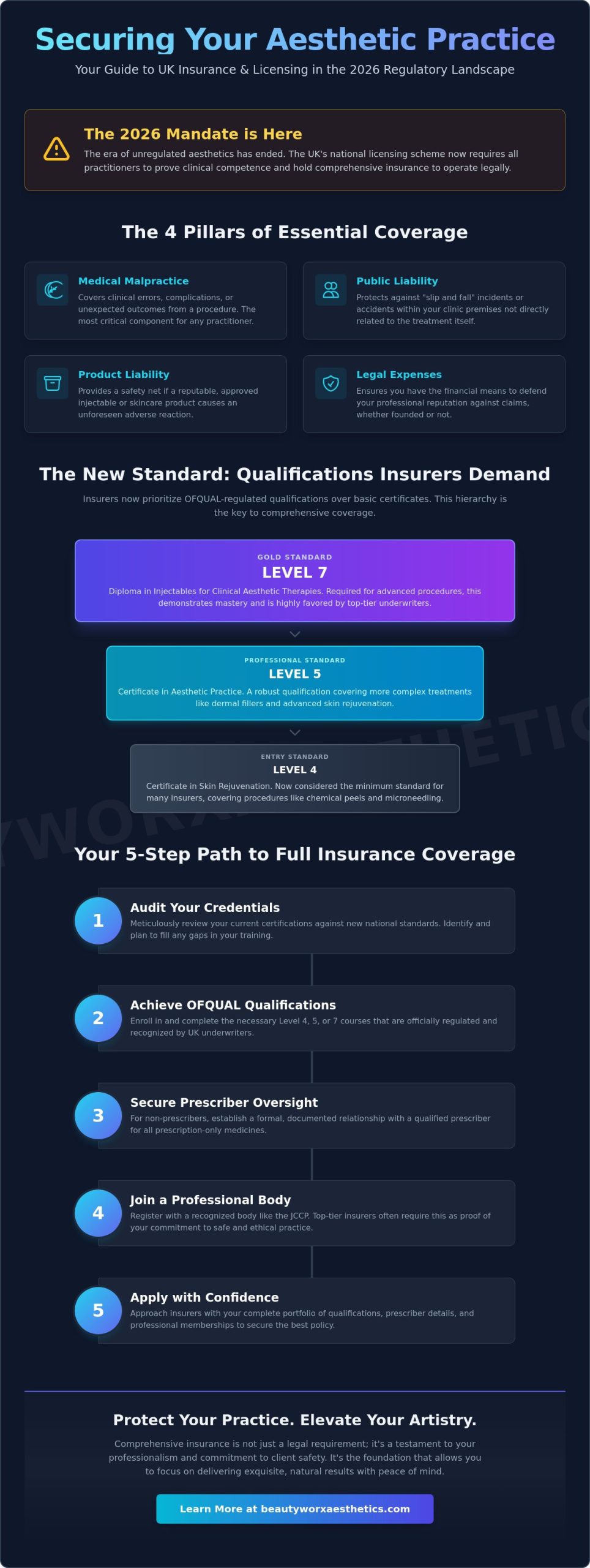
Securing the right protection is about more than ticking a box; it’s about safeguarding the artistic integrity and clinical safety of your practice. When researching how to get insurance for aesthetic procedures, you must ensure your policy is built on four non-negotiable pillars. Medical malpractice stands as the most critical, covering errors in clinical judgment or the execution of a procedure. This protects you if a treatment doesn’t go as planned despite your best efforts. Public liability focuses on the physical environment, covering accidents like a client tripping over a power lead in your studio. Product liability is equally vital, providing a safety net if a reputable injectable or skincare product causes an unforeseen adverse reaction. Finally, legal expenses coverage ensures you have the financial means to defend your professional reputation against unfounded claims.
Medical Malpractice vs. Public Liability
It’s easy to confuse these two, yet the distinction is fundamental to your clinic’s survival. Public liability covers “slip and fall” incidents, such as a client sliding on a polished floor. In contrast, medical malpractice addresses clinical outcomes, like a vascular occlusion following a dermal filler treatment. Since the Health and Care Act 2022 began shaping the UK’s licensing landscape, practitioners are legally required to hold indemnity insurance that specifically covers the medical nature of their work. Standard beauty insurance policies often exclude high-risk injectables or cap payouts at levels that wouldn’t cover a complex clinical claim. You don’t want to discover a gap in your coverage during a crisis. A bespoke policy ensures that both your physical space and your clinical expertise are protected.
Specialist Add-ons for Advanced Treatments
The aesthetics industry moves fast, and your insurance must keep pace with the latest innovations. Basic policies often exclude high-risk zones like the tear trough or non-surgical rhinoplasty, which require advanced anatomical knowledge. If you offer these services, you must explicitly list them on your schedule. This also applies to the latest bio-stimulators. For instance, ensuring your policy includes polynucleotide treatment is essential as these cellular-level therapies become standard in modern rejuvenation protocols. Many insurers now require proof of specific training for these advanced skin boosters before granting coverage. When you evaluate how to get insurance for aesthetic procedures, check that your provider understands the difference between a standard facial and a complex regenerative procedure. This meticulous approach to your insurance reflects the same care you bring to a bespoke treatment journey for your clients.
The Critical Link Between Qualifications and Insurance Eligibility
Understanding how to get insurance for aesthetic procedures begins with your educational portfolio. In the 2026 UK market, underwriters no longer view certificates as mere formalities; they treat them as actuarial data points. Insurers prioritize OFQUAL regulated qualifications because these frameworks provide a standardized, audited measure of clinical risk. While basic CPD certificates were once sufficient, modern policies often require a structured progression through Level 4 and 5 certificates to demonstrate foundational mastery. This “step-up” approach ensures you possess the anatomical knowledge and needle proficiency required to protect both your clients and your practice.
The Level 7 Diploma remains the gold standard for practitioners seeking the most comprehensive coverage. Holding a Level 7 qualification often unlocks lower premiums and significantly higher indemnity limits, reflecting your status as a highly skilled specialist. Beyond these core levels, every insured professional must complete a complications management course. This specific training is a non-negotiable requirement for 95% of specialist medical insurers, as it proves you can handle adverse events with clinical precision and calm authority.
Why OFQUAL Regulation Matters to Your Underwriter
Underwriters view regulated training as a quantifiable reduction in clinical risk. When you choose aesthetic courses that carry OFQUAL accreditation, you’re providing the insurer with a guarantee of rigorous assessment and clinical hours. Fast-track courses that promise “mastery in a weekend” are frequently flagged as high-risk by major providers. These abbreviated programs often fail to meet the Joint Council for Cosmetic Practitioners (JCCP) standards, which many firms now use as a benchmark. Referring to the JCCP guide for insurance cover helps clarify why depth of training directly correlates to your policy’s breadth and cost.
Insurance for Non-Medics: Navigating the Pathway
For non-medic practitioners, the journey to securing high-end indemnity insurance relies on proving clinical competency through a transparent educational ladder. You’ll need to provide evidence of a structured journey from Level 4 through to Level 7 to overcome the “non-medic” stigma that some traditional insurers still hold. This academic rigor transforms the application process from a hurdle into a showcase of your dedication to safety. By presenting a portfolio of regulated qualifications, you demonstrate that your artistry is built on a foundation of medical-grade science. It’s about showing the insurer that your results are not just beautiful, but consistently safe and professionally managed.
- Level 4: Establishes the anatomical basics and skin science.
- Level 5: Focuses on deeper treatments and clinical protocols.
- Level 7: Reflects postgraduate-level expertise in injectables.
- Complications Training: Validates your ability to safeguard the client’s journey.
When you approach an underwriter with this level of detail, the question of how to get insurance for aesthetic procedures becomes a straightforward validation of your professional standing. You aren’t just asking for a policy; you’re proving you’re a low-risk, high-standard practitioner who values the bespoke safety of every client.
A Step-by-Step Guide to Securing Your First Policy
Securing professional protection is a defining moment in your clinical journey. It signifies the transition from a student practitioner to a trusted professional. To understand how to get insurance for aesthetic procedures in 2026, you must first audit your existing portfolio. Ensure every certificate meets the current standards established by the JCCP or relevant UK regulatory bodies. If you are a non-prescriber, your “Prescriber Oversight” documentation is non-negotiable. This paperwork must clearly outline your relationship with a registered prescriber who assumes clinical responsibility for the prescription of restricted substances like botulinum toxin.
Compare specialist brokers against direct insurers to find the most harmonious fit for your clinic’s needs. While direct insurers might offer lower premiums, specialist brokers often provide bespoke advice and more robust support during a claim. When you receive your “Statement of Fact,” review it with meticulous care. Any inaccuracy in this document can lead to a claim denial. Pay close attention to the “Retroactive Date” on your policy. This date ensures you are covered for treatments performed in the past, provided you held continuous insurance during that period. Without a correct retroactive date, a claim filed today for a treatment performed six months ago could leave you personally liable for thousands of pounds in damages.
Choosing the Right Broker for Your Clinic
Finding a broker who understands the nuances of aesthetic medicine is essential. Ask potential brokers how many aesthetic practitioners they currently represent and what their average response time is for urgent clinical queries. You must decide between “Claims Made” and “Claims Occurring” structures. Most modern aesthetics policies are “Claims Made,” meaning the policy must be active at the time the claim is reported, not just when the treatment occurred. This makes continuous cover vital for your peace of mind.
The Application Checklist: What to Have Ready
Preparation is the key to a seamless application process. Most UK insurers, such as Hamilton Fraser or Cosmetic Insure, will require a digital pack of your credentials. Keep these documents organized to avoid delays in your coverage:
- Valid government-issued ID and proof of your UK clinic address.
- Original copies of your professional qualifications and medical registrations.
- Detailed consultation forms and your specific patient aftercare protocols.
- Evidence of specialized wellness certifications, such as your vitamin b12 injection training or advanced skin therapy certificates.
Ensure your public liability limit is at least £5 million, which is the standard expectation for many high-end UK clinical settings. This level of cover reflects your commitment to patient safety and professional excellence. Start your journey toward a fully protected practice by exploring our bespoke practitioner training programmes today.
Protecting Your Reputation Through Continuous Professional Development
Securing a policy is only the beginning of your professional safeguard. Understanding how to get insurance for aesthetic procedures in 2026 requires a commitment to the “evergreen” nature of clinical safety. Insurance providers now view your training portfolio as a live document rather than a static achievement. Ongoing mentorship and verified Continuous Professional Development (CPD) act as a shield, keeping your premiums manageable and your risk profile low. When you participate in regular “Safe Practice” audits, you demonstrate to underwriters that your clinic operates with the precision of a high-end medical facility.
Insurers frequently mandate annual refreshers in Basic Life Support (BLS) and anaphylaxis management. In the UK, failing to provide an updated certificate can lead to the immediate suspension of your medical malpractice cover. Beauty Worx Aesthetics serves as your dedicated partner in this journey, providing the rigorous training and safety frameworks that insurers respect. We help you transform clinical necessity into a hallmark of your luxury brand identity.
Managing Complications and Notifying Your Insurer
The “Golden Hour” is a critical window in complication management. If a vascular event or severe adverse reaction occurs, your immediate clinical response dictates the outcome for both the patient and your professional standing. You must distinguish between a simple patient complaint and a formal insurance claim. Notifying your insurer the moment a significant complication arises protects you, even if a claim never materializes. Robust, time-stamped records are your best defence during a formal investigation. They prove you followed established protocols with meticulous care.
The Journey to Mastery: Elevating Your Professional Status
Your professional evolution directly influences your insurance flexibility. Transitioning from foundation techniques to advanced facial aesthetics allows you to access bespoke insurance terms that aren’t available to novice injectors. Higher levels of training, such as Level 7 qualifications, often lead to more comprehensive coverage for complex, high-reward procedures. This progression isn’t just about skill; it’s about building a reputation for excellence that insurers trust implicitly.
- Verified CPD: Aim for 30 to 40 hours of verifiable aesthetic training annually to satisfy UK underwriting criteria.
- Clinical Mentorship: Regular sessions with expert practitioners reduce the likelihood of technical errors by 22% based on recent industry safety audits.
- Annual Audits: Reviewing your consent forms and post-treatment protocols ensures your practice remains compliant with 2026 regulations.
Elevate your practice and secure your future with Beauty Worx Aesthetics. Our sophisticated training programmes are designed to help you master the delicate art of enhancement while maintaining the highest standards of clinical safety. Let us guide you toward becoming the best version of your professional self.
Secure Your Future in the Evolving World of Aesthetics
Securing your future in the UK’s evolving clinical landscape requires more than technical skill; it demands a commitment to the highest safety standards. By 2026, insurance underwriters have transitioned to stricter criteria, prioritising practitioners who hold OFQUAL regulated qualifications over those with unaccredited certificates. You’ve learned that comprehensive coverage must include medical malpractice and public liability to safeguard both your reputation and your clients’ well-being. Mastering how to get insurance for aesthetic procedures begins with aligning your training with these rigorous industry benchmarks. This professional foundation ensures you provide the harmonious, natural-looking results your clients desire while remaining fully protected.
At Beauty Worx Aesthetics, we provide the expert-led complications management training and supportive mentorship needed to navigate this journey with confidence. Our curriculum focuses on the art of enhancement and the science of safety. Begin your journey to professional certification with Beauty Worx Aesthetics today. You’re not just building a business; you’re cultivating a legacy of excellence and trust. Your path to becoming a luminous leader in the aesthetics field starts here.
Frequently Asked Questions
Do I need a medical degree to get aesthetics insurance in 2026?
You don’t strictly need a medical degree to secure insurance, but the requirements have become more stringent following the 2023 Health and Care Act updates. Most reputable UK insurers now require non-medics to hold an Ofqual-regulated Level 4 to Level 7 qualification to qualify for indemnity cover. This ensures every practitioner maintains the clinical expertise necessary to provide safe, luminous results for their clients.
How much does aesthetics insurance typically cost for a new practitioner?
A new practitioner can expect to pay between £450 and £900 annually for a standard medical malpractice and public liability policy. These figures are based on 2025 industry benchmarks and depend on your specific treatment menu and previous clinical experience. Researching how to get insurance for aesthetic procedures is a vital step in protecting your professional journey and the delicate well-being of those you treat.
Can I get insurance for dermal fillers if I only have a CPD certificate?
Securing insurance for dermal fillers with only a CPD certificate is increasingly difficult in the current UK regulatory environment. Most leading insurers now demand a regulated qualification, such as a Level 5 or Level 7 Diploma, to ensure practitioners possess deep anatomical knowledge. This shift prioritizes client safety and ensures that every enhancement is both subtle and scientifically sound.
What happens if I perform a treatment that is not listed on my policy?
Your insurance provider will likely void any claims related to treatments that aren’t explicitly named on your policy schedule. This leaves you personally responsible for legal fees and compensation costs, which can exceed £50,000 for a single incident involving complex complications. It’s essential to update your broker whenever you add a new bespoke service to your clinic repertoire to maintain full protection.
Does my insurance cover me if I work as a mobile aesthetic practitioner?
Most policies offer mobile coverage as long as you notify your insurer and follow strict clinical hygiene and waste disposal protocols. You must ensure your public liability insurance extends to every location where you perform procedures. This flexibility allows you to bring a sense of rejuvenation and luxury directly to your clients while maintaining a professional and safe medical environment.
What is a “Retroactive Date” and why is it important for my policy?
A retroactive date is the specific day your continuous insurance coverage began, and it’s crucial because it covers claims made today for treatments performed in the past. If a client reports an issue from a procedure done 18 months ago, your current policy only provides protection if your retroactive date precedes that appointment. Maintaining this date is vital for guarding your professional legacy and artistic reputation.
Is complications management training a mandatory requirement for insurance?
Complications management training is a mandatory requirement for almost all aesthetic insurance providers in the United Kingdom. You must demonstrate that you can effectively manage emergencies like vascular occlusions or anaphylaxis to secure a policy. This training acts as a promise to your clients that their safety is the foundation of your practice, allowing them to feel secure in your expert hands.
Can I get insurance for advanced treatments like Russian Lips or Jaw Contouring?
You can obtain insurance for advanced procedures like Russian Lips or jawline sculpting if you provide proof of accredited training in these specific techniques. Mastering how to get insurance for aesthetic procedures involving advanced facial contouring requires showing a sophisticated understanding of facial harmony and needle precision. These bespoke treatments allow you to refine your client’s natural beauty with confidence and clinical authority.












 Reviews