
What if the most vital instrument in your aesthetic kit isn’t a premium dermal filler or a precision needle, but a direct line to an expert who has already navigated the complexities you now face? Many practitioners find that the transition from a foundation course to a live clinical environment feels unexpectedly solitary, especially when confronted with the nuanced realities of patient anatomy or the pressure of managing potential complications. It’s a common feeling of vulnerability that often follows the initial excitement of certification. This is where professional mentorship for aesthetic practitioners uk becomes more than just a support system; it’s a strategic investment in your identity as a safe, sophisticated artisan.
You deserve to feel as composed and confident as the results you aim to achieve for your clients. We’ll explore how structured guidance provides a clear pathway toward prestigious Level 7 qualifications and ensures you’re prepared for the mandatory licensing schemes arriving in 2026. By the end of this guide, you’ll understand how a mentor helps you master advanced techniques, from complex lip augmentations to skin booster applications, while providing the reassurance of expert oversight when it matters most. Discover how to evolve from a trainee into a trusted specialist who prioritizes both clinical excellence and the quiet luxury of patient safety.
Key Takeaways
- Bridge the gap between initial certification and clinical mastery by overcoming the professional isolation often felt after foundation training.
- Master the nuances of product rheology and needle placement through a structured partnership that balances clinical skill with business strategy.
- Navigate the transition toward the OFQUAL Level 7 Diploma, a vital step for mentorship for aesthetic practitioners uk ahead of the 2026 mandatory licensing scheme.
- Identify the essential criteria for selecting a mentor who offers clinical empathy and a proven track record in both safety and artistic discernment.
- Transform your approach from one-off treatments to a comprehensive partnership in professional excellence and patient self-confidence.
Beyond the Foundation: Why Mentorship is Essential for UK Aesthetic Practitioners
Aesthetic mentorship represents far more than a casual exchange of advice; it’s a meticulously structured, expert-led partnership designed to foster both clinical precision and professional maturity. While a foundation course provides the essential map, mentorship is the compass that guides you through the intricate terrain of human anatomy and patient psychology. It’s the bridge that allows you to cross from being a technically trained injector to becoming a true clinical artisan. This evolution requires a dedicated focus on the subtle nuances of facial harmony and the delicate balance of restoration rather than change.
The UK private sector often leaves practitioners feeling isolated, a phenomenon frequently described as the lonely practitioner syndrome. After leaving the supportive environment of a classroom, many find themselves in a quiet clinic room, facing complex decisions without a second opinion. Within the broad scope of Aesthetic medicine, the sheer variety of patient presentations can feel overwhelming. Professional mentorship for aesthetic practitioners uk provides the essential community needed to maintain high ethical standards and ensure that your practice remains a sanctuary of safety and excellence.
The Gap Between Training and Real-World Practice
A two-day foundation course is an excellent starting point, but it’s only the first step of a lifelong journey. The psychological shift from being a supervised student to the lead practitioner is significant. You’re no longer just following instructions; you’re responsible for the emotional journey and physical safety of another person. Real-world practice introduces the unpredictability of human anatomy, where every face tells a unique story and requires a bespoke approach that textbooks cannot always predict.
Mentorship as a Safety Net for Complications
The most daunting aspect of the profession is the management of rare but serious complications, such as vascular emergencies. Having a trusted expert to call in these high-pressure moments isn’t just a comfort; it’s a professional necessity. This direct access to seasoned clinical expertise drastically reduces the risk of litigation and significantly improves patient outcomes. By fostering a culture of transparency, mentorship helps build a safer aesthetics industry in the UK, where practitioners feel empowered to share challenges rather than hide them.
As England moves toward a mandatory licensing scheme in 2026, the transition from being merely ‘trained’ to becoming ‘qualified’ is no longer optional. Mentorship ensures you aren’t just following a checklist but are developing the artistic discernment required for the high-end, natural-looking results your clients expect. This ongoing partnership in excellence is what separates a standard service from a truly premium patient encounter.
The Anatomy of High-Level Mentorship: Clinical, Business, and Artistic Guidance
High-level mentorship isn’t a one-dimensional checklist. It’s a sophisticated triad of skill, strategy, and soul. Clinical mastery serves as the foundation. Business strategy ensures your longevity in a competitive market. Artistic soul provides the eye for beauty that looks entirely natural. This holistic approach ensures you don’t just perform procedures but curate bespoke experiences that preserve a client’s inherent features. Mentorship for aesthetic practitioners uk helps you move beyond the basics of injection to understand how a product behaves once it’s beneath the skin.
Mastery involves deep knowledge of product rheology, or how fillers interact with different tissue depths to create vitality without bulk. It’s the difference between a face that looks “done” and one that looks restored. By refining your technical precision, you learn to choose the right product for the right anatomical plane, ensuring results that are as discreet as they are effective. This level of discernment is what elevates a practitioner from a technician to a trusted artisan.
Refining Your Clinical Technique
Mastering advanced injection techniques requires a mentor’s watchful eye. You’ll learn to distinguish between the subtle diffusion patterns of different toxins, such as Azzalure and Botox. It’s also vital to integrate the safety protocols from a complications management course into your daily routine. This proactive stance transforms safety from a reactive fear into a confident professional standard, allowing you to focus on the artistic outcome of every procedure.
Building a Sustainable Aesthetics Business
A successful practice relies on the quality of the consultation. You’re not selling a single treatment; you’re designing a personalized journey toward self-confidence. This requires a firm grasp of professional standards set by the Joint Council for Cosmetic Practitioners (JCCP). You’ll also need to navigate the complexities of UK advertising rules for prescription-only medicines. Pricing shouldn’t just cover costs. It should reflect your commitment to premium products and your growing expertise as a clinical specialist. If you’re ready to advance your career, consider how our foundation dermal filler course can serve as the first step toward this professional partnership.
Comparing Mentorship Pathways: CPD Workshops vs. OFQUAL Regulated Level 7
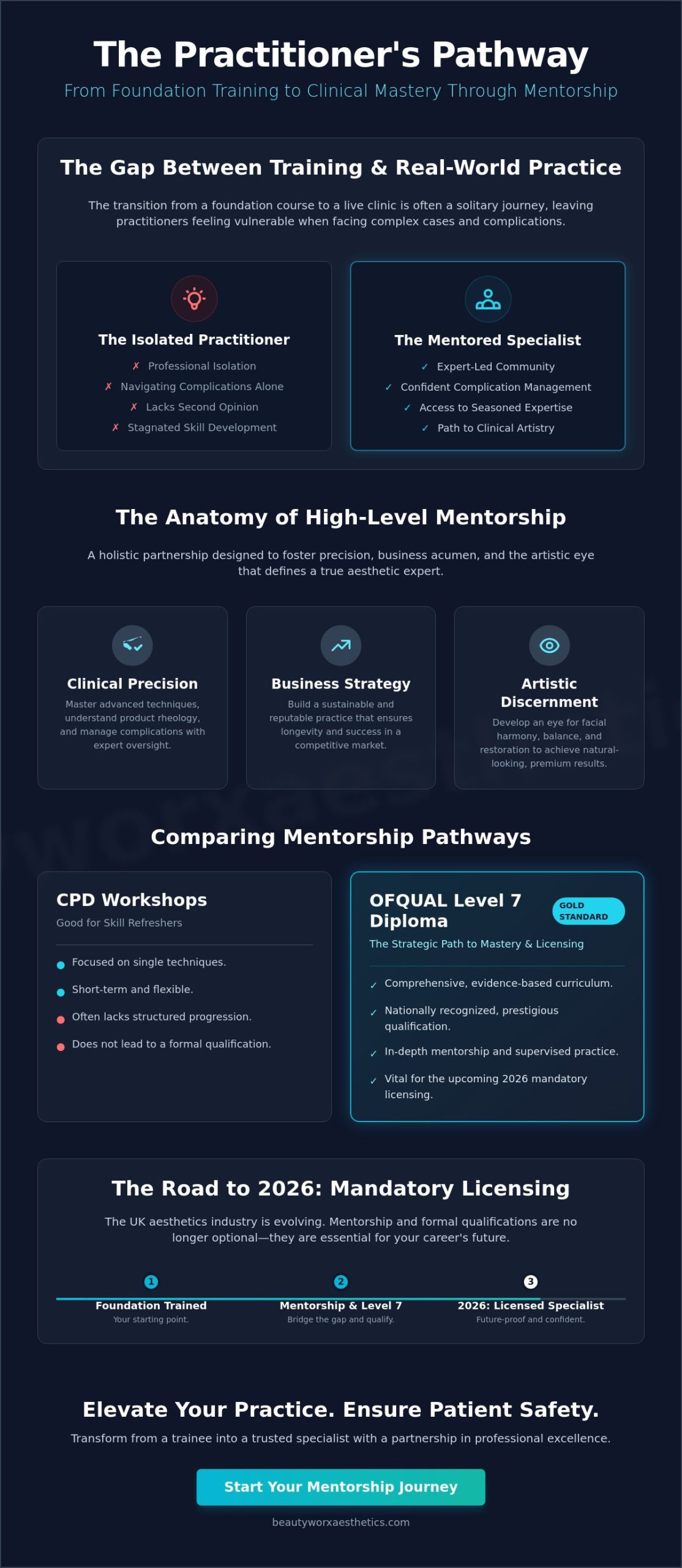
Choosing the right educational path is a defining moment for any clinician. While informal shadowing offers a glimpse into a mentor’s daily routine, it often lacks the rigorous accountability required for true clinical growth. In contrast, structured mentorship for aesthetic practitioners uk provides a documented framework that aligns with the evolving regulation of non-surgical cosmetic procedures. This distinction is vital as the industry shifts away from fleeting masterclasses toward a culture of lifelong learning and verifiable competence. A high-end mentorship programme isn’t merely an expense; it’s a strategic investment in your professional portfolio and future revalidation.
Evaluating the return on investment requires looking beyond the initial cost. Cheap, unaccredited workshops might provide a few “tips and tricks,” but they rarely offer the depth needed to manage complex patient profiles or regulatory scrutiny. True mastery is built through hours of supervised practice where every needle placement is scrutinized and refined by an expert artisan. This level of dedication ensures that your skills remain sharp and your clinical decisions are backed by evidence-based rationale.
The Role of OFQUAL Regulated Qualifications
The industry is moving toward a formalized future where the Level 7 Diploma stands as the undisputed gold standard. Mentorship plays a critical role here, acting as the bridge between theoretical knowledge and the practical assessment requirements of higher diplomas. As the 2026 mandatory licensing scheme approaches, having a mentor to guide you through the academic rigour of an OFQUAL regulated pathway is essential. It ensures you don’t just pass an exam but truly embody the standards of a Level 7 practitioner.
Bespoke 1-to-1 Mentoring vs. Small Group Training
Individualized attention allows a mentor to focus exclusively on your specific clinical weaknesses, whether that’s refining your approach to tear trough filler or mastering the art of the consultation. While small group training offers valuable peer-to-peer networking, bespoke 1-to-1 sessions provide a safe, quiet environment for deep contemplation and skill refinement. Your choice should align with your long-term aspirations. If you aim to lead the market in subtle, natural-looking results, the highly customized nature of 1-to-1 guidance is often the most effective route. It’s about finding a rhythm that supports your unique journey toward clinical excellence.
Selecting Your Mentor: Key Criteria for Safety, Ethics, and Career Growth
Choosing the right guide for your professional journey is a decision that requires both clinical discernment and a clear vision for your future. When seeking mentorship for aesthetic practitioners uk, you must look beyond mere years of experience. A truly effective mentor balances clinical success with a proven aptitude for teaching, ensuring they can translate complex anatomical concepts into actionable skills. This partnership should feel like a safe, welcoming space where your growth is the primary focus. It’s about finding a trusted artisan who views their craft with the same meticulous attention to detail that you aspire to achieve.
Verification is a non-negotiable step in this process. Ensure your mentor holds JCCP registration, maintains comprehensive insurance, and possesses regulated teaching qualifications. Beyond these technicalities, look for clinical empathy. This is the mentor’s ability to understand your specific professional background and the unique challenges you face. Whether you are transitioning from a traditional medical environment or a high-end wellness setting, your mentor should offer a customized approach that respects your previous expertise while pushing you toward new heights of clinical excellence.
The Importance of Clinical Artisanry
The hallmark of a superior mentor is a portfolio that prioritizes subtle, natural-looking results over fleeting trends. You want a guide who treats facial aesthetics as a delicate intersection of science and art. When reviewing their work, look for consistency and a commitment to preserving a client’s inherent features. A mentor who values restoration over drastic change will help you develop the “eye” required for high-end practice, ensuring your work remains discreet and tailored specifically to the individual.
Accessibility and Long-Term Support
The true value of mentorship for aesthetic practitioners uk is revealed in the moments when you need support the most. A professional partnership is not a one-off transaction; it’s an ongoing relationship. You need to know that your mentor is accessible should you encounter a complex case or a potential complication in your own clinic. Establishing clear communication channels from the outset provides a sense of reliability and transparency that is crucial for your clinical confidence. If you’re ready to align yourself with a specialist who prioritizes your long-term success, consider taking the next step with our Advanced Dermal Filler Course.
Be wary of red flags that suggest a lack of professional integrity. Avoid mentors who promise rapid shortcuts or suggest bypassing essential safety protocols to save time. These approaches undermine the meticulous nature of the profession and put both you and your clients at risk. True mastery is built on a foundation of safety, cleanliness, and artistic discernment. By selecting a mentor who embodies these values, you’re not just learning a technique; you’re adopting a philosophy of clinical excellence that will define your career for years to come.
Elevating Your Practice with Beauty Worx Aesthetics: A Partnership in Professional Excellence
At Beauty Worx Aesthetics, we believe that true clinical excellence is a lifelong pursuit rather than a weekend achievement. Our philosophy is rooted in a meticulous, sophisticated approach that treats every procedure as a scientific art form. By choosing mentorship for aesthetic practitioners uk with our team, you aren’t just enrolling in a training programme; you’re entering a professional partnership dedicated to the preservation of your clients’ inherent beauty. We’re committed to the Level 7 Diploma pathway, ensuring our practitioners lead the industry in OFQUAL regulated excellence and ethical practice. You’ll join a national network of like-minded artisans who prioritize safety and subtle enhancement above all else.
The Beauty Worx Mentorship Experience
Tactile mastery is the cornerstone of our mentorship experience. While some competitors offer brief online sessions, we believe that true confidence is forged through physical interaction. We provide hands-on clinical guidance with live models in a quiet, high-end environment. You’ll refine your technique under the watchful eye of a specialist, gaining the precision that only comes from supervised, real-world application. This immersive approach is complemented by personalized business strategy sessions. These are designed to help you scale your clinic with the same discernment you apply to your clinical work. With access to over 25 accredited courses, your potential for growth is limitless.
Your Journey Toward Clinical Mastery
We support both medical and non-medical practitioners through structured, supportive pathways that respect your individual starting point. Your evolution is our priority. Whether you’re seeking to master the subtleties of a Lip Masterclass or expanding your rejuvenation portfolio with vitamin b12 injection training, our team provides the steady guidance you need. We move at a pace that invites trust and contemplation, mirroring the professional consultation process you’ll provide for your own clients. This ongoing partnership ensures you’re never alone in your clinical decision-making.
Your journey toward clinical mastery begins with a single, thoughtful conversation. We invite you to a professional consultation to discuss your specific mentorship needs and long-term career goals. Together, we’ll design a bespoke pathway that elevates your practice and reaffirms your commitment to clinical excellence. Reach out today to discover how our expertise can become the foundation of your professional success.
Shaping Your Future in Aesthetic Artisanry
Clinical excellence isn’t a destination; it’s an ongoing commitment to your patients and your craft. By moving beyond the basics of foundation training, you’re choosing to prioritize the subtle, natural-looking results that define a true artisan. We’ve explored how the right mentorship for aesthetic practitioners uk bridges the gap between technical knowledge and clinical mastery, especially as the industry prepares for the 2026 mandatory licensing standards. It’s about securing your place in a regulated future where safety and artistic discernment are the primary markers of success.
As an OFQUAL Regulated Level 7 Training Provider with over 25 CPD accredited courses, Beauty Worx Aesthetics is dedicated to your professional evolution. Our specialists are experts in complications management and patient safety; they provide the reassurance you need to practice with quiet confidence. You don’t have to navigate the complexities of this evolving landscape alone. Begin your journey to clinical mastery with Beauty Worx Aesthetics and transform your practice into a sanctuary of professional excellence. Your path to becoming a trusted clinical leader starts with a single, sophisticated step.
Frequently Asked Questions
Is mentorship for aesthetic practitioners mandatory in the UK?
Mentorship isn’t currently a legal requirement under existing legislation, but it’s rapidly becoming a professional necessity. With the mandatory licensing scheme arriving in 2026, demonstrating ongoing expert oversight is essential for maintaining clinical safety and professional integrity. It serves as a vital bridge between your initial foundation training and the prestigious Level 7 Diploma.
Can non-medics access professional aesthetics mentorship?
Yes, non-medical practitioners can and should access professional mentorship to ensure their practice meets the highest safety standards. This guidance is particularly vital for those pursuing Level 4 or Level 5 certificates in aesthetic practice. It provides the essential clinical oversight often required by insurance providers and future regulatory frameworks for non-healthcare professionals.
How much does aesthetics mentorship cost in the UK?
The investment for mentorship varies significantly based on the level of clinical expertise provided and the duration of the partnership. Some practitioners prefer intensive 1-to-1 sessions focused on specific techniques, while others opt for long-term support packages that cover both clinical and business growth. You should check with individual providers for their specific fee structures and what their support packages include.
What is the difference between an aesthetics mentor and a clinical lead?
An aesthetics mentor focuses on your personal clinical growth and artistic development through a collaborative, long-term partnership. In contrast, a clinical lead typically holds a supervisory role within a specific clinic, overseeing daily operations and immediate safety protocols. While a clinical lead manages practice standards, a mentor guides your emotional and professional journey toward becoming a clinical artisan.
How long does a typical mentorship programme last?
There is no fixed duration for a mentorship programme, as the length is tailored to your unique clinical goals and experience level. Some practitioners require short-term, focused support to master a specific skill, while others maintain a mentor for several years to navigate complex cases. This fluid approach ensures you always have a trusted expert to consult as your practice evolves and grows.
Will mentorship help me get insurance for my aesthetics clinic?
Professional mentorship for aesthetic practitioners uk is highly regarded by insurance providers as clear evidence of your commitment to patient safety. Demonstrating that you have access to expert guidance and a structured complications management framework can often simplify the underwriting process. It provides insurers with the confidence that you are practicing within a supportive, meticulously professional structure.
Can I get mentorship for specific treatments like lip augmentation?
Mentorship is frequently tailored to specific advanced procedures where precision and artistic discernment are paramount. You might seek focused guidance for a Lip Augmentation Treatment to refine your needle placement and product selection. This bespoke support allows you to master the nuances of facial harmony and restoration, ensuring your results remain subtle and tailored specifically to the individual.
How do I know if an aesthetics mentor is properly qualified?
You should verify that a mentor holds a regulated qualification, such as the Level 7 Diploma, and is registered with a professional body like the JCCP. A qualified mentor should also possess a formal teaching or assessing certificate to ensure they can effectively communicate complex concepts. Don’t hesitate to ask for their clinical portfolio to ensure their aesthetic style aligns with your own professional values.














 Reviews