What if the precision you’ve honed in high-pressure emergency care could be translated into a career that offers both clinical fulfillment and the luxury of time? As a paramedic, you’re accustomed to environments where every millimetre and second counts, yet the relentless pace of frontline service often leads to a sense of exhaustion that no amount of dedication can fully soothe. Transitioning from paramedic to aesthetic practitioner isn’t about leaving your medical expertise behind; it’s about refining it into a specialized art form where your HCPC registration remains your greatest asset.
We understand that the shift toward private practice can feel daunting, especially as the 2026 licensing changes introduce stricter oversight and risk-based categorizations across the UK. You value your professional standing and want to ensure your move into aesthetics is as ethical as it is successful. This guide explores how you can leverage your clinical authority to build a respected, regulated practice. We will outline the clear pathways to becoming a specialist injector, including the gold-standard Level 7 Diploma, and show you how to achieve a harmonious work-life balance while maintaining the highest standards of patient safety.
Key Takeaways
- Learn how to map your high-pressure emergency skills and needle dexterity to the precise, restorative art of medical aesthetics.
- Understand the 2026 regulatory changes to ensure your journey from paramedic to aesthetic practitioner remains fully compliant with HCPC and national licensing standards.
- Identify the non-negotiable legalities surrounding the prescription of botulinum toxin and the importance of face-to-face clinical consultations.
- Discover the structured educational roadmap from foundation training to achieving the gold-standard Level 7 Diploma in Clinical Aesthetic Injectable Treatments.
- Explore how small-group, mentor-led environments respect your professional seniority while guiding you toward a more balanced and rewarding career.
The Evolution of the Frontline: Why Paramedics are Moving into Aesthetics
The journey from the high-velocity world of emergency medicine to the refined precision of a private clinic represents a significant professional evolution. For many, the transition from paramedic to aesthetic practitioner is born from a desire to move away from reactive, crisis-driven care toward a proactive model of health and restoration. While the frontline demands immediate, life-saving interventions, the field of medical aesthetics allows for a more contemplative approach to patient care. This shift is beautifully documented in this Aesthetic Medicine Overview, which highlights how the discipline has matured into a sophisticated branch of clinical practice that prioritizes both physiological health and psychological well-being.
The UK medical aesthetics market is currently experiencing a structural shift. Patients are increasingly seeking out HCPC-registered professionals because they recognize the inherent safety and clinical rigor that a paramedic brings to the treatment room. As you explore the path from paramedic to aesthetic practitioner, you’ll find that in an industry moving toward stricter regulation, your background in acute care isn’t just a set of skills; it’s a badge of trust that sets you apart from non-medical injectors. This transition represents a psychological pivot, moving from managing acute illness to facilitating elective aesthetic enhancement that empowers the individual.
Autonomy and Professional Satisfaction
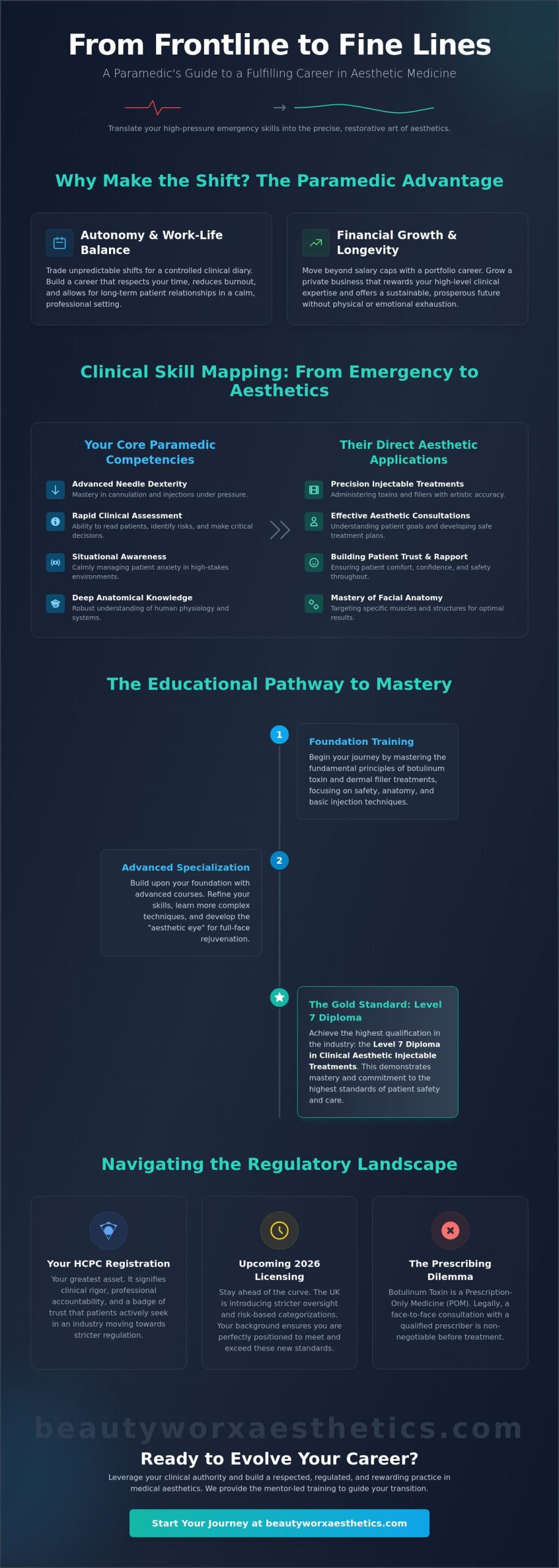
One of the most profound benefits of this transition is the restoration of professional autonomy. In the ambulance service, your schedule is often at the mercy of dispatch and overstretched resources. Moving into aesthetics allows you to regain control over your clinical diary, ensuring that patient consultations are never rushed. You can trade the high-stress environment of an emergency vehicle for a calm, luxury clinical setting. This atmosphere isn’t just for the patient’s comfort; it’s for your own mental clarity. It facilitates the building of long-term patient relationships, moving away from one-off emergency interventions toward a collaborative journey of self-confidence and graceful aging.
Financial Growth and Career Longevity
The physical and emotional toll of frontline work is a reality many paramedics face as they progress through their careers. Transitioning into aesthetics offers a path toward career longevity that doesn’t sacrifice earning potential. While NHS Agenda for Change bands provide a stable foundation, they often come with a salary cap that doesn’t always reflect the high level of clinical responsibility you carry. A portfolio career allows you to maintain your frontline skills on a part-time basis while growing a private business that rewards your expertise. It’s about creating a sustainable future where your clinical precision is valued, your time is respected, and your professional growth has no artificial limits.
Clinical Skill Mapping: From Emergency Care to Aesthetic Precision
Your transition from paramedic to aesthetic practitioner is underpinned by a level of clinical competence that most novice injectors spend years trying to replicate. In the ambulance service, you’ve mastered the art of “reading” a patient within seconds, a skill that translates perfectly into the consultation room. While the context changes from crisis to enhancement, the fundamental requirement for anatomical precision and calm patient management remains identical. You possess a unique blend of needle dexterity and situational awareness that makes you a natural fit for this field.
The synergy between emergency triage and aesthetic consultation lies in the ability to rapidly assess clinical risk while maintaining a calm, empathetic focus on the patient’s desired outcome.
Developing an “aesthetic eye” is the next stage of your evolution. It involves combining your existing clinical science with the artistry of facial rejuvenation. You aren’t just administering a treatment; you’re restoring balance and vitality. This requires a deep understanding of how light hits the face and how subtle changes in volume can dramatically improve a patient’s self-confidence. It’s a journey from life-saving to life-enhancing care.
Needle Mastery and Anatomy
Your years of performing cannulation under pressure provide the perfect foundation for advanced dermal filler techniques. You understand that skin isn’t just a surface; it’s a complex, living landscape of facial nerves and vasculature. By adhering to JCCP Standards, you’ll learn to map these structures with surgical precision. Maintaining a sterile field is second nature to you, ensuring that every treatment is delivered with the highest clinical standards in a private setting. If you’re ready to refine your expertise, exploring our Foundation Dermal Filler Course can be your first step toward artistic mastery.
Complications Management: The Paramedic Advantage
Perhaps your most significant asset in the move from paramedic to aesthetic practitioner is your ability to remain composed when things don’t go as planned. Paramedics are uniquely qualified to handle adverse events like vascular occlusions because they already possess the emergency protocols required for patient rescue. You don’t just see a complication; you see a clinical challenge to be resolved with calm authority. Integrating a complications management course into your practice isn’t just about ticking a box. It’s about formalizing your existing life-saving skills for a new environment where safety is the ultimate luxury.
Navigating Regulations: HCPC Status and the Prescribing Dilemma
Maintaining your professional integrity while moving from paramedic to aesthetic practitioner requires a nuanced understanding of the current regulatory framework. Your HCPC registration is a powerful testament to your clinical ethics, but it operates within a complex ecosystem alongside JCCP and DHSC guidelines. One of the most significant hurdles for paramedics is the management of Prescription Only Medicines, specifically botulinum toxin. Since 2025, remote prescribing without a face-to-face consultation has been deemed non-compliant. This means that if you aren’t yet an independent prescriber, you must work alongside a qualified partner who can personally assess every patient before you proceed with treatment.
For those seeking total clinical autonomy, the V300 Independent Prescribing course is the natural progression. It bridges the gap between being a highly skilled injector and a fully independent clinician. Until that milestone is reached, working with a prescribing partner isn’t a limitation; it’s a cornerstone of robust clinical governance. It ensures a secondary layer of safety, mirroring the collaborative nature of emergency care while you focus on the artistic execution of the procedure. This partnership allows you to build your practice on a foundation of absolute transparency and patient safety.
The Future of Regulation in the UK
The landscape is shifting toward a more structured future. The UK Government’s New Aesthetics Licensing Scheme, set for implementation in 2026, aims to standardize the industry through a tiered risk-based framework. As an HCPC-registered professional, you already possess a significant head start. Your existing registration proves you meet high standards of proficiency and conduct, which will likely simplify your transition under the new local authority licensing requirements. However, securing specific medical malpractice cover designed for aesthetic injectors remains a mandatory step to protect both your patients and your professional future.
Professional Parity and Clinical Governance
Your private practice should be an extension of your professional identity, mirroring the rigor found in your facial aesthetics training. It’s vital to distinguish between the roles of a Medical Director and a Lead Practitioner. While you may lead the clinic, a designated Medical Director often provides the high-level oversight necessary for complex cases or complications management. Every procedure you perform and every consultation you lead contributes to your professional portfolio. This documentation is essential for HCPC revalidation, ensuring that your journey as a paramedic to aesthetic practitioner is viewed as a legitimate, specialized evolution of your clinical career.
The Educational Pathway: From Foundation to Level 7 Mastery
Embarking on the journey from paramedic to aesthetic practitioner requires a structured approach that respects your existing clinical seniority while building a new foundation in facial artistry. This transition is a logical progression, starting with the core principles of injectable medicine. Your first step involves mastering foundation techniques in anti-wrinkle injections and dermal fillers, where you’ll learn to translate your needle precision into the subtle restoration of facial harmony. Following this, the focus shifts to practical mentorship, allowing you to build a robust clinical case portfolio under the watchful eye of expert artisans.
As your confidence grows, you can refine your craft through specialized masterclasses. These sessions allow you to focus on high-demand areas such as lip augmentation filler, where the goal is always a natural, bespoke result that enhances the patient’s inherent features. The final stage of this educational evolution is achieving an OFQUAL regulated qualification, ensuring your practice meets the highest possible standards of academic and clinical excellence.
Why OFQUAL Regulation Matters
In a rapidly evolving industry, the distinction between a simple CPD certificate and a regulated qualification is vital for your long-term security. While short courses provide initial skills, the Level 7 Diploma in Clinical Aesthetic Injectable Treatments acts as the gold standard for medical professionals. This university-equivalent learning pathway is designed to future-proof your career against upcoming legislative changes. It moves beyond basic “how-to” training, diving deep into the science of aging and the complexities of facial anatomy, ensuring you practice with the quiet confidence of a true specialist.
Building Your Treatment Menu
A successful transition from paramedic to aesthetic practitioner involves more than just mastering a single procedure; it’s about creating a comprehensive wellness journey for your patients. Most clinicians begin with core injectables, but diversifying your menu allows for a more holistic approach to self-care. You might consider expanding into the wellness sector with vitamin b12 injection training, offering patients a sense of renewed vitality alongside their aesthetic treatments. Introducing advanced skin rejuvenation, such as polynucleotides and skin boosters, further establishes your clinic as a destination for sophisticated, restorative care that prioritizes long-term skin health.
Ready to secure your professional future in medical aesthetics? Discover how our Level 7 Diploma in Clinical Aesthetic Injectable Treatments provides the regulated pathway you need to excel.
Why Beauty Worx Aesthetics is the Choice for Paramedic Clinicians
Choosing the right environment for your transition from paramedic to aesthetic practitioner is a decision that impacts your professional reputation and your clinical confidence. At Beauty Worx Aesthetics, we recognize that you aren’t a novice to the medical world; you’re an experienced clinician with a wealth of frontline knowledge. Our training philosophy is built on a foundation of mutual respect for your existing seniority. We provide small-group environments where the focus remains on refining your expertise rather than teaching you basic clinical concepts you’ve already mastered. This approach ensures your learning is efficient, sophisticated, and deeply relevant to your career goals.
Transitioning from the NHS to private practice is as much a psychological shift as it is a professional one. Our mentor-led practical days move beyond the technicalities of injection, focusing instead on real-world patient outcomes and the nuances of private consultation. You’ll join a supportive community of like-minded professionals who understand the specific challenges of leaving a reactive emergency setting. This network provides a sense of camaraderie and shared purpose, ensuring you feel empowered as you navigate your new path as an expert artisan in the field of medical aesthetics.
The Beauty Worx Aesthetics Difference
Our commitment to excellence is reflected in our unwavering focus on subtle, natural-looking results. We believe that true aesthetic mastery lies in enhancement rather than transformation, preserving the inherent features that make every patient unique. This philosophy is balanced by a rigorous dedication to patient safety, mirroring the high clinical standards you’ve maintained throughout your paramedic career. Our training environment strikes a delicate balance between clinical expertise and high-end luxury, providing a space where you can feel both professionally challenged and personally inspired. Mentorship at Beauty Worx Aesthetics doesn’t end when your course dates conclude; it’s an ongoing partnership designed to support your growth as you establish your own reputation for excellence.
Take the First Step Toward Your New Career
If you’re ready to evolve from paramedic to aesthetic practitioner, the journey begins with a clear understanding of your specific aspirations. We invite you to book a consultation with our team to discuss your career goals and how our OFQUAL regulated pathways can help you achieve them. During this conversation, we can clarify the prerequisites for our Level 7 and Advanced courses, ensuring you have a seamless entry into our professional network. Joining Beauty Worx Aesthetics means becoming part of a collective of expert artisans who view aesthetic medicine as both a science and a restorative art form. Your future in medical aesthetics is a journey toward autonomy, balance, and the continued pursuit of clinical excellence in a refined, private setting.
A Sophisticated Evolution of Your Clinical Career
The shift from the high-pressure environment of the frontline to the serene precision of a private clinic is more than a career change; it’s a sophisticated evolution of your professional identity. You already possess the needle mastery and anatomical insight required to excel in this field. By aligning your HCPC registration with the gold standard of training, you ensure that your practice remains both ethically sound and clinically superior as the 2026 regulations take effect. This transition is about honoring your medical roots while embracing the artistry of restoration.
Navigating the path from paramedic to aesthetic practitioner empowers you to build a legacy of patient trust and restorative beauty. This journey allows you to maintain your clinical excellence while finally enjoying the autonomy and balance of a private setting. As an OFQUAL Regulated Training Provider, we offer CPD Accredited Courses and advanced clinical mentorship designed specifically for medical professionals who refuse to compromise on quality or safety.
Explore our OFQUAL Regulated Level 7 Aesthetics Training for Paramedics today to secure your place in the future of medical aesthetics. Your expertise is the most valuable asset you bring to this field, and we’re honored to act as your expert guide in this rewarding new chapter. Your future in aesthetics starts with a single, confident step toward excellence.
Frequently Asked Questions
Can I legally perform aesthetic treatments as a paramedic in the UK?
Yes, you can legally perform aesthetic treatments in the UK, as your status as an HCPC-registered professional provides a robust foundation for this transition. Paramedics are recognized as qualified healthcare providers capable of performing non-surgical cosmetic procedures, provided they have completed accredited training. You must practice within your scope of competence and ensure you hold appropriate medical malpractice insurance to protect your patients and your professional standing.
Do I need to be a prescriber to train in Botox and dermal fillers?
You don’t need to be an independent prescriber to begin your training in botulinum toxin and dermal fillers. While dermal fillers are currently classified as medical devices, botulinum toxin is a prescription-only medicine that requires oversight. If you aren’t a prescriber, you must collaborate with a prescribing partner who will perform the mandatory face-to-face consultation with every patient before you administer the treatment.
How long does it take to transition from paramedic to aesthetic practitioner?
The journey from paramedic to aesthetic practitioner typically takes between six and twelve months to establish a confident clinical foundation. While initial foundation courses are completed over a few days, building a comprehensive portfolio and mastering advanced techniques requires ongoing mentorship and practice. Achieving a gold-standard qualification like the Level 7 Diploma will extend this timeline as you complete more rigorous academic and practical assessments.
Will I lose my HCPC registration if I move into aesthetics?
You will not lose your HCPC registration by entering the field of medical aesthetics. Maintaining your registration is actually a significant advantage, as it demonstrates your commitment to high professional standards and clinical ethics. You must continue to adhere to the HCPC standards of proficiency and keep a detailed record of your continuing professional development to ensure your aesthetic practice is recognized during your regular revalidation process.
What insurance do I need as a paramedic working in aesthetics?
You must obtain specialist medical malpractice and professional indemnity insurance specifically tailored for aesthetic procedures. Your standard paramedic insurance will not cover cosmetic treatments like dermal fillers or anti-wrinkle injections. Most reputable insurers will require proof of your HCPC registration and certificates from accredited training providers before granting cover. This insurance is a mandatory requirement for maintaining a safe, professional, and legally compliant private practice.
Is a Level 7 Diploma necessary for paramedics in 2026?
While not a universal legal requirement today, the Level 7 Diploma is the most effective way to future-proof your career for the 2026 licensing changes. This qualification is designed to meet the highest tier of educational standards expected under the UK government’s new risk-based framework. For any paramedic to aesthetic practitioner, achieving Level 7 status ensures you are prepared for stricter regulations and are viewed as a highly competent, specialist injector.
Can I still work in the NHS while building an aesthetics business?
Many paramedics successfully maintain a portfolio career by working part-time in the NHS while growing their private aesthetics business. This balance allows you to retain your emergency clinical skills and pension benefits while enjoying the flexibility and higher earning potential of private practice. You should check your employment contract for any requirements to declare outside business interests, but most trusts support clinicians who pursue additional professional development.
How do I find a prescriber to work with if I am not one myself?
You can find a prescribing partner through professional networking platforms, local clinical mentorship schemes, or dedicated prescribing networks. Many paramedics form partnerships with local doctors, dentists, or nurse prescribers who provide the necessary face-to-face consultations for prescription-only medicines. Establishing a reliable relationship with a prescriber is essential for clinical governance, ensuring that your practice remains safe, ethical, and fully compliant with current UK regulations.











 Reviews