
Is the era of effortless growth in aesthetics over, or are we simply witnessing a refinement where only the most meticulous practitioners flourish? With the global medical aesthetics market projected to reach $22.59 billion in 2026, the opportunity for success is vast, yet many feel a lingering hesitation. You’re likely balancing the excitement of this growth against the weight of new legislation and the high initial investment required for elite training. It’s common to feel a sense of pressure as the industry shifts toward mandatory registration and stricter prescribing rules. We understand that the profitability of an aesthetics business depends on more than just skill; it requires a delicate harmony of clinical authority and strategic foresight.
This guide serves as your professional compass, providing the precise financial frameworks and high-margin service models needed to build a sustainable, six-figure practice. We’ll demystify the value of OFQUAL-regulated qualifications like the Level 7 Diploma and show you how to transition from a dedicated practitioner to an influential educator. You’ll discover which treatments offer the most graceful returns on investment, ensuring your clinic remains a sanctuary of both luxury and profit. Let’s explore the roadmap to a practice that reflects your artistry and secures your future.
Key Takeaways
- Learn how clinical excellence and operational efficiency form the foundation for the long-term profitability of an aesthetics business in a regulated market.
- Identify the “Golden Trio” of high-margin treatments—anti-wrinkle, dermal fillers, and skin rejuvenation—that drive consistent revenue growth.
- Understand how achieving an OFQUAL-regulated Level 7 Diploma can reduce your insurance premiums while justifying a more sophisticated, premium pricing structure.
- Discover how rigorous safety protocols and complications management protect your practice from the significant financial risks of clinical errors.
- Master the transition from a solo practitioner to a scalable clinic by implementing structured associate models and refined operational phases.
The Economic Landscape of the Aesthetics Industry in 2026
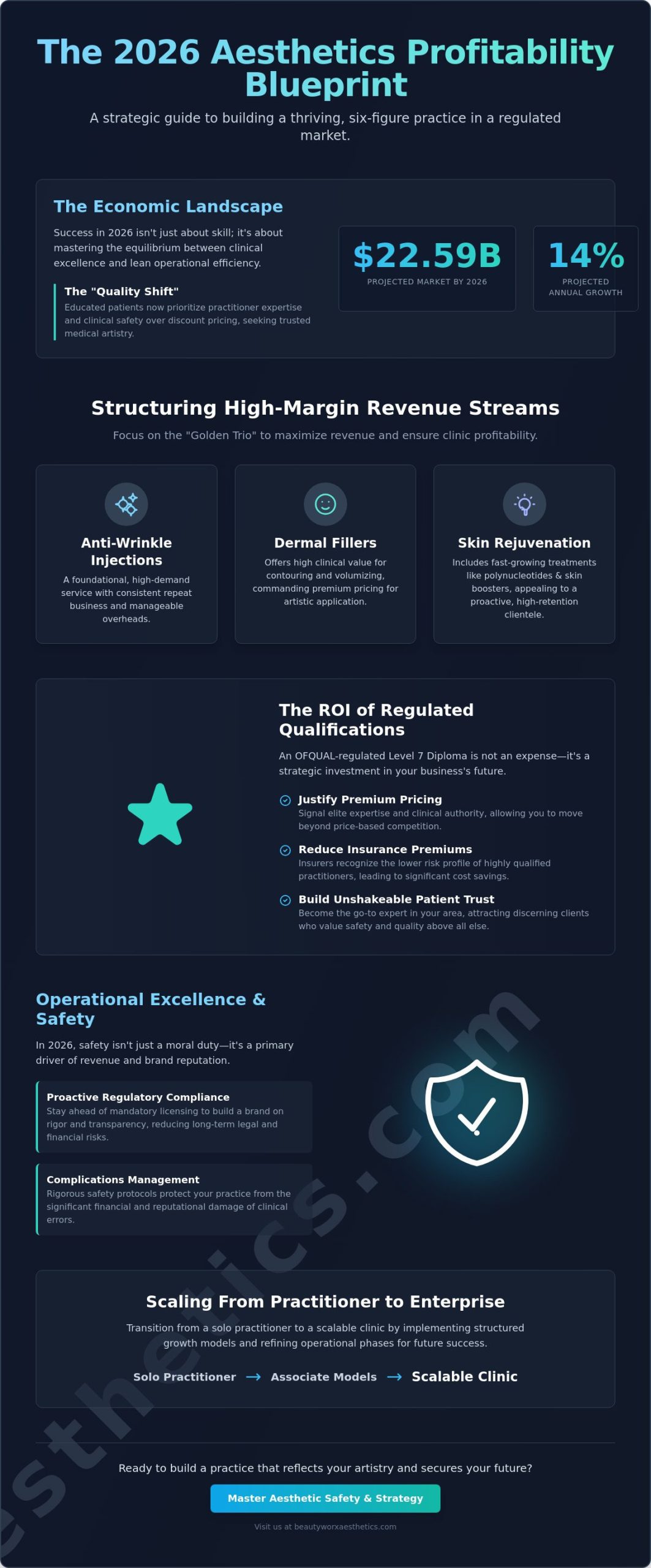
The 2026 market doesn’t reward the mere act of injecting; it rewards the mastery of the craft. True profitability of an aesthetics business now rests on a sophisticated equilibrium between clinical excellence and lean operational efficiency. While the global industry is projected to grow by as much as 14% annually through 2026 according to McKinsey & Company, this growth isn’t distributed equally. Success belongs to those who view Aesthetic medicine as a long-term partnership in skin health rather than a series of transactional, one-off appointments. We’re seeing a definitive “Quality Shift” where patients prioritize the practitioner’s expertise and the safety of the clinical environment over the allure of discount pricing. This evolution transforms the clinic from a simple service provider into a sanctuary of trusted, medical artistry.
Market Saturation vs. Clinical Demand
Critics often claim the market is oversaturated, but this perspective ignores a crucial divide. The entry-level, low-cost segment is indeed crowded, with practitioners competing on price alone. These models are struggling because today’s patients are more educated than ever. They seek subtle, natural-looking results and are willing to pay a premium for the peace of mind that comes with a regulated practitioner. You can find significant growth by identifying underserved segments. While the high street is full of standard lip fillers, there’s a rising demand for sophisticated regenerative treatments and “Brotox” for the growing male patient base. Transitioning from a service-based mindset to a clinical outcomes mindset allows you to rise above the noise of the saturated market. It’s about offering a bespoke journey toward self-confidence that a discount clinic simply cannot replicate.
The Role of Regulatory Compliance in Revenue
Regulatory shifts, including the mandatory licensing requirements following the Health and Care Act 2022, are transforming the industry’s financial structure. Instead of viewing these changes as a hurdle, profitable businesses see them as a protective moat. Being ahead of the regulatory curve allows you to establish a brand built on clinical rigor and transparency. This proactive approach reduces long-term costs associated with oversight and potential legal complications. A cornerstone of this strategy is Mastering Aesthetic Safety, which ensures that your reputation remains untarnished and your insurance premiums stay manageable. In 2026, safety isn’t just a moral obligation; it’s a primary driver of revenue. When patients feel safe, they become loyal advocates for your brand, providing the organic growth that sustains a high-margin practice.
Structuring High-Margin Revenue Streams in Aesthetics
Achieving long-term success requires a strategic focus on the “Golden Trio”: anti-wrinkle injections, dermal fillers, and advanced skin rejuvenation. These services remain the pillars of the profitability of an aesthetics business because they offer high clinical value with manageable overheads. When you calculate your margins, you must look beyond the initial product cost. Your true profit is the remainder after accounting for practitioner time, clinic overheads, and the insurance required for high-level clinical oversight. As the global medical aesthetics market continues its upward trajectory, the most successful clinics are those that optimize their schedules for these high-impact procedures. It’s about working smarter. You want to ensure that every hour spent in the clinic maximizes your artistic talent while maintaining a healthy bottom line. This requires a meticulous approach to inventory management and a deep understanding of which treatments your specific clientele values most.
Optimising Your Treatment Menu
Polynucleotides and skin boosters have emerged as the fastest-growing profit centres for 2026. Unlike traditional fillers, these regenerative treatments encourage the body’s own healing processes, appealing to the proactive patient demographic. Prioritising high-retention services like Polynucleotide Treatment ensures a steady stream of returning clients, which significantly improves the profitability of an aesthetics business through increased lifetime customer value. You can further enhance this by integrating wellness injections. Offering Vitamin B12 injections provides a quick, low-overhead service that complements more intensive procedures. Bundling these into holistic skin-health packages transforms a single visit into an ongoing partnership. This approach shifts the client’s perspective from seeing you for a quick fix to viewing you as a vital guide in their long-term self-care journey.
The Practitioner-to-Educator Transition
The most significant shift in 2026 is the transition from practitioner to educator. Many clinic owners find that their growth plateaus when their time at the chair is fully booked. By leveraging your clinical expertise to offer CPD accredited training, you unlock a secondary, high-margin revenue stream that doesn’t rely solely on your manual labour. Transforming your clinic into a training hub allows you to mentor the next generation while establishing yourself as a leading clinical authority. This academy model offers a remarkable ROI, as it utilises your existing space and knowledge to generate income. It’s a scalable solution that protects your business from the physical limitations of solo practice. If you’re looking to diversify your expertise, beginning with specialised clinical training is an accessible way to enter the educational space. By teaching, you aren’t just selling a service; you’re cultivating a legacy of safety and excellence within the industry.
The ROI of Regulated Qualifications: Level 7 vs. CPD
Choosing the right educational path is perhaps the most significant financial decision you’ll make for your clinic. While basic CPD courses offer a gateway, the Level 7 Diploma serves as a profound investment in the long-term profitability of an aesthetics business. It’s a shift from being a technician to becoming a clinical authority. This distinction is vital because the 2026 patient is discerning; they look for the reassurance of OFQUAL-regulated credentials before they trust someone with their face. By securing a higher level of qualification, you aren’t just learning a skill; you’re building a brand on a foundation of academic rigor and safety. This academic standing allows you to move away from price-sensitive markets and into a space where your expertise is the primary draw.
Level 7: The Gold Standard for Profit
Navigating the various Aesthetic Courses available can be overwhelming, yet the Level 7 Diploma in Clinical Aesthetic Injectable Treatments remains the gold standard. It allows you to attract a higher-tier clientele who value expertise over economy. These patients often pay 30-50% more for a Level 7 qualified practitioner, creating a “Trust Dividend” that quickly offsets the initial cost of the diploma. Beyond pricing, this qualification acts as a business asset that simplifies clinical oversight and reduces the complexity of maintaining high standards in a busy practice. It’s an aspirational milestone that signals to your clients that you prioritize their emotional journey and physical safety above all else.
The Hidden Costs of “Fast-Track” Schemes
Short-term “fast-track” schemes might seem cost-effective initially, but they often carry hidden financial risks. Inadequate training in complications management can lead to reputation damage that is far more expensive than any tuition fee. Additionally, insurance providers are increasingly rewarding practitioners who hold regulated qualifications with lower premiums. This trend mirrors the maturity seen in the U.S. Aesthetic Medicine Market, where advanced credentials are directly tied to lower operational risk and higher patient retention. Investing in thorough, regulated education ensures you don’t face the heavy cost of retraining when UK legislation inevitably tightens further. The Regulation Gap is the primary differentiator for high-profit clinics in 2026, as it separates practitioners who simply perform procedures from those who command authority and premium pricing through academic and clinical mastery.
Operational Efficiency: Managing Costs and Complications
Precision in the back-office is as vital as precision with a needle. The profitability of an aesthetics business is often won or lost in the subtle margins of supply chain management and administrative flow. While the temptation to seek lower-cost alternatives exists, choosing established, premium products like Azzalure or Botox ensures a consistent clinical outcome that preserves your professional reputation. Beyond product selection, the implementation of digital systems for patient mapping, digital consent, and automated follow-ups can recover several hours of practitioner time each week. This reclaimed time allows for more high-value consultations, directly impacting your bottom line without increasing your physical workload. Efficiency, in this sense, is the art of removing friction from the client journey.
Complications Management as a Business Strategy
Safety is your most robust profit protector. While we focus on beautiful, restorative results, the expert management of adverse events is what truly builds unbreakable client loyalty. A single vascular occlusion, if handled without the necessary clinical rigor, can lead to devastating financial and reputational loss. Conversely, having an on-site complications kit and the advanced training to use it effectively turns a potential crisis into a powerful demonstration of your clinical authority. Meticulous clinical documentation isn’t just a regulatory requirement; it’s a financial shield that lowers your insurance risk and protects the long-term health of your practice. When patients know they are in the hands of a prepared expert, their trust becomes your most valuable asset.
Marketing for Authority, Not Discounts
To truly scale your revenue, you must move away from the “discount” culture that erodes profit margins. Promoting “Lip Filler Deals” attracts price-sensitive clients who often lack long-term loyalty. Instead, focus your marketing on “Sophisticated Face Contouring” and the preservation of natural beauty. By leveraging educational content, such as our guide to Lip Augmentation Filler, you showcase your discernment as a specialist. This approach pre-sells high-value treatment plans before the client even enters the clinical space. It significantly reduces your Cost Per Acquisition (CPA) by attracting patients who value your expertise over a bargain. If you are ready to elevate your clinical standards and protect your margins, consider enrolling in our Complications Management Course to secure your practice’s future.
Scaling Your Aesthetics Business: The Path to 2027 and Beyond
Scaling a practice requires a graceful transition from the hands-on artistry of a solo practitioner to the strategic vision of a business owner. The long-term profitability of an aesthetics business is ultimately determined by how well you can detach your income from your own physical hours at the chair. This evolution typically unfolds in three distinct phases. First, you must establish a regulated foundation of clinical excellence, often through advanced qualifications like the Level 7 Diploma. Second, you expand your reach by implementing associate models that allow your clinic to breathe and grow. Finally, you diversify into the educational space, transforming your clinical expertise into a scalable training academy. This journey isn’t just about increasing volume; it’s about elevating your brand’s authority until the clinic’s reputation exceeds any single individual’s presence.
Building a Multi-Practitioner Clinic
Moving beyond a solo practice involves a careful calculation of your operational model. You’ll likely choose between room-rent and commission-based structures. While room-rent provides predictable, steady income, a commission model often aligns the practitioner’s success more closely with the clinic’s growth. Maintaining quality control during this expansion is paramount. To preserve the subtle, natural-looking results your brand is known for, you should prioritise recruiting practitioners who value regulated pathways. Hiring those with Level 5 or Level 7 certificates ensures that your team shares a common language of safety and artistic discernment. This clinical alignment protects your brand’s integrity while allowing you to scale your service volume without compromising the patient’s emotional journey toward self-confidence.
Your Future with Beauty Worx Aesthetics
At Beauty Worx Aesthetics, we view our relationship with you as an ongoing partnership in self-care and professional mastery. Our OFQUAL regulated diplomas provide more than just letters after your name; they offer the clinical and business foundation required to thrive in a tightening regulatory landscape. Beyond the classroom, our graduates benefit from a professional network and mentorship that helps navigate the complexities of clinic ownership. We’re here to support your transition from an expert artisan to a leader in the field, ensuring your practice remains a sanctuary of luxury and clinical safety for years to come. Enrol in the Level 7 Diploma and future-proof your business profitability today.
Securing Your Clinical Legacy in a Regulated Era
Transitioning from the mechanics of injection to the strategic mastery of a clinic requires a profound shift in perspective. We’ve explored how the profitability of an aesthetics business in 2026 now depends on a foundation of regulated excellence and operational precision. By prioritizing high-margin regenerative treatments and mastering the complexities of complications management, you create a practice that is as resilient as it is refined. True success in this evolving landscape is found where clinical safety meets an uncompromising commitment to natural, artistic results. It’s about building a brand that patients trust implicitly.
Your path to a high-growth practice begins with the right credentials. Our OFQUAL Regulated Level 4, 5, and 7 qualifications provide the academic rigor needed to command premium pricing and patient trust. With CPD Accredited training featuring live models and expert mentorship from industry leaders, you’ll gain the specific insights required to lead the market. Explore our OFQUAL Regulated Aesthetics Courses and scale your business to ensure your practice thrives through 2027 and beyond. The future of aesthetics belongs to the trusted, expert artisan, and we’re here to guide your journey.
Frequently Asked Questions
Is the aesthetics industry still profitable in 2026?
Yes, the aesthetics sector remains exceptionally lucrative for those who prioritize clinical excellence over high-volume, low-cost services. Success in 2026 is defined by a shift toward long-term skin health plans, which foster higher patient retention and stable revenue. By establishing yourself as a regulated expert, you move away from price-sensitive markets and into a space where your artistry is valued.
How much can a self-employed aesthetic practitioner realistically earn?
Realistic earnings vary based on experience and clinical setting. Industry estimates for 2026 suggest that junior injectors can earn approximately $78,000, while senior injector nurses often see salaries reaching $95,000. For those running their own practice, income is determined by operational efficiency and the ability to scale beyond a solo practitioner model.
What is the most profitable aesthetic treatment to offer?
The most profitable treatments are those that combine low product overhead with high clinical value and patient loyalty. While anti-wrinkle injections provide steady cash flow, regenerative treatments like polynucleotides and skin boosters are the fastest-growing profit centers. These procedures require minimal downtime and encourage a cycle of repeat visits that sustain your bottom line.
Does a Level 7 qualification actually increase clinic revenue?
Achieving a Level 7 Diploma directly impacts the profitability of an aesthetics business by justifying premium pricing structures. Patients are increasingly aware of the Regulation Gap and are willing to pay significantly more for the safety of an OFQUAL-regulated practitioner. This credential also helps reduce long-term operational costs by lowering insurance premiums and minimizing the risk of expensive clinical errors.
What are the biggest hidden costs in running an aesthetics business?
Hidden expenses often include specialized insurance, the maintenance of emergency complications kits, and the time required for meticulous clinical documentation. Additionally, the cost of staying ahead of UK licensing changes can be significant if you haven’t invested in future-proofed qualifications. Managing these overheads through digital efficiency is crucial for protecting your net margins.
How do I compete with clinics that offer cheaper treatments?
You compete by building a brand centered on safety, artistry, and subtle, natural-looking results. Discount clinics often struggle with high patient turnover and lower clinical standards. By positioning your practice as a premium clinical sanctuary, you attract a discerning clientele who value professional discernment and long-term care over a temporary bargain.
Can non-medics still run a profitable aesthetics business in the UK?
Non-medics can maintain a profitable practice by strictly adhering to the new 2026 legislative requirements and completing accredited training. Following the Level 4, 5, and 7 pathways ensures you meet the upcoming standards for practitioner registration and accreditation. This commitment to education provides the necessary clinical authority to operate safely and successfully in a regulated market.
How much should I spend on marketing for my new clinic?
Marketing spend should focus on building authority through educational content rather than aggressive, discount-led advertising. It’s often more cost-effective to invest in high-quality content that pre-sells your expertise, which lowers your cost per acquisition. Focusing on client retention and word-of-mouth referrals will yield a much higher return on investment than broad, un-targeted campaigns.













 Reviews