

What if the most precarious measurement in your practice isn’t the depth of a needle, but the figure you’ve placed on your treatment menu? It is common to feel a quiet, persistent anxiety as you watch ‘basement injectors’ undercut your expertise, making the delicate task of pricing your aesthetic treatments feel like a race to the bottom. You understand that your craft is a sophisticated blend of medical science and artistic discernment; however, your clinical overheads, from specialist insurance to life-saving complications kits, require a strategy that prioritizes profit over mere survival.
Mastering this balance is the definitive step toward building a practice that is as sustainable as it is sophisticated. With new UK licensing requirements arriving in July 2026, the industry is finally moving to reward practitioners who hold a Level 7 Diploma and prioritize clinical safety. This guide offers you a clear, professional formula to balance your overheads with your artistic premium. You’ll learn how to charge for your expertise with absolute confidence, ensuring your business model supports high-end results, ongoing education, and the graceful preservation of your clients’ inherent features.
Key Takeaways
- Define your clinical baseline by accurately calculating the direct costs of high-quality toxins, fillers, and advanced bioremodelers.
- Understand the significant market value of OFQUAL-regulated qualifications and how a Level 7 Diploma establishes your authority to command higher fees.
- Protect your practice by integrating the essential costs of specialist insurance and complications management into every treatment fee.
- Transition from commodity-based pricing to a value-driven model that prioritizes your artistic discernment and the subtle, natural results your clients desire.
- Master the art of pricing your aesthetic treatments with a sustainable structure that supports both your professional growth and long-term business profitability.
The Foundation of Profitability: Calculating Clinical Overheads and Consumables
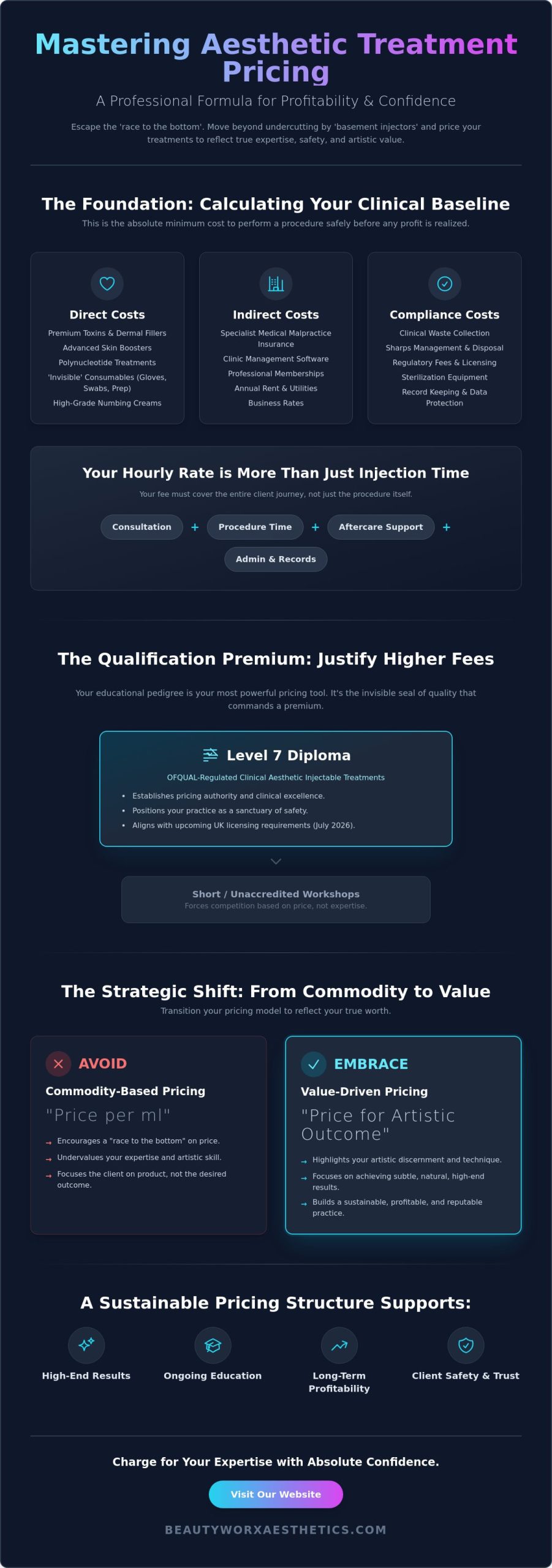
Profitability is never an accident; it is the result of meticulous calculation and a deep respect for the clinical environment you provide. When you begin the process of pricing your aesthetic treatments, you must first establish a clinical baseline. This baseline represents the absolute minimum cost required to perform a procedure safely and legally before a single penny of profit is realized. It’s a protective measure for your business, ensuring that every appointment contributes to your sustainability rather than eroding your margins.
Your direct costs are often the most visible, yet they require precise tracking. This includes the acquisition of premium toxins, dermal fillers, and advanced skin boosters. Emerging categories like polynucleotide treatments often carry a higher cost of goods, which must be reflected in your final fee. Beyond the primary product, you must account for the ‘invisible’ consumables that ensure a sterile and comfortable experience. High-grade numbing creams, sterile swabs, gloves, and skin prep solutions may seem negligible individually. Collectively, they form a significant portion of your overhead. To appreciate the professional scope of these interventions, one might look at the broader definition of Aesthetic Medicine, which bridges the gap between luxury beauty and clinical expertise.
Indirect costs are equally vital. These include your specialist medical malpractice insurance, clinic management software, and professional memberships. These elements provide the infrastructure of trust that allows your clients to feel safe and pampered in your care.
Determining Your Hourly Clinical Rate
Every minute spent in your clinic carries a cost. To calculate your ‘room cost,’ divide your annual rent, utilities, and business rates by your total working hours. However, your hourly rate must extend beyond the time the needle is in the skin. It’s essential to account for the thorough consultations that build rapport, the meticulous aftercare support you provide, and the non-billable administrative time required to maintain patient records. If your pricing only covers the injection time, you’re essentially gifting your expertise for free during the most critical stages of the client journey.
The Cost of Clinical Waste and Compliance
Maintaining a safe, professional environment involves specific regulatory expenses. Budgeting for professional clinical waste collection and sharps management is a non-negotiable aspect of pricing your aesthetic treatments. A sterile, compliant environment projects an image of discipline and care. Cutting corners on these consumables is a false economy. It risks your reputation and the safety of the clients who trust you to preserve their natural beauty. True luxury is found in the quiet confidence that every detail, from the disposal of a needle to the sterilization of a surface, has been handled with artisanal precision.
The Qualification Premium: Why OFQUAL Regulation and Level 7 Training Command Higher Fees
Your educational pedigree is the most powerful tool you possess when pricing your aesthetic treatments. It’s the invisible seal of quality that justifies a premium fee to the discerning client. Investing in OFQUAL-regulated aesthetic courses isn’t merely about personal growth; it’s a strategic business move that establishes your pricing authority. When you hold a Level 7 Diploma in Clinical Aesthetic Injectable Treatments, you’re no longer competing on price with those who have only attended short, unaccredited workshops. You’re positioning your practice as a sanctuary of safety and clinical excellence.
The upcoming changes to the UK government’s licensing scheme have created a shift in public perception. Clients are becoming increasingly aware that not all training is equal. They’re looking for practitioners who can prove their competence through rigorous, regulated pathways. By highlighting your high-level qualifications, you provide a ‘Safety Guarantee’ that resonates deeply with those seeking subtle, natural-looking results. This assurance is exactly what allows you to maintain higher margins while others struggle to justify their costs.
The Difference Between CPD and Regulated Qualifications
It’s vital to help your clients understand the distinction between continuous professional development (CPD) and regulated qualifications. While CPD is excellent for staying current, a Level 4, 5, or 7 status represents a verified standard of proficiency that is recognized nationally. In your pricing literature, don’t just list your services; mention your regulated status. This transparency builds immediate trust. Over time, these higher qualifications often lead to lower insurance premiums, as providers recognize the reduced risk associated with advanced clinical training. It’s a virtuous cycle of professional credibility and financial sustainability.
Justifying Premium Fees Through Specialist Knowledge
True value is found in the depth of your anatomical understanding. When you explain the complexity of a procedure, such as the intricate vascular mapping required for a safe result, you’re educating the client on why your fee is higher. A practitioner who has completed a Lip Masterclass can charge more than a foundation injector because they offer a level of artisanal precision that foundation training cannot match. They’re paying for your ability to manage complications and your eye for facial harmony, not just the product in the syringe.
In 2026, the Level 7 Diploma in Clinical Aesthetic Injectable Treatments stands as the ultimate pricing anchor, signaling a level of clinical mastery that transcends standard aesthetic practice. If you’re ready to elevate your practice and command the fees your expertise deserves, consider advancing your journey with a Level 7 Diploma in Clinical Aesthetic Injectable Treatments today.
Beyond the Syringe: Pricing for Safety, Complications Management, and Insurance
Professionalism in aesthetics is defined by what happens when things don’t go according to plan. When you’re pricing your aesthetic treatments, the cost of the syringe is only a fraction of the value you provide. A significant portion of your fee must account for the infrastructure of safety that surrounds every injection. This includes maintaining an emergency complications fund, ensuring you have immediate access to reversal agents like Hyaluronidase, and staying current with life-saving protocols. Investing in a complications management course is an essential business expense that directly influences your pricing authority. It transforms you from a practitioner who simply injects into a clinical expert who protects.
Refining your pricing and negotiation strategies involves helping clients see that they aren’t just paying for 1ml of filler; they’re paying for your 24/7 availability and clinical accountability. True expert artisans don’t hide these costs. They present them as a hallmark of their meticulous nature. Your price must reflect the reality that you’re always on call for your patients, providing a level of post-treatment support that ‘basement injectors’ simply cannot offer. This commitment to the long-term client encounter is what builds enduring trust and justifies a premium position in the market.
The ‘Safety Surcharge’ vs. Clinical Excellence
Frame your safety protocols as a primary benefit rather than a burdensome overhead. For non-medically qualified practitioners, the cost of maintaining a relationship with a prescribing lead is a vital component of your clinical baseline. High-quality medical malpractice insurance is equally non-negotiable. With specialist packages for non-medics starting from approximately £76.69 a month and medically qualified practitioners from £34.53, these figures must be integrated into your margins. When a client questions a price, explain that it covers the highest standard of protection, ensuring they’re safe in a professional environment that prioritizes their emotional and physical well-being.
Building a Complications Contingency into Your Margin
Every treatment carries a different risk profile, and your pricing should be ‘risk-adjusted’ accordingly. High-risk areas, such as tear troughs or liquid rhinoplasty, require greater focus, more time, and a higher degree of clinical discernment. Your initial fee must also pre-pay for the ‘free’ follow-up appointment. This ensures your business remains profitable even when a rare adverse event requires multiple dissolving sessions. Given that dermal filler dissolving treatments start from £300, failing to account for these potential costs can quickly turn a profitable procedure into a financial loss. By pricing for the full scope of care, you ensure your practice remains sustainable, allowing you to act as a knowledgeable guide through every stage of the client’s journey.
Value-Based Strategy: Transitioning from ‘Price per ml’ to ‘Artistic Outcome’
Treating your services as a raw commodity is a precarious strategy that inevitably leads to a race to the bottom. When you focus solely on the volume of product used, you invite clients to compare your years of clinical expertise with ‘basement injectors’ based on a single, misleading metric. In the world of sophisticated facial aesthetics, your true value isn’t found in the syringe; it’s found in the transformation. Shifting your approach to pricing your aesthetic treatments means moving away from ‘price per ml’ and toward the artistic outcome. This transition allows you to charge for your discernment, your safety record, and the emotional journey toward self-confidence.
Consider the technical difference between various styles of lip augmentation filler. A client seeking ‘Russian Lips’ requires a vastly different technical approach and time commitment than one desiring ‘Natural Restoration’. Pricing these by the desired look rather than the product used acknowledges the specific skill set and time required for each unique result. Research from early 2026 indicates that practitioners who build and sell combination treatment packages see 40-60% higher per-patient revenue than those offering only à la carte services. This data confirms that discerning clients are willing to invest in a comprehensive, long-term result rather than a single-area fix.
The Artisan Approach: Pricing Your Discernment
An expert artisan understands that the most impactful work often involves knowing when to stop. Your artistic discernment, including the ability to say ‘no’ to inappropriate or excessive treatments, is a premium service. Paradoxically, the most experienced practitioners often use less product to achieve a superior, more subtle result. They charge more for this outcome because it requires a higher level of clinical mastery and an eye for facial harmony. By creating bespoke, multi-session treatment plans, you justify a pricing structure that reflects your expertise rather than a simple material markup. It’s about selling the preservation of the client’s inherent features, which is a far more valuable proposition than just adding volume.
Packaging Treatments for Maximum Impact
Building a sustainable business model involves moving beyond single-modality treatments. You can create a ‘Total Skin’ pricing tier by combining skin boosters with dermal fillers, addressing both structural volume and surface skin quality. This ‘Good, Better, Best’ pricing model helps clients navigate their options without feeling pressured, acting as a guide through their aesthetic journey. You might even bundle your vitamin b12 injection training knowledge into broader wellness packages, offering a holistic approach to self-care. This method frames your services as an ongoing partnership in graceful aging, moving the conversation from ‘how much product’ to ‘how much confidence’.
Refine your artistic eye and your business margins by enrolling in our Lip Masterclass today.
Building a Sustainable Aesthetic Practice: Implementing Your New Pricing Structure
Implementing a refined structure for pricing your aesthetic treatments is a delicate transition that requires both clinical confidence and empathetic communication. It’s a move away from the frantic pace of high-volume, low-margin work toward a practice that values the artisan’s touch and the patient’s long-term safety. When communicating a price increase to your loyal client base, transparency is your greatest asset. Frame the adjustment as a commitment to maintaining the high-end luxury and clinical excellence they’ve come to expect. Most clients who value their emotional journey toward self-confidence will understand that your fees reflect the rising costs of premium consumables and your ongoing investment in advanced education.
Your price list should act as a sophisticated starting point rather than a rigid, fixed menu. This transparency allows for the highly customized nature of your services, where the final fee is determined during the consultation based on the individual’s unique facial anatomy and desired outcome. To protect your brand’s luxury status, avoid the trap of ‘discounting,’ which often devalues your expertise in the eyes of the consumer. Instead, utilize ‘Introductory Offers’ for new modalities. This invites exploration of your diverse skill set without compromising your professional authority. By tracking your ‘Profit per Treatment Hour,’ you can identify which services truly support your business’s health, allowing you to focus your energy on the most lucrative and rewarding aspects of your craft.
Communicating Value During the Consultation
The consultation is where your pricing strategy meets the reality of the client encounter. Scripting the ‘Why I charge more’ conversation doesn’t need to feel defensive. It’s an opportunity to act as a knowledgeable guide, explaining how your pricing your aesthetic treatments accounts for the ‘Qualification Premium’ discussed earlier. Use your before-and-after portfolios to demonstrate the subtle, natural-looking results that only an expert artisan can achieve. When price objections arise, pivot the focus back to safety, the preservation of their inherent features, and the peace of mind that comes from being in a professional, CQC-compliant environment.
Reviewing and Adjusting Your Prices Annually
A sustainable practice requires a rhythmic review of its financial health. It’s essential to monitor inflation and any supplier price hikes for toxins and dermal fillers to ensure your margins remain protective. A helpful industry benchmark is the ‘80% capacity’ rule: once your diary is consistently 80% full, it’s often the ideal time to raise your prices. This shift ensures you’re working with clients who truly value your discernment rather than those simply seeking the lowest cost. The ultimate goal of a professional pricing strategy is to ensure the practitioner can provide the highest level of care and artistic precision without the burden of financial compromise.
Elevating Your Practice with Purpose and Precision
Refining your approach to pricing your aesthetic treatments is about more than just numbers; it’s an affirmation of your clinical mastery and your commitment to patient safety. You’ve learned to look beyond the syringe, factoring in the meticulous overheads that ensure a secure, luxury environment. By transitioning to a value-based model, you prioritize the artistic outcome over simple material volume. This shift protects your margins and honors the trust your clients place in your expert discernment. It’s the difference between a simple transaction and a sophisticated partnership in self-care.
As an OFQUAL Regulated Training Provider, we’re here to support your journey toward professional sustainability. We offer expert-led complications management support and over 25 CPD accredited masterclasses to ensure you remain at the forefront of the industry. Your path to a flourishing, respected practice starts with the confidence to charge what your artistry is truly worth. Elevate your expertise and pricing authority with our OFQUAL regulated Level 7 Diploma. We look forward to guiding you toward your most successful chapter yet.
Frequently Asked Questions
How do I know if my aesthetic treatment prices are too low?
Your prices are likely too low if you find yourself working at maximum capacity without the financial surplus to invest in advanced education or high-grade consumables. If your diary is consistently 80% full, it’s a clear signal that your market values your expertise enough to sustain a price increase. Don’t let a busy schedule mask a lack of profitability; true success means having the time and resources to provide meticulous care for every client.
Should I charge more for dermal fillers if I have a Level 7 Diploma?
Holding a Level 7 Diploma represents a significant investment in clinical safety and artistic discernment, which naturally justifies a higher fee. This qualification acts as a ‘Safety Guarantee’ for your clients, distinguishing your practice from those with only foundation-level training. When pricing your aesthetic treatments, you’re charging for the peace of mind and the predictable, natural results that come from a Master’s-level understanding of facial anatomy and complications management.
How can I compete with local injectors who charge significantly less than me?
Compete by highlighting the superior quality of your products, your regulated qualifications, and your comprehensive approach to patient safety. Discerning clients aren’t looking for the cheapest option; they’re looking for a trusted artisan who prioritizes their long-term health and subtle enhancement. By articulating the value of your complications management protocols and your artistic eye, you attract a loyal base that views aesthetics as a vital partnership in self-care rather than a one-off transaction.
Is it better to price dermal fillers per ml or per treatment area?
Pricing per treatment area or desired outcome is generally superior to the ‘price per ml’ model because it prioritizes your artistic discernment. This shift moves the conversation away from raw materials and toward the sophisticated transformation you provide. Whether a client seeks natural restoration or a specific structural enhancement, charging for the result allows you to use exactly what is needed without the pressure of commodity-based expectations.
How often should an aesthetic practitioner review their pricing structure?
You should conduct a comprehensive review of your pricing structure at least once a year to account for inflation and supplier price hikes. It’s also wise to assess your margins whenever you complete advanced training or invest in new clinical technology. Regular audits ensure that your business remains sustainable and that your fees continue to reflect the growing depth of your expertise and the premium nature of your service environment.
What are the hidden costs of running an aesthetics clinic I might be missing?
Many practitioners overlook the cost of professional clinical waste management, specialist medical malpractice insurance, and the maintenance of emergency reversal kits. You must also factor in the ‘time-cost’ of administrative tasks, such as patient record management and follow-up support. These elements are essential for a CQC-compliant environment and must be integrated into your clinical baseline to ensure your practice remains profitable while delivering the highest standard of safety.
Can I charge a consultation fee and should it be redeemable against treatment?
Charging a consultation fee is a professional way to value your time and the specialist knowledge you share during the initial assessment. Making this fee redeemable against a treatment encourages commitment while filtering for clients who are serious about their aesthetic journey. This practice establishes a tone of mutual respect and ensures that your administrative and clinical time is compensated, even if a client chooses not to proceed immediately.
How do I factor complications management into my treatment pricing?
Every treatment fee should include a small ‘safety margin’ that contributes to your complications contingency fund. This fund covers the replacement of emergency medications like Hyaluronidase and ensures you can provide ‘free’ follow-up sessions if a rare adverse event occurs. Factoring these costs into pricing your aesthetic treatments ensures your business can survive the time and material costs of managing complex cases without financial strain, preserving your reputation as a safe, responsible practitioner.














 Reviews