
What if the secret to a refreshed, youthful appearance isn’t the filler itself, but the depth of the conversation you have before the needle even touches your skin? In an era where aesthetic treatments are increasingly accessible, knowing the right questions to ask before getting dermal fillers is no longer just a recommendation; it’s a vital safeguard for your health and your reflection. You likely feel a mix of excitement and hesitation, perhaps worrying about the dreaded artificial look or feeling overwhelmed by the shifting UK regulations surrounding practitioner qualifications. It’s completely natural to seek a result that feels like you, only more rested and vibrant.
We understand that your aesthetic journey is deeply personal. This guide empowers you to navigate your consultation with the quiet confidence of an informed patient. We’ll explore how the new July 2026 licensing standards and Level 7 qualification requirements protect you, while providing a precise checklist to ensure your practitioner possesses the artistic discernment necessary for subtle, authentic enhancement. You’ll gain a clear understanding of clinical safety and the long-term maintenance required to preserve your inherent features with grace. By the end, you’ll be ready to transform your anxiety into a partnership based on transparency and excellence.
Key Takeaways
- Discover why a professional consultation serves as a meticulous clinical evaluation rather than a casual chat, ensuring your aesthetic goals are met with precision.
- Identify the significance of OFQUAL regulated Level 7 qualifications to navigate the evolving UK regulatory landscape and ensure practitioner excellence.
- Empower your decision making with the specific questions to ask before getting dermal fillers regarding product brands, batch numbers, and the science of reversible results.
- Prioritize your safety by learning how to assess a practitioner’s proactive approach to emergency protocols and their specialized expertise in complications management.
- Transition from viewing treatments as isolated transactions to embracing a tailored, long-term partnership focused on preserving your inherent beauty and vitality.
The Consultation Mindset: Why Your Questions Set the Standard for Safety
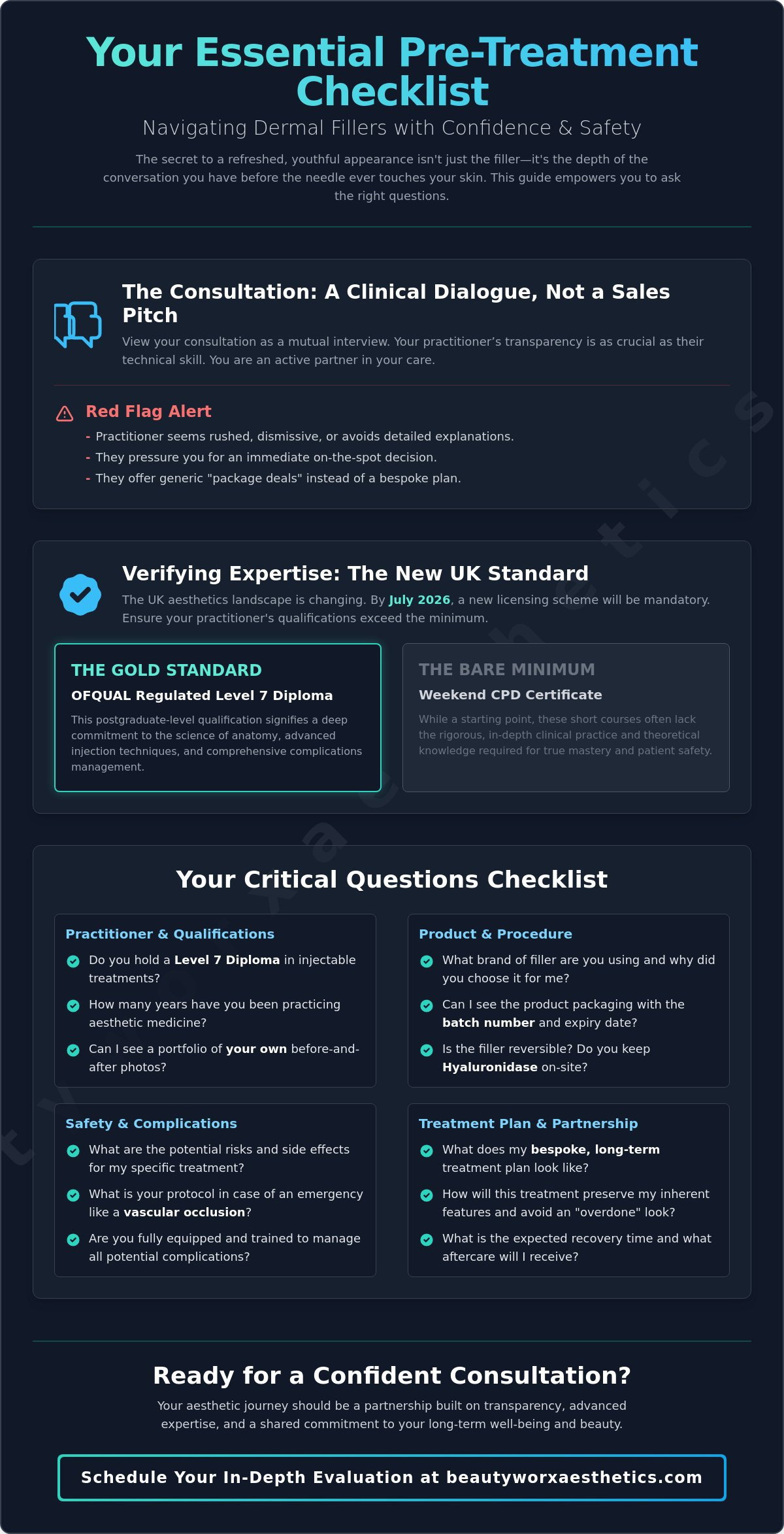
A professional consultation is far more than a simple preliminary chat; it’s a rigorous clinical encounter that establishes the foundation of your safety and satisfaction. You should view this time as a mutual interview where your practitioner’s transparency is as important as their technical skill. Compiling a list of specific questions to ask before getting dermal fillers transforms you from a passive recipient into an active partner in your care. This dialogue allows you to assess the practitioner’s clinical honesty and their willingness to prioritize your well-being over a transaction. If a practitioner appears rushed, dismissive of your concerns, or avoids detailed explanations, it’s a significant red flag that suggests a lack of the meticulous care your face deserves.
Establishing a rapport built on trust requires a steady, fluid exchange of information. You’re seeking a specialist who views their craft as both a science and an art form. To truly grasp the potential of your treatment, it’s helpful to understand what dermal fillers are and how they interact with your unique anatomy. A trusted expert will take the time to explain these interactions, ensuring you feel both safe in a professional environment and pampered in an upscale setting. This process isn’t just about the physical application; it’s about managing your psychological readiness and aligning your expectations with what is clinically achievable.
Moving Beyond the Mirror: The Emotional Journey
Your motivations for seeking enhancement are as unique as your features. A sophisticated practitioner will move beyond the physical surface to explore what you hope to feel after your treatment. They’ll evaluate your emotional readiness, ensuring that your desire for restoration comes from a place of self-confidence rather than external pressure. It’s essential to respect a cooling-off period. This quiet interval after your initial questions are answered allows you to contemplate the information without feeling pressured to make an immediate decision. True artistry requires reflection.
Defining Your Aesthetic Goals with Precision
When discussing your desired outcome, focus on language that suggests vitality and balance. Terms like “restoration” and “clarity” are far more helpful than vague requests for “change.” You should always ask for a bespoke treatment plan tailored specifically to your facial structure rather than a standard “package” often marketed by less experienced clinics. This individualized approach ensures the preservation of your inherent features. By prioritizing a timeless enhancement over trend-led looks, you ensure that your results remain discreet, elegant, and authentically you.
Evaluating Expertise: Qualifications, Regulation, and the Level 7 Standard
The UK aesthetics landscape is currently undergoing a transformative shift toward greater transparency. By July 2026, a new licensing scheme will make it a legal requirement for all practitioners in England to be registered and accredited. However, simply being “accredited” isn’t always enough to guarantee clinical excellence. When considering your safety, the most critical questions to ask before getting dermal fillers should revolve around your practitioner’s specific qualifications. A weekend CPD certificate simply doesn’t compare to an OFQUAL regulated pathway. You should specifically ask if they have completed a Level 7 Diploma in Clinical Aesthetic Injectable Treatments. This postgraduate-level qualification represents the gold standard in the industry, reflecting a commitment to both the science of anatomy and the art of injection.
Expert artisans don’t just perform treatments; they master them. This mastery stems from a rigorous educational background that combines deep theoretical knowledge with extensive clinical practice. While regulatory bodies like the FDA provide guidance on FDA-approved dermal fillers, the skill of the person holding the syringe determines the outcome. A practitioner’s dedication to their own education is your greatest protection against complications. Choosing someone who prioritizes clinical excellence ensures your journey is both safe and aspirational.
The Clinical Pathway: From Foundation to Mastery
A comprehensive clinical pathway is non-negotiable for anyone seeking subtle, natural-looking results. Look for a professional who has moved beyond a foundation course to achieve true mastery. This journey must include significant hands-on experience with live models under expert supervision. Advanced practitioners often seek specialized certifications for complex areas like the jaw or chin to ensure facial harmony. This level of detail-oriented training is what separates a standard procedure from an artistic restoration.
Insurance and Professional Accountability
Professional accountability is the hallmark of a high-end clinic. You have every right to ask directly: “Who is your aesthetic insurance provider?” A specialist who carries comprehensive insurance and belongs to a professional register demonstrates a serious approach to patient safety. These affiliations ensure a higher standard of care and provide a clear framework for resolution should issues arise. It’s about creating a secure environment where you feel both safe and pampered throughout your long-term aesthetic partnership.
Product Integrity and Artistry: What is Being Injected and Why?
While the practitioner’s skill is paramount, the substance within the syringe is equally vital to your safety and the elegance of your results. Sophisticated patients understand that transparency regarding product choice is a non-negotiable standard. One of the most essential questions to ask before getting dermal fillers is for the specific brand and batch number of the product being used. A professional clinic will proactively provide this information, often giving you a sticker or digital record for your personal files. This level of meticulous detail ensures that only premium, CE-marked or FDA-approved substances are used, protecting you from the risks associated with low-grade or counterfeit materials.
The majority of modern enhancements utilize Hyaluronic Acid, a substance naturally found within our skin. Understanding the different types of dermal fillers is helpful, but the true safety feature of Hyaluronic Acid lies in its reversible nature. Should any complication occur or if the aesthetic result isn’t perfectly aligned with your vision, a specialist can use an enzyme to safely dissolve the filler. This provides a clinical safety net that allows for complete peace of mind. True facial aesthetics are not about drastic change; they are about a deep understanding of light, shadow, and your unique anatomy to create a more rested, vibrant version of yourself.
Understanding Hyaluronic Acid and Cross-Linking
Not all fillers are created equal. Practitioners choose different densities and “cross-linking” technologies based on the specific facial zone being treated. A high-density filler might be used to provide structural support to the jawline, while a much softer, more fluid gel is required for the delicate area around the eyes. A “one-size-fits-all” approach is a sign of poor clinical discernment and often leads to the artificial, “over-filled” look that many patients fear. Your practitioner should be able to explain the specific rheology, or flow characteristics, of the product they’ve selected for your bespoke plan.
The Balance of Science and Art
The transition from a clinical procedure to an artistic restoration requires a specialist who respects the “Golden Ratio” of facial proportions. When performing a lip augmentation filler treatment, the goal is to restore lost volume and define the borders rather than simply inflating the tissue. This ensures the results remain discreet and sophisticated. You should feel empowered to ask your practitioner to explain the “why” behind every injection point. An expert artisan will describe how each placement contributes to overall facial symmetry and balance, ensuring the preservation of your inherent features.
Transparency in Outcomes: Risks, Recovery, and Complications Management
True clinical excellence is defined by how a practitioner prepares for the unexpected. While we all anticipate a seamless enhancement, the mark of a sophisticated specialist is a proactive approach to safety. One of the most vital questions to ask before getting dermal fillers is how your practitioner manages potential complications. You are looking for a professional who views emergency protocols as an essential part of their craft. A practitioner who has invested the time to complete a complications management course demonstrates a level of clinical responsibility that far outweighs a low price point. Safety is the ultimate luxury, and transparency regarding risks is the foundation of a trusted partnership.
The journey toward self-confidence includes a clear understanding of the recovery process. It’s natural to experience minor bruising or swelling as the product settles into your unique anatomy. This “settling” period typically lasts about two weeks. During this time, the filler integrates with your tissues to reveal a refined, authentic result. If you ever feel uncertain about your recovery, your clinic should provide a clear pathway for communication. For those seeking the highest standard of safety, choosing a practitioner with advanced complications training ensures you are in expert hands at every stage of your journey.
Mastering Aesthetic Safety
Every professional treatment room must be equipped with a comprehensive emergency kit. This kit should include Hyaluronidase, the enzyme required to safely dissolve Hyaluronic Acid fillers if a vascular occlusion is suspected. Recognizing the early signs of such a complication is a skill honed through rigorous education and clinical discernment. Your safety expertise is far more valuable than the treatment itself. A specialist who can explain their emergency steps with quiet confidence provides the peace of mind necessary for a truly pampered experience.
Longevity and Maintenance
Dermal fillers are not a permanent change but a graceful, ongoing partnership in self-care. The longevity of your results depends on the area treated and your individual metabolism. For instance, lip enhancements may require a refresh every six to nine months, while structural work in the cheeks or tear troughs can often last up to eighteen months. Your body naturally metabolises the product over time. Planning your maintenance appointments with a detail-oriented artisan prevents the “over-filled” look, ensuring your enhancement remains subtle, balanced, and timelessly elegant.
Designing Your Long-Term Aesthetic Partnership
True elegance is rarely the result of a single appointment; it’s a patient, layered process that respects the natural cadence of your skin’s evolution. Shifting your perspective from a one-off transaction to an ongoing self-care journey allows for more subtle, authentic results that grow with you. While your initial questions to ask before getting dermal fillers focus on immediate safety and product choice, the dialogue should eventually evolve into a broader strategy for skin health. A professional clinic doesn’t just provide injections. It acts as a dedicated steward for your complexion, offering guidance on post-treatment care and ensuring that every follow-up appointment builds upon the last with meticulous precision.
The most successful aesthetic outcomes are achieved through a gradual approach. By layering treatments over time, your practitioner can monitor how your tissues respond and integrate the product, avoiding the unnatural “over-filled” appearance that often results from rushed, aggressive changes. This method prioritizes the preservation of your inherent features. It transforms the clinical encounter into a supportive partnership where your long-term vitality is the primary objective. You aren’t just a client; you’re a collaborator in a shared vision of graceful aging.
The Bespoke Treatment Plan
Your aesthetic needs will naturally shift across different decades of life. A sophisticated plan might integrate fillers with advanced regenerative options, such as polynucleotide treatment, to improve skin quality at a cellular level before adding structural volume. This holistic view ensures that the skin remains a vibrant, healthy canvas for any injectable work. Perhaps the most valuable trait in a practitioner is the discernment to know when to say “no.” An expert artisan will prioritize your facial harmony over a request for more product, ensuring your look remains timeless and balanced rather than trend-led.
Experience the Beauty Worx Standard
At Beauty Worx, we’ve cultivated an environment where clinical excellence meets high-end luxury. Our dual role as an elite training academy and a premier treatment centre means we don’t just follow safety standards; we help set them. By adhering to the highest levels of OFQUAL regulation and promoting the Level 7 standard, we ensure every patient feels both safe and pampered. We invite you to begin your journey with a sophisticated, low-pressure consultation. It’s an opportunity to explore your options with a specialist who views your confidence as their greatest achievement. Your path to a refreshed, authentic reflection starts with a single, informed conversation.
Empowering Your Aesthetic Future
Your journey toward a refined reflection is built on the foundation of transparency and clinical mastery. By internalizing the essential questions to ask before getting dermal fillers, you’ve transitioned from an observer to an empowered advocate for your own safety. You now understand that the highest standard of care is found where OFQUAL regulated Level 7 practitioners combine technical precision with an artisan’s eye for detail. This knowledge ensures your results are never just a transaction; they are a carefully curated restoration of your inherent beauty.
As a CPD accredited training academy and treatment centre, we prioritize your long-term skin health above all else. Our specialists in complications management provide a secure, upscale environment where you can feel both pampered and protected. We invite you to Book a Professional Consultation at Beauty Worx Aesthetics to begin designing your bespoke enhancement plan. Trust your reflection to those who view aesthetics as a delicate balance of science and art. You deserve a partner who values your confidence as much as you do.
Frequently Asked Questions
How do I check if my aesthetics practitioner is properly qualified in the UK?
You can verify a practitioner’s credentials by checking professional registers such as the Joint Council for Cosmetic Practitioners (JCCP) or Save Face. It’s essential to confirm they hold an Ofqual-regulated qualification, particularly a Level 7 Diploma in Clinical Aesthetic Injectable Treatments. This ensures they’ve met rigorous standards for both theory and clinical practice. Always ask to see their certificates during your consultation to confirm their commitment to your safety.
What is the most serious risk associated with dermal fillers?
The most critical risk is a vascular occlusion, which occurs when filler is accidentally injected into a blood vessel or compresses it. This can lead to tissue necrosis if not treated immediately. While rare, it’s one of the most important questions to ask before getting dermal fillers to ensure your practitioner has an emergency kit containing Hyaluronidase. Expert artisans are trained to recognize early signs like skin blanching or unusual pain to intervene instantly.
Can I get dermal fillers if I have an active skin infection or cold sore?
You should postpone your treatment if you have an active skin infection, cold sore, or any inflammation in the target area. Injecting through compromised skin significantly increases the risk of introducing bacteria into deeper tissues, which can lead to granulomas or systemic infection. A responsible specialist will always prioritize your health by rescheduling the appointment until your skin’s completely healed. This ensures a safe environment for your aesthetic restoration.
What should I avoid doing immediately after my filler treatment?
Avoid strenuous exercise, intense heat like saunas, and alcohol for at least 24 to 48 hours following your procedure. These activities increase blood flow and can exacerbate swelling or bruising in the treated zones. It’s also vital to avoid touching or massaging the area to prevent the product from shifting before it has fully integrated. Keeping the area clean and resting quietly helps preserve the precision of the artistic placement.
How can I tell the difference between normal swelling and a complication?
Normal swelling is typically symmetrical and gradually subsides within a few days, whereas a complication often presents with intense, localized pain or skin discolouration. Look for signs like livedo reticularis, a dusky, mottled appearance of the skin, or extreme paleness. If the area feels excessively hot to the touch or if the pain is worsening rather than improving, contact your practitioner immediately. Their expertise in complications management is your primary safeguard during recovery.
Is it possible to reverse dermal fillers if I am unhappy with the result?
Yes, hyaluronic acid fillers can be safely reversed using an injectable enzyme called Hyaluronidase. This enzyme breaks down the filler particles almost immediately, allowing the product to be naturally absorbed by your body. While most patients are delighted with their subtle enhancements, knowing that a treatment is reversible provides a significant clinical safety net. It’s one of the vital questions to ask before getting dermal fillers to ensure your practitioner is prepared for any outcome.
Why do prices for dermal fillers vary so significantly between clinics?
Price differences usually reflect the quality of the product used and the practitioner’s level of clinical expertise. Premium, FDA-approved fillers and highly qualified specialists command a higher fee because they invest in ongoing education and rigorous safety protocols. A lower price point often indicates a lack of insurance, cheaper unregulated products, or a practitioner with minimal training. Investing in a specialist ensures you receive a bespoke, safe, and sophisticated result.
What is the difference between a medical and a non-medical aesthetic practitioner?
Medical practitioners traditionally include doctors, dentists, or nurses, whereas non-medical practitioners typically enter the field through a beauty therapy background. Currently, the most important factor is whether they’ve achieved the Level 7 standard of training. This postgraduate-level education ensures they possess the deep anatomical knowledge and clinical skill required for safe injecting. Always look for a practitioner who treats their work as a meticulous science and a refined art.














 Reviews