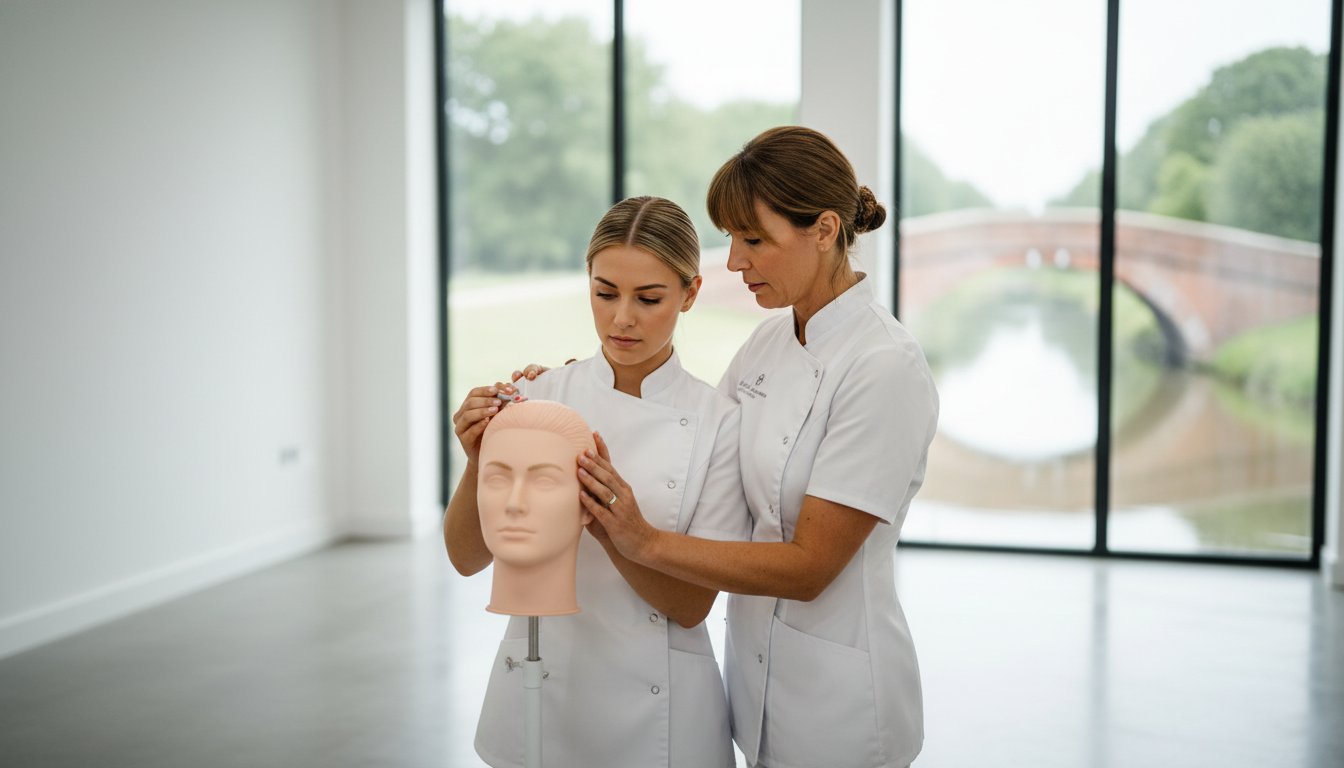
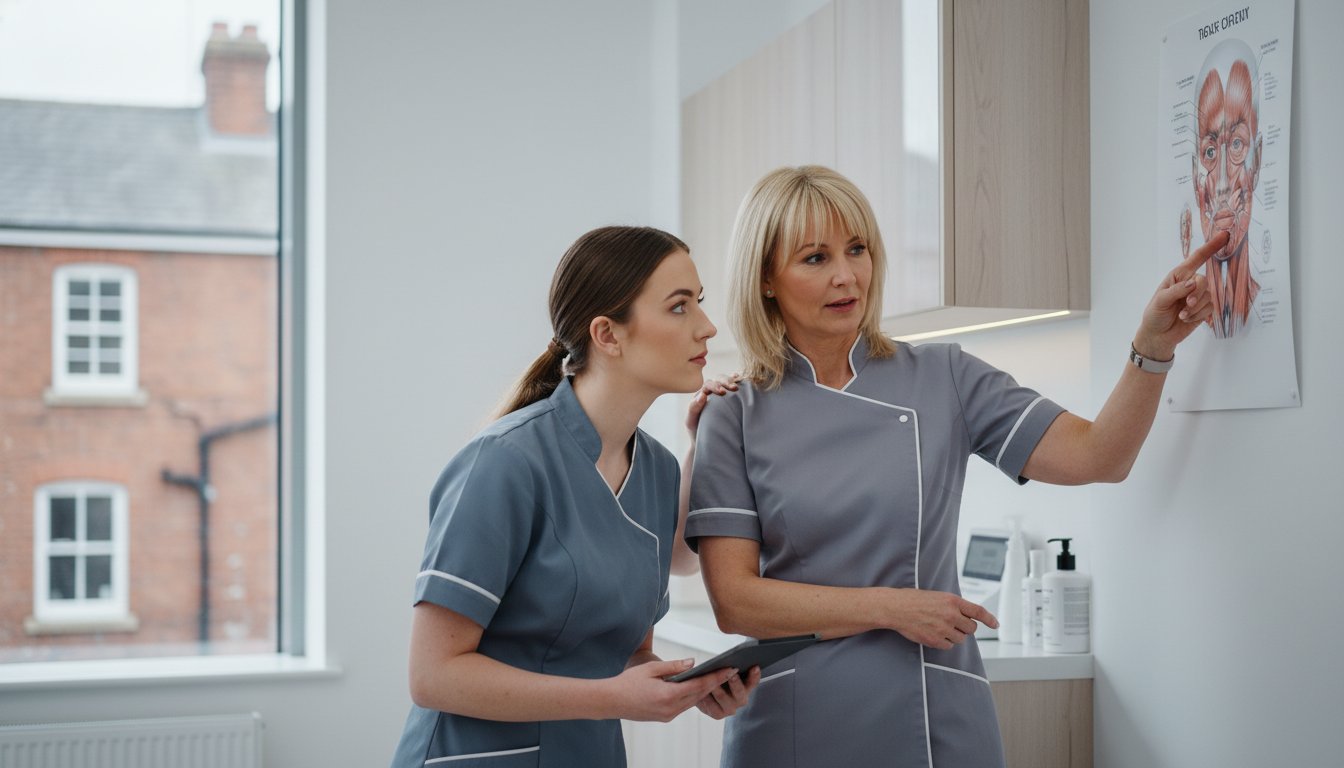
What if the £2,500 “fast-track” certificate you’re eyeing is actually a one-way ticket to a professional dead end as we approach the 2026 licensing changes? It’s a question many aspiring practitioners are asking as the UK government moves toward stricter oversight of the aesthetics industry. Choosing a cosmetic college isn’t just about learning to inject. It’s about securing a legacy of safety and artistic excellence in a market that’s finally demanding clinical rigour. You deserve to feel confident, not just capable.
You’ve likely felt the overwhelming confusion of choosing between a weekend CPD course and a multi-year OFQUAL-regulated pathway. It’s natural to feel anxious about clinical complications or the fear of investing your savings into a qualification that might be deemed worthless by next year. This guide will clarify the gold standards of training, helping you distinguish between mere attendance certificates and the regulated qualifications that’ll define the next decade of your career. We’ll explore the essential roadmap to becoming a truly qualified practitioner, ensuring you find a mentor-led environment where science and art meet harmoniously.
Key Takeaways
- Understand the essential evolution from traditional beauty therapy to clinical aesthetics, ensuring your chosen cosmetic college aligns with the highest standards of medical precision.
- Discover why standard CPD certificates fall short and how the OFQUAL Level 4, 5, and 7 frameworks provide a future-proof foundation for your professional longevity.
- Recognise the necessity of supervised, live-model practice over virtual alternatives to master the delicate artistry and safety required for harmonious results.
- Navigate the bespoke pathways available for both medical and non-medical professionals, demystifying the transition into the aesthetics industry through structured, regulated education.
- Identify the crucial criteria for selecting a training partner that prioritises your long-term journey through expert mentorship and dedicated clinical support.
Defining the Modern Cosmetic College: More Than Just a Beauty School
The aesthetics industry has undergone a radical transformation. We’ve moved beyond the era of simple steam facials into a sophisticated world of medical-grade interventions. A modern cosmetic college represents this shift, functioning as a bridge between traditional beauty and high-level medical science. It isn’t merely a place to learn a trade; it’s an academy where clinical artistry meets rigorous safety protocols. This distinction is vital for anyone looking to build a career that’s both lucrative and ethically sound in the 2026 market.
Precision is the new luxury. While traditional beauty therapy focuses on relaxation and topical skin health, clinical aesthetics involves altering biological structures through non-surgical means. This requires a curriculum rooted in evidence-based medicine. Students are no longer just learning how to apply a product. They’re learning how to manage the human body’s response to foreign substances. It’s a journey from pampering to professional medical practice.
The Evolution of Aesthetic Education
The industry’s trajectory has shifted from basic maintenance to complex restorative procedures. In 2024, the UK government’s focus on licensing for non-surgical procedures changed the educational requirements forever. Practitioners now need a profound understanding of facial anatomy, including the 43 muscles and complex vascular networks that dictate safety during dermal filler injections. A cosmetic college is a clinical training centre focused on regulated, non-surgical injectable treatments.
- 2022 Health and Care Act: The foundation for mandatory licensing in England.
- Anatomy First: Modern training prioritises “danger zones” and vascular mapping over injection technique alone.
- Clinical Artistry: The blend of medical safety with an artistic eye for facial harmony and luminous, natural results.
Why “Beauty School” is a Misnomer for Injectables
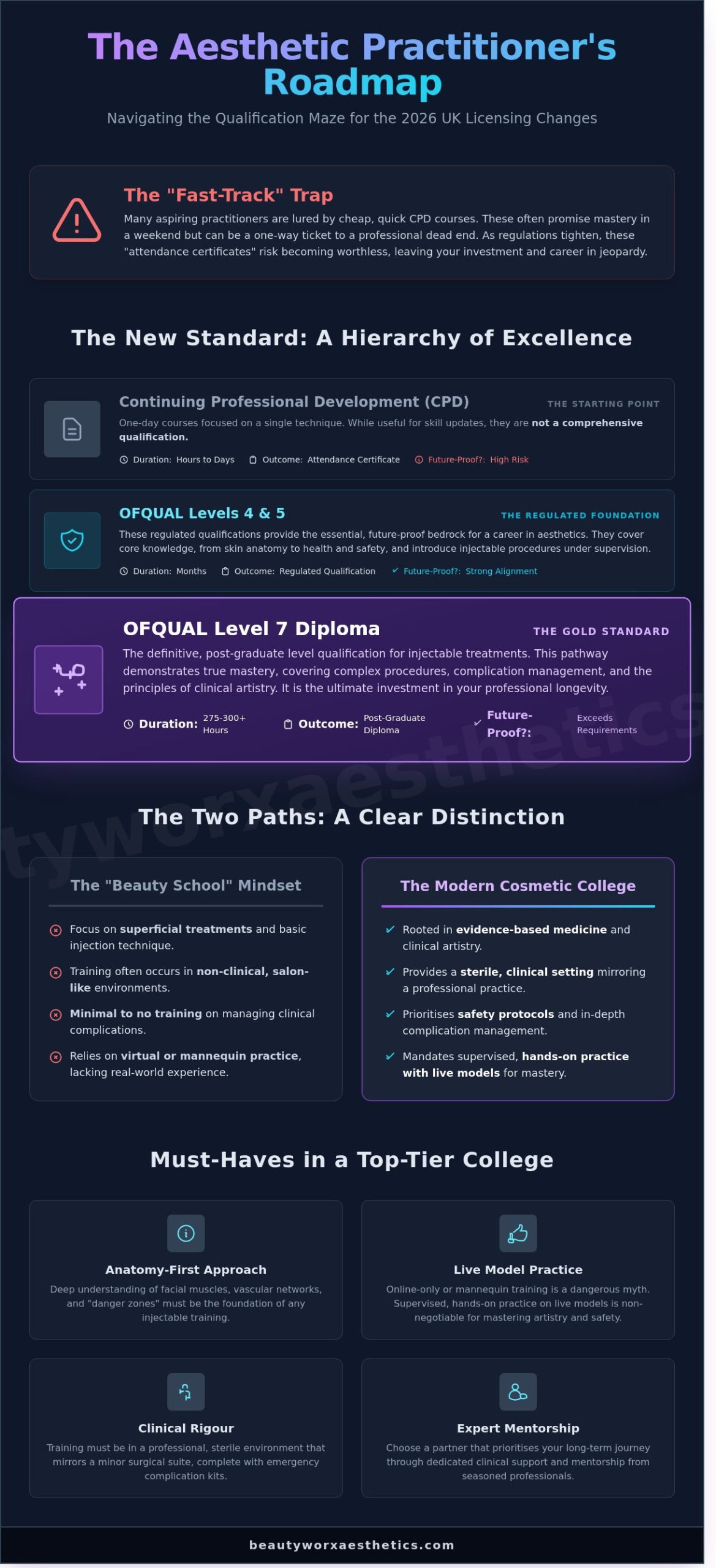
The term “beauty school” often evokes images of salons and superficial treatments. This label is dangerous when applied to the world of medical aesthetics. Injecting neurotoxins or dermal fillers requires a clinical environment that mirrors a minor surgical suite rather than a spa. The insurance implications alone highlight this gap. Professional indemnity for aesthetic practitioners, often sourced through specialist providers like Hamilton Fraser, carries significantly different requirements than standard public liability for a beauty therapist.
Training in a cosmetic college provides a sophisticated, reassuring atmosphere that prepares you for the realities of professional practice. You won’t find the necessary sterile conditions or emergency complication kits in a salon back-room. A top-tier academy ensures you’re comfortable in a medical setting, allowing you to offer a bespoke experience that makes your future clients feel safe and pampered. This professional environment is where your journey toward becoming a trusted, expert artisan truly begins.
The Qualification Hierarchy: Why CPD Isn’t Always Enough
The aesthetics industry is moving gracefully away from its “wild west” origins toward a period of rigorous clinical accountability. Many practitioners mistakenly believe a one-day Continuing Professional Development (CPD) certificate grants them “master” status. It doesn’t. True mastery requires a structured educational path that spans months, not hours. When you select a cosmetic college, you’re choosing the bedrock of your professional reputation. A single afternoon spent in a hotel conference room can’t replace the deep anatomical understanding required to deliver safe, luminous results.
Understanding OFQUAL Regulated Qualifications
The Level 7 Diploma stands as the definitive gold standard for injectable treatments in the UK. It’s a post-graduate level qualification that typically requires 275 to 300 hours of total learning. Following the Health and Care Act 2022, the government is steadily moving toward a mandatory licensing scheme for all practitioners. Regulated pathways like Levels 4, 5, and 7 align with Joint Council for Cosmetic Practitioners (JCCP) standards, ensuring your training remains valid as legislation tightens. These frameworks protect your career by proving you can manage complex complications. You can explore these regulated pathways in our Ultimate Guide to Aesthetic Courses.
The Role of CPD in Ongoing Professional Development
CPD has a vital place in your career, but it acts as a flourish rather than a foundation. It’s the perfect vehicle for mastering specific, innovative products, such as learning the precise protocols for Lemon Bottle fat dissolving. However, CPD should never replace foundational clinical training. In 2026, you must be wary of “accreditation mills” that offer cheap, unverified certificates. These often bypass the essential 1:1 clinical supervision required for patient safety. A reputable cosmetic college prioritises long-form learning over fast-track convenience to ensure every treatment is harmonious and subtle. If you’re ready to start your own bespoke aesthetic journey, understanding these tiers is your first step toward professional excellence.
- Level 4: Focuses on skin rejuvenation and chemical peels.
- Level 5: Covers deeper skin treatments and microneedling.
- Level 7: The masters-equivalent for Botox and dermal fillers.
Choosing a training provider that values these regulated steps ensures you won’t be left behind when the UK’s new licensing laws are fully enacted. It’s about the confidence that comes from knowing your skills are underpinned by national standards.
The Hands-On Reality: Why Online-Only Training is a Dangerous Myth
The digital era has birthed a surge in “Virtual Beauty Institutes” promising mastery through a screen. Since early 2024, the UK market has seen a 38% rise in these low-cost, high-speed courses that bypass the treatment room entirely. While the convenience of a laptop is tempting, aesthetics remains a tactile art form. You simply cannot feel the resistance of the dermis or the subtle “pop” of a cannula through a 4K monitor. A reputable cosmetic college understands that pixels are no substitute for the complex reality of human skin.
There’s a persistent myth that injection depth is a visual metric. It isn’t. It’s a sensory one. Relying on video tutorials to understand the difference between supraperiosteal and subcutaneous placement is a gamble with a patient’s safety. Real-world complications management, such as identifying the early blanching of a vascular occlusion within the first 60 seconds, requires physical presence. It demands the guidance of an expert who has seen thousands of faces and can guide your hand with precision.
The Importance of Supervised Clinical Practice
Mannequins don’t bruise, bleed, or possess unique vascular patterns. A high-calibre cosmetic college prioritises live models to ensure you encounter the beautiful nuances of real human tissue. Immediate feedback from a lead practitioner transforms a nervous first injection into a controlled, artistic movement. True clinical competence is forged through supervised, hands-on application on diverse facial structures. This mentorship ensures your technique is refined long before you ever treat a private client in your own practice.
Anatomy and Complications: The Non-Negotiables
Navigating the “danger zones” of the mid-face requires a 3D spatial awareness that a flat screen cannot provide. Learning in a physical, luxury-medical hybrid centre allows for peer-to-peer collaboration and direct mentorship. This environment fosters the calm confidence needed to handle adverse events with grace. Training in a space that mirrors the standards of a £500-per-hour London clinic helps you internalise the excellence your future clients will expect. It’s about the psychological shift from student to professional artisan.
- Tactile Feedback: Learn the “feel” of different tissue layers to ensure product is placed perfectly.
- Live Observation: Watch how real skin reacts to neurotoxins and fillers in real-time.
- Expert Intervention: Benefit from a mentor who can correct your grip or angle mid-procedure.
- Bespoke Guidance: Receive tailored advice on how to enhance the unique features of every individual model.
Choosing a path that avoids the clinic is a shortcut to mediocrity. To offer results that are truly harmonious and safe, you must step away from the screen and into the treatment room. Your future clients aren’t looking for a technician who watched a video; they’re looking for a specialist who has mastered the craft through experience.
Navigating the Pathway: Medical vs. Non-Medical Entry
Entry into the aesthetics industry is often misunderstood as a gated community reserved solely for the medical elite. This is a misconception. While clinical backgrounds offer a head start, the modern industry values precision, safety, and artistic vision above all else. A reputable cosmetic college serves as the bridge for both healthcare professionals and ambitious career-changers, ensuring every practitioner meets the rigorous standards required for the 2026 licensing landscape. Safety and anatomical knowledge are the great levellers here. No matter your background, the goal remains the same: achieving harmonious, natural-looking results that empower the client.
Aesthetics for Healthcare Professionals
Doctors, nurses, and dentists possess a profound understanding of patient care, yet the transition into facial aesthetics requires a shift from curative medicine to elective artistry. Pursuing a Level 7 Diploma provides medical prescribers with a Master’s-equivalent qualification, focusing on the delicate balance of facial symmetry and the science of neurotoxins. These professionals bring clinical safety into a boutique environment, ensuring that high-end luxury never compromises medical integrity. The transition is about refining existing skills to serve a client’s emotional journey toward self-confidence.
The Journey for Non-Medics
The route for non-medical practitioners is structured, demanding, and highly rewarding. It typically follows a regulated progression that ensures practitioners are both skilled and insurable. The myth that non-medics provide lesser results is easily debunked by the intensive training hours required at a leading cosmetic college. Many non-medical practitioners clock over 300 hours of supervised clinical practice before qualifying, often exceeding the aesthetic-specific training of many GPs.
- Level 3: The foundation of skin physiology and basic electrical treatments.
- Level 4: Advanced skin rejuvenation, including chemical peels and micro-needling.
- Level 5 to 7: Specialised training in injectables and dermal fillers, mirroring the depth of medical modules.
Insurability for non-medics depends entirely on following these OFQUAL-regulated pathways. By the time a student reaches advanced levels, their grasp of facial mapping and complication management is exhaustive. This meticulous approach ensures that every treatment, from a subtle lip enhancement to a liquid facelift, is performed with artistic discernment and clinical precision. It’s about the quality of the education, not just the title on the certificate.
Ready to begin your professional journey in aesthetics? Explore our bespoke training pathways at BeautyWorx Aesthetics.
Elevating Your Career: Choosing a College That Prioritises Your Journey
Selecting the right cosmetic college is a vital investment in your professional legacy. While it’s tempting to focus solely on the immediate tuition fee, the true value of your education lies in the depth of clinical mentorship and the long-term safety of your future patients. In a UK market valued at over £3.6 billion, your reputation is your most precious currency. Choosing a training provider that mirrors your commitment to excellence ensures you enter the industry with more than just a certificate; you enter with the quiet confidence of a specialist who understands both the art and the anatomy of aesthetics.
What to Look for in a Prospectus
Scrutinise the details of any curriculum before committing your capital. Personalised attention is non-negotiable; seek out a 1:3 tutor-to-student ratio to ensure every injection you perform is closely supervised and corrected in real-time. High-quality programmes must include a robust “live model” component, providing at least 8 to 10 unique patient cases to help you understand diverse facial structures. The presence of a dedicated complications management module is also essential. Data suggests that practitioners with formal emergency training, including the use of Hyaluronidase, are 75% more likely to manage adverse events effectively within their own practice. When searching for quality training, our comprehensive guide on aesthetic courses near me provides a detailed professional checklist to help you evaluate training centres and ensure your education meets the highest clinical standards.
The Beauty Worx Advantage
At Beauty Worx, we transcend the standard cosmetic college model by blending clinical rigour with an artisan’s touch. Our training modules focus on creating harmonious, natural-looking results that celebrate the individual’s unique features. You’ll learn within an active, high-end centre that delivers over 150 bespoke treatments every month, offering a realistic view of a successful clinical environment. We don’t believe in one-off transactions. Our bespoke mentorship provides a steady, supportive hand as you build your own practice, ensuring your professional journey is as luminous as the results you provide for your clients.
Your transition into the world of aesthetics should be a sophisticated evolution. By choosing a pathway that prioritises safety, artistry, and ongoing support, you’re not just starting a job; you’re embarking on a journey to become the best version of yourself as a practitioner. Reach out to our admissions team today to begin your transformation into a trusted aesthetic expert.
Elevate Your Professional Journey in 2026
The £3 billion UK aesthetics market is evolving rapidly as we approach 2026. Navigating this shift requires more than just a certificate; it demands a deep commitment to safety and anatomical precision. Selecting a cosmetic college that offers OFQUAL regulated pathways ensures your qualifications stand the test of time and upcoming licensing changes. You’ll find that the most successful practitioners are those who prioritise clinical excellence alongside a luxury patient experience.
Confidence in your clinical touch is the ultimate luxury for your future clients. At BeautyWorx Aesthetics, we support your ambition with over 25 CPD accredited and OFQUAL regulated courses. Our training is led by experts and focuses on practical mastery using live clinical models, ensuring you’re never left guessing. We provide bespoke mentorship for your long-term career growth, helping you build a reputation for subtle, harmonious results. It’s your time to step into a role that defines the future of beauty.
Explore our OFQUAL Regulated Aesthetics Qualifications
Frequently Asked Questions
Can I really become an aesthetic practitioner if I am not a doctor?
You can certainly become a successful aesthetic practitioner without a medical degree by following the regulated Ofqual Level 4 to Level 7 pathway. The 2023 Health and Care Act established a framework where non-medics who meet these specific educational standards can qualify for a practitioner licence. This route ensures you develop the clinical expertise needed to deliver luminous, safe results while building a professional foundation in the industry.
What is the difference between a Level 5 and a Level 7 qualification?
A Level 5 qualification focuses on advanced skin rejuvenation techniques such as microneedling and deep chemical peels, while Level 7 is a postgraduate-equivalent diploma specialising in injectables. The Level 7 programme involves 277 hours of total qualification time. It provides the deep anatomical knowledge required to deliver a refreshed, natural-looking result with the precision of a true artisan.
How long does it typically take to complete a regulated aesthetics programme?
A regulated aesthetics programme typically takes between 6 and 18 months to complete depending on your prior experience. This timeframe allows you to master the delicate balance of clinical science and aesthetic beauty through a mix of theory and practical sessions. You’ll move through your bespoke journey at a pace that ensures you’re confident in your ability to enhance your clients’ natural beauty.
Will I be able to get insurance after finishing my course at a cosmetic college?
You’ll certainly be able to secure comprehensive professional indemnity insurance if you graduate from a regulated cosmetic college. Leading UK providers like Hamilton Fraser or Cosmetic Insure require proof of an Ofqual-regulated certificate before issuing a policy. Holding these credentials ensures your practice is recognised as a sophisticated, professional environment where client safety is the absolute priority.
Are online aesthetics courses recognised by major insurance providers?
Major insurance providers don’t recognise 100% online aesthetics courses for injectable treatments like dermal fillers or neurotoxins. Insurers require a significant portion of your training to be conducted via face-to-face clinical supervision to ensure safety standards are met. This hands-on experience is vital for learning how to create harmonious, subtle changes that truly reflect the best version of your clients.
What happens if I encounter a complication during my training?
You’re fully protected by the college’s clinical indemnity insurance during every practical session you attend. All procedures are overseen by a clinical lead who typically has at least 5 years of aesthetic experience. This safety net allows you to focus on the artistic journey of restoration while knowing expert guidance is always available to manage any clinical concerns.
Is a cosmetic college more expensive than a standard beauty school?
A cosmetic college typically requires a higher investment than a standard beauty school; Level 7 diplomas often range from £6,000 to £9,000. This cost reflects the medical-grade environment, the use of premium products, and the high ratio of clinical educators to students. You’re investing in a sophisticated career that promises a blend of clinical authority and high-end luxury service.
Do I need to bring my own models for the practical training days?
Most elite colleges provide all the models required for your practical training days to ensure a diverse range of skin types and facial structures. At BeautyWorx, we maintain a database of over 500 clinical models to guarantee you gain experience on varied ages and concerns. This allows you to focus entirely on perfecting your technique and delivering bespoke, natural-looking results.


Related Posts










 Reviews