What if the longevity of your aesthetics practice depended entirely on a single credential you choose today? With the UK Government’s consultation on a new licensing scheme for non-surgical cosmetic procedures gathering pace since September 2023, the industry is no longer the unregulated landscape it once was. You’ve likely felt the growing anxiety surrounding these shifting mandates and the legitimate fear that yesterday’s short CPD courses won’t protect your livelihood against future crackdowns. It’s a daunting transition, but it also represents a unique opportunity to distinguish your artistry from the crowd.
Investing in a level 7 qualification is your definitive path to future-proofing your career while achieving the Master’s-equivalent prestige your expertise deserves. We’ll help you master these clinical complexities to ensure you gain insurance with ease and build a reputation for safety that resonates with a discerning, high-end clientele. This 2026 buying guide explores the nuances of regulated diplomas, helping you navigate the pathway to becoming a trusted leader in aesthetic medicine and ensuring your journey is as luminous as the results you provide.
Key Takeaways
- Understand the distinction between foundational certificates and the prestigious postgraduate Diploma to ensure your training reflects the gold standard of clinical excellence.
- Explore the essential theoretical modules, from advanced facial anatomy to complex pharmacology, that allow you to deliver safe and harmonious aesthetic results.
- Discover why a level 7 qualification is the definitive path to securing premier insurance and future-proofing your career against evolving UK regulations.
- Navigate the bespoke entry pathways for both medical professionals and beauty therapists to find your most direct route to professional mastery.
- Learn how the BeautyWorx “expert artisan” philosophy blends rigorous scientific training with artistic discernment in our state-of-the-art boutique clinical centre.
What is a Level 7 Qualification in the UK Aesthetics Industry?
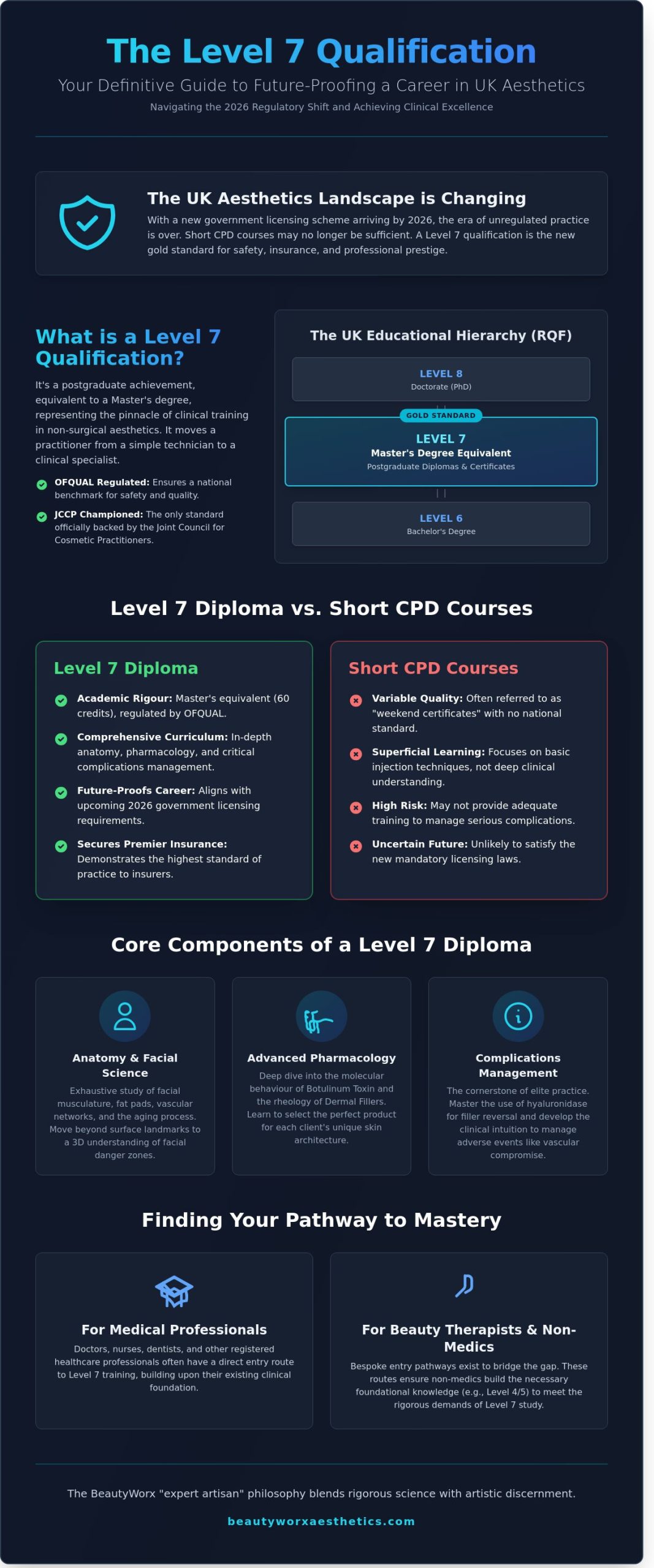
A level 7 qualification represents the pinnacle of academic and clinical training within the UK non-surgical sector. It is a post-graduate achievement that aligns with the rigour of a Master’s degree, providing practitioners with a profound depth of knowledge that transcends basic injection techniques. While many short courses offer introductory skills, the Level 7 Diploma in Clinical Aesthetic Injectable Treatments is the only standard officially championed by the Joint Council for Cosmetic Practitioners (JCCP). This distinction is vital; it moves the practitioner from a simple technician to a specialist capable of managing complex patient journeys with artistic discernment.
The Office of Qualifications and Examinations Regulation (OFQUAL) oversees these standards to ensure every graduate meets a national benchmark of safety. This regulatory oversight provides you with the peace of mind that your clinician’s expertise is verified by the highest educational authorities in England. It replaces the era of “weekend certificates” with a structured, academic path that prioritises patient welfare above all else. By choosing a practitioner with a level 7 qualification, you are investing in a professional who views aesthetic medicine as a sophisticated blend of science and art.
Understanding the Educational Hierarchy
Within the Regulated Qualifications Framework (RQF), a Level 7 sits above a Bachelor’s degree (Level 6) and just below a Doctorate (Level 8). A comprehensive level 7 qualification typically encompasses 60 credits of intensive study, covering facial anatomy and the nuances of skin physiology. This alignment ensures that your practitioner understands the biological “why” behind every needle placement, ensuring results that are as safe as they are luminous. It is a commitment to excellence that separates the expert artisan from the amateur injector.
The Shift Toward Mandatory Regulation
The UK aesthetics landscape is undergoing its most significant transformation to date. Following the Health and Care Act 2022, the government is introducing a national licensing scheme expected to be fully operational by 2026. This move aims to eliminate the risks posed by uncertified injectors. For the discerning client, “Level 7” has become the definitive shorthand for a safe, ethical practitioner. Choosing a clinician with this status ensures you are in the hands of someone who has already met the stringent standards that will soon become the legal baseline for the entire industry.
- Academic Weight: Equivalent to a Master’s degree (Level 7 RQF).
- Clinical Focus: Specialises in toxins and dermal fillers.
- Regulatory Body: Fully regulated by OFQUAL for national consistency.
- Future Proofing: Aligns with the 2026 UK government licensing requirements.
The Core Components of a Level 7 Diploma in Injectables
The level 7 qualification represents the gold standard in aesthetic medicine, moving far beyond the superficial techniques taught in traditional weekend workshops. It provides a postgraduate-level framework that aligns with the 2026 UK regulatory requirements for non-surgical cosmetic procedures. This comprehensive curriculum ensures you don’t just perform treatments; you understand the biological response behind every injection. You’ll explore advanced pharmacology, dissecting the molecular behaviour of Botulinum Toxin and the rheology of cross-linked Dermal Fillers. This scientific depth allows you to select the precise product for a client’s unique skin architecture, ensuring results are always subtle and harmonious. Complications management remains the absolute cornerstone of the curriculum. You’ll master the use of hyaluronidase for filler reversal and develop the clinical intuition to identify early signs of vascular compromise, a skill that separates elite practitioners from the rest of the market.
Anatomy and Facial Science
The curriculum demands an exhaustive study of facial musculature, deep and superficial fat pads, and complex vascular networks. While basic courses might touch on surface landmarks, a level 7 qualification requires you to visualise the face in distinct layers. You’ll learn how aging affects the underlying bone structure and how to restore volume with artistic discernment. Mastering the intricate three-dimensional mapping of facial danger zones ensures that every needle placement respects the delicate vascular architecture, effectively eliminating the risk of life-altering ischemic events.
Practical Mentorship and Portfolio Building
Clinical proficiency is built through a rigorous requirement of 40 observed and performed treatments, a standard established by Health Education England (HEE) to ensure public safety. At Beauty Worx, we organise these sessions with live models in a setting that feels like a high-end boutique rather than a sterile classroom. You’ll compile a detailed portfolio of evidence-based practice, documenting your growth through logbooks and reflective essays. As you begin your bespoke training journey, you’ll find that this depth of knowledge creates a foundation of unwavering clinical confidence. This structured mentorship ensures your transition into the industry is seamless, professional, and grounded in medical excellence. By the time you complete your portfolio, you’ll possess the quiet confidence of a specialist who views aesthetic medicine as both a science and an art form.
Level 7 vs. CPD: Choosing the Right Path for Your Career
Choosing your training path is the most defining moment of your professional journey. While the allure of a two-day “fast-track” course is understandable, these brief encounters often fail the rigorous safety tests required for long-term clinical success. True mastery isn’t found in a weekend; it’s cultivated through the evidence-based framework of a level 7 qualification. This postgraduate-level journey ensures you aren’t just injecting, but instead, you’re artistically restoring facial harmony with a deep understanding of anatomy.
Top-tier insurers, such as Hamilton Fraser and Cosmetic Insure, increasingly favour practitioners with regulated qualifications. They recognise that a practitioner who has completed 275 hours of learning is a significantly lower risk than one who has only attended a weekend seminar. This preference translates into more comprehensive coverage and lower annual premiums. Investing in a diploma is a strategic move for your long-term ROI. While the initial cost is higher, it pales in comparison to the potential legal fees or reputational damage caused by a single complication that a CPD-only course didn’t prepare you to manage.
Clients are becoming more discerning and often look for clinical credentials before booking. Holding a level 7 qualification allows you to command premium rates. It signals to your patients that they’re in the hands of an expert artisan who prioritises their safety and emotional well-being. This trust is the foundation of a loyal patient base and a thriving, high-end practice.
The Reality of CPD Accreditation
CPD, or Continuing Professional Development, is designed to update existing skills rather than provide foundational clinical training. In the current market, a CPD certificate is often viewed as the bare minimum. As the UK government moves toward stricter oversight, these certificates may not meet the mandatory education blocks required for the upcoming licensing scheme. The industry is shifting its gaze toward the “Gold Standard” of Ofqual-regulated training, leaving the “minimum requirement” path behind.
Future-Proofing Your Aesthetics Business
The Health and Care Act 2022 has already set the stage for a mandatory licensing scheme in England and Wales, expected to be fully operational by 2026 or 2027. By achieving a regulated qualification now, you protect your right to practice before the window of opportunity narrows. It’s about securing your future in a landscape that will soon demand formal proof of competence. For a deeper look at your options, explore The Ultimate Guide to Aesthetics Training Courses to align your education with your career aspirations.
Entry Requirements and the Pathway for Non-Medics
The journey towards achieving a level 7 qualification is as much about professional evolution as it is about academic achievement. For registered healthcare professionals, including doctors, nurses, and dentists, the entry route is typically direct. This acknowledges their existing clinical foundations and professional accountability. However, for dedicated beauty therapists, the path is a structured, intentional ascent that ensures safety and excellence at every stage of the process.
Transitioning into aesthetics isn’t just a career move; it’s a profound shift in professional identity. You aren’t just learning to inject; you’re developing the clinical judgment of an expert artisan. This path requires a commitment to the “bespoke” nature of patient care, where every treatment is a harmonious blend of science and art.
The Non-Medic Progression Route
Beauty therapists must build a robust portfolio before reaching the Level 7 threshold. This begins with a Level 4 qualification in skin needling or chemical peels, providing a foundational understanding of skin physiology. The subsequent step is the Level 5 Certificate in Aesthetic Practice. This acts as a vital bridge, introducing more complex clinical protocols and deeper anatomical studies. You can find a detailed breakdown in our guide on how to become a professional aesthetic practitioner.
This transition is an emotional metamorphosis. You’re moving from the world of holistic beauty into the precise, high-stakes realm of a clinical aesthetic practitioner. It requires a shift in mindset where patient safety and natural-looking results take precedence over simple service delivery. It’s about becoming a trusted, expert guide for your clients.
Assessing Your Readiness
The level 7 qualification sits at a Master’s degree level on the Regulated Qualifications Framework. You’ll need to demonstrate advanced academic writing skills and a capacity for critical analysis. It’s not just about the technical skill; it’s about the evidence-based rationale behind every clinical decision. Consider these factors before enrolling:
- Academic Commitment: Expect to dedicate 10 to 15 hours per week to self-directed study and assignment writing.
- Financial Investment: View the tuition fees as a long-term business asset rather than a simple expense. 2024 industry data suggests that practitioners holding a Level 7 see a 35% increase in client retention due to enhanced trust.
- Regulation: Ensure your awarding body is OFQUAL-regulated. This is crucial for future-proofing your career against the UK government’s upcoming licensing schemes.
Balancing this diploma with a full-time career is a challenge that requires meticulous planning. Most students complete the programme within 12 to 18 months. This pace allows for a steady, fluid integration of new skills, ensuring you feel confident and empowered as you move towards your new professional reality.
Why Beauty Worx is the Premier Choice for Level 7 Training
Choosing where to pursue your level 7 qualification is a pivotal decision that defines your professional trajectory. At Beauty Worx, we move beyond standard curriculum delivery to cultivate the “expert artisan.” This philosophy blends rigorous clinical science with the artistic discernment required to create harmonious, subtle enhancements. You won’t find sterile, cold classrooms here. Instead, you’ll train within our boutique clinical centre; a space designed to mirror the high-end luxury of a private practice while maintaining the highest medical standards.
Our commitment to excellence is reflected in our intimate class sizes. We limit intake to small groups, often just four practitioners per session, to ensure you receive bespoke attention from our lead educators. This intensive focus allows for real-time feedback during practical injecting sessions, ensuring your technique is flawless. Beyond the classroom, the Beauty Worx mentorship programme offers a lifelong safety net. Whether you’re six months or two years post-graduation, our experts remain available to provide clinical guidance as you navigate the complexities of running your own aesthetic business.
A Supportive Learning Environment
The transition from a traditional healthcare role into aesthetics is an emotional journey that requires more than just technical skill. We prioritise your self-confidence, helping you overcome the hesitation that often accompanies new clinical responsibilities. Our training focuses on achieving the “best version of you” for every patient, moving away from “done” looks toward refreshed, luminous results. Statistics from our 2024 graduate cohort show that 92% of our students launched their own successful clinics within six months of completion. One graduate, now a leading practitioner in Cheshire, noted that the psychological support she received was just as transformative as the clinical training itself.
The Enrolment Process
Your path to becoming a specialist is structured and transparent. We begin with a personalised consultation to assess your current experience and align your level 7 qualification with your long-term aspirations. Once your application is accepted, you’ll follow these steps:
- Initial Assessment: A deep dive into your clinical background and career objectives.
- Digital Induction: Immediate access to our theoretical modules and anatomy resources.
- Clinical Scheduling: Mapping out your hands-on training days in our boutique facility.
We’re ready to help you master the art of aesthetic medicine with precision and grace. Enrol in our Level 7 Diploma and redefine your professional future.
Secure Your Future in the Elite Tier of Aesthetic Medicine
The landscape of UK aesthetic medicine is shifting, with 2026 marking a definitive move toward mandatory clinical standards and professional oversight. Choosing a level 7 qualification ensures you aren’t just keeping pace; you’re establishing yourself as a safe, sophisticated practitioner in a market that increasingly values transparency. This diploma transcends basic CPD certificates by providing a deep, harmonious understanding of facial anatomy and injectable precision. At Beauty Worx, we bridge the gap between medical rigour and the bespoke artistry your clients desire. You’ll benefit from the mentorship of lead practitioners who bring over 10 years of clinical experience to every session. As an OFQUAL regulated and CPD accredited training centre, we provide the prestigious foundation needed to transform your career into a lifelong journey of self-confidence and professional mastery. It’s time to secure your future in an industry that rewards those who prioritise patient safety and natural-looking results.
Secure your place on our OFQUAL-regulated Level 7 Diploma today
Your transition from a practitioner to a trusted aesthetic artisan starts with a single, confident step toward clinical excellence.
Frequently Asked Questions
Is a Level 7 qualification a legal requirement for aesthetics in 2026?
The UK government’s licensing scheme, which is progressing through 2026, establishes the Level 7 qualification as the gold standard for practitioners. While the Department of Health and Social Care is still finalising specific mandates, holding this qualification ensures you meet the anticipated educational requirements for high-risk procedures like dermal fillers. It provides a secure foundation for your practice, ensuring you remain compliant as new regulations are enforced.
How long does it take to complete a Level 7 Diploma in Aesthetics?
A comprehensive Level 7 qualification typically requires between 12 and 18 months to finish. This timeframe allows you to balance your professional commitments with the mastery of 40 clinical observations and 40 supervised treatments. It’s a steady, rewarding journey that ensures you develop the refined technical skills and clinical discernment necessary to provide the safest, most harmonious results for your clients.
Can non-medics achieve a Level 7 qualification in the UK?
Most Ofqual-regulated pathways are currently reserved for registered healthcare professionals like doctors, nurses, and dentists. However, approximately 15% of training providers offer specific entry routes for aesthetic therapists who hold a regulated Level 4 qualification. You should check the specific prerequisites of your chosen academy, as many elite institutions prioritise a medical background to maintain the highest standards of clinical safety and professional integrity.
What is the difference between a Level 7 Certificate and a Level 7 Diploma?
The primary distinction lies in the depth of the curriculum, as a Diploma is a full 60-credit qualification while a Certificate involves fewer modules. The Diploma offers a more exhaustive exploration of aesthetic medicine, covering both botulinum toxins and dermal fillers across all facial zones. Choosing the Diploma reflects a deeper commitment to bespoke patient care and provides a more versatile skill set for your boutique practice.
Will a Level 7 qualification help me get cheaper aesthetics insurance?
Yes, holding this postgraduate-level qualification can reduce your professional indemnity premiums by 10% to 20% with specialist insurers like Hamilton Fraser. Insurance providers view the Level 7 as a mark of reduced clinical risk and superior expertise. This investment in your education doesn’t just enhance your artistry; it offers practical financial benefits by lowering the annual overheads required to run a safe, professional clinic.
Can I fast-track my way to a Level 7 if I have years of experience?
Experienced practitioners can often utilise Recognition of Prior Learning (RPL) to accelerate their progress through the course. This process allows you to bypass certain foundational modules by providing documented evidence of your clinical history and previous training. While you’ll still need to pass the final assessments, RPL can reduce your total study time by up to 30%, acknowledging your existing expertise while formalising your skills.
What happens if the government changes the aesthetics laws after I qualify?
The Level 7 framework was developed in alignment with JCCP and HEE standards, making it the most future-proof education currently available in the UK. If the government introduces new licensing laws in late 2026, your qualification will act as a robust shield for your professional reputation. It positions you as a highly trained specialist, ensuring your practice remains harmonious with any new safety mandates or clinical oversight requirements.
Is the Level 7 qualification recognised internationally?
While the Level 7 is a UK-regulated framework under Ofqual, its status as a postgraduate-level achievement is respected across Europe and the Commonwealth. It equates to 60 ECTS credits, which simplifies the process of transferring your skills to other regulated international markets. You should always verify the specific licensing laws of your destination country, but this qualification serves as a prestigious credential that highlights your dedication to clinical excellence.












 Reviews