Would you risk your professional reputation on a 48-hour “fast-track” certificate when the UK’s 2026 licensing mandate demands verifiable clinical excellence? For most therapists, the shift from a serene spa to a medical-grade environment feels shadowed by the Health and Care Act 2022 and the fear of investing in unrecognised training. You likely feel that your passion for skin deserves a future built on legitimacy rather than regulatory loopholes. Establishing a clear, regulated pathway to aesthetics for beauty therapists is the only way to ensure your career is both legally compliant and aesthetically exceptional.
You know that true radiance is a result of meticulous skill and scientific understanding. We promise to show you exactly how to transition from Level 3 beauty therapy to a Level 7 clinical practice with total confidence. This guide breaks down the specific OFQUAL-regulated milestones and insurance-approved qualifications you need to claim the title of Aesthetic Practitioner. We will explore the journey from foundational skin science to advanced injectables, ensuring your transition is as seamless and sophisticated as the natural-looking results you provide.
Key Takeaways
- Embark on a sophisticated journey from foundational beauty to Level 7 Clinical Aesthetics, ensuring your practice meets the highest OFQUAL-regulated standards for safety and excellence.
- Identify your ideal starting point, whether through existing qualifications or a bespoke ‘Access to Aesthetics’ route designed to bridge the gap to professional clinical practice.
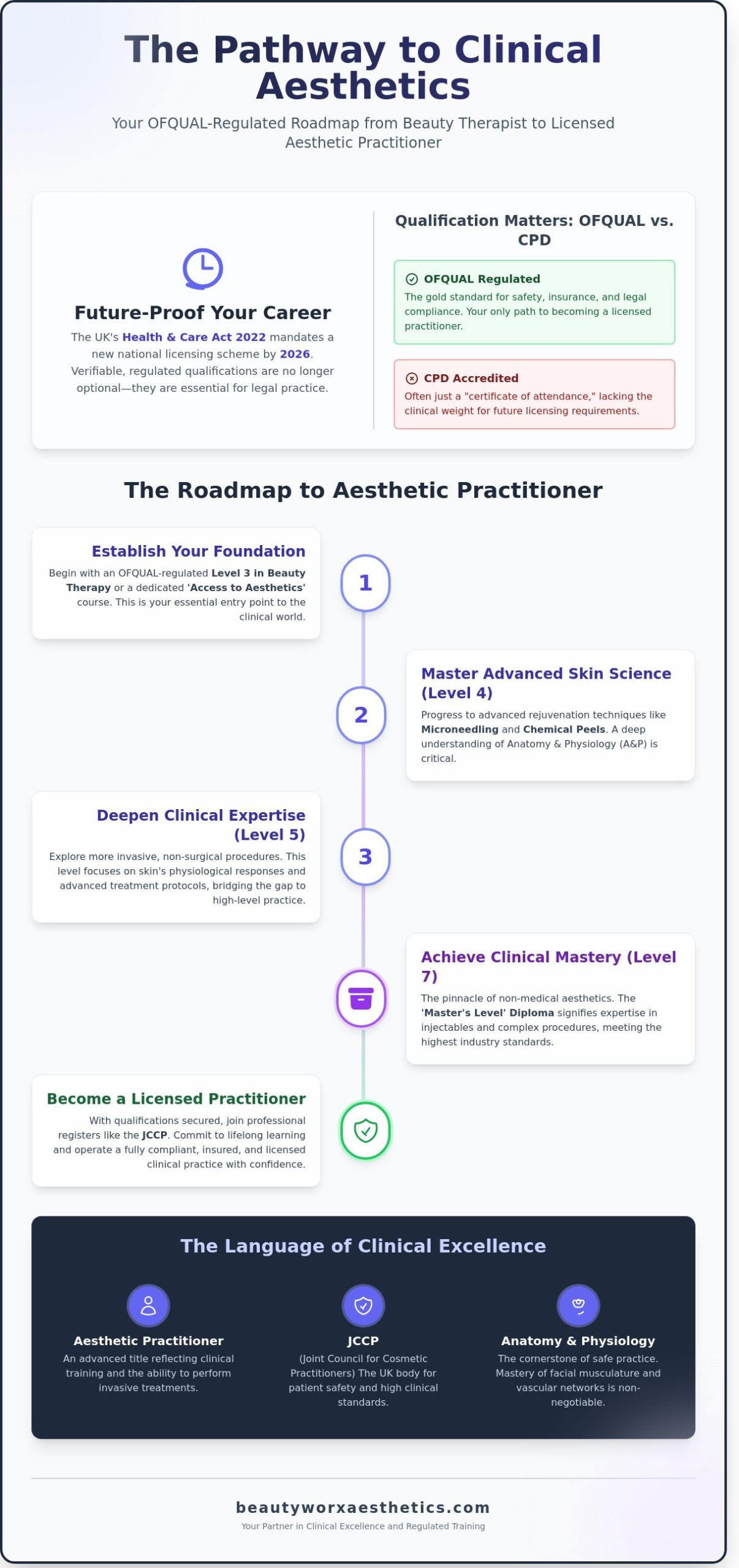
- Navigate the pathway to aesthetics for beauty therapists with a clear five-step roadmap that evolves your skillset from traditional skin treatments to advanced, medical-grade interventions.
- Recognise the importance of a boutique learning environment and expert mentorship in honing the delicate touch required for harmonious, natural-looking results.
- Future-proof your career by aligning with upcoming UK licensing requirements, moving beyond simple certificates toward the gold standard of clinical accreditation.
What is the Pathway to Aesthetics for Beauty Therapists?
The journey from a traditional salon environment to a high-end clinical setting is a transformative process. This pathway to aesthetics for beauty therapists represents a structured professional progression, typically starting at Level 3 Beauty Therapy and culminating in the prestigious Level 7 Diploma in Clinical Aesthetics. You’ll move from providing relaxing, superficial skin treatments to performing sophisticated, invasive procedures that require a deep understanding of What is Aesthetic Medicine? and its clinical implications. It’s a transition that demands a shift in mindset, moving from a service-led approach to one rooted in medical safety and anatomical precision.
The UK industry is currently undergoing a significant regulatory shift. The Department of Health and Social Care is working toward a 2026 deadline to implement a new national licensing scheme for non-surgical cosmetic procedures. This mandate will require practitioners to hold specific qualifications to obtain a license to practice. Achieving this standard isn’t just about compliance; it’s about mastering the delicate balance between artistic discernment and clinical safety. You’re not just changing a client’s appearance. You’re enhancing their natural beauty and restoring their self-confidence through meticulous, evidence-based care.
The Evolution from Beauty Therapy to Clinical Practice
The role of the ‘Aesthetician’ has matured into the ‘Aesthetic Practitioner’. This evolution marks a move away from pampering-led services toward result-driven clinical interventions. You’re already uniquely positioned for this transition. Your existing knowledge of skin histology and client care provides the perfect foundation for more complex work. It’s a move from the sensory experience of a spa to the precise, restorative power of medical-grade treatments like collagen induction and chemical peels. The goal is always a refreshed, luminous result that looks entirely natural.
Key Terminology Every Aspiring Practitioner Must Know
Understanding the language of the clinic is vital for your professional credibility. It helps you navigate the landscape with confidence.
- Aesthetic Practitioner: A title that reflects your advanced clinical training and ability to perform invasive treatments.
- JCCP (Joint Council for Cosmetic Practitioners): This body acts as a primary advocate for patient safety and maintains a register of practitioners who meet high clinical standards.
- A&P (Anatomy and Physiology): This is the cornerstone of your work. You’ll need to master the 11 body systems, specifically the facial musculature and vascular network, to perform treatments safely.
Distinguishing yourself as a professional practitioner means embracing these standards. It’s about a commitment to a lifelong journey of learning. You’ll move beyond the basics, ensuring every bespoke treatment plan is as safe as it is beautiful.
Understanding the Levels: OFQUAL Regulated vs. CPD Accredited
Choosing the right educational foundation is the most critical decision you’ll make when establishing your pathway to aesthetics for beauty therapists. You’ll frequently encounter two types of certification: CPD (Continuing Professional Development) and OFQUAL regulated qualifications. While a CPD ‘certificate of attendance’ confirms you participated in a session, it doesn’t hold the same clinical weight as a regulated diploma. OFQUAL regulation acts as a seal of quality, ensuring the training provider has met rigorous national standards for assessment, depth, and safety. In a field where precision is paramount, these regulated credits are the only way to prove your technical competence to the wider medical community.
The Hierarchy of Aesthetic Qualifications
- Level 4: This stage focuses on advanced skin rejuvenation. It covers procedures like microneedling and superficial chemical peels, providing the essential anatomical knowledge required to transition from traditional beauty into clinical skin health.
- Level 5: These qualifications delve into non-surgical aesthetic procedures, offering a deeper understanding of skin science and the physiological responses to more invasive treatments.
- Level 7: Often referred to as the ‘Master’s Level’ Diploma, this is the pinnacle of aesthetic training for injectables. It requires a significant commitment, often involving over 270 hours of total qualification time, to ensure every treatment you perform is both safe and harmonious.
Why Regulation Matters for Your Professional Insurance
The UK aesthetic industry is currently undergoing its most significant transformation to date. Since the Health and Care Act 2022 was passed, the government has been working toward a mandatory licensing scheme for non-surgical cosmetic procedures. It’s expected that by 2026, practitioners without regulated qualifications will find it nearly impossible to secure professional indemnity insurance. Insurers are already tightening their criteria, often favouring those who can demonstrate a structured learning history over those who opted for ‘fast-track’ weekend courses.
Staying informed about the new government licensing rules is essential for future-proofing your business. Beyond insurance, your qualification level directly impacts your relationship with prescribers. A regulated Level 7 qualification gives a prescriber the confidence that you understand the complexities of facial anatomy and complication management. Avoiding unregulated schemes that bypass essential supervised clinical hours protects your professional reputation. You can learn more about how to begin your bespoke aesthetic journey by aligning with providers who prioritise these high standards. This meticulous approach ensures you aren’t just performing treatments, but are instead curating an experience of safety and artistic excellence for every client.
Entry Requirements: Where Do You Start?
The gold standard for beginning your pathway to aesthetics for beauty therapists remains a Level 3 NVQ or VTCT in Beauty Therapy. This qualification serves as the biological map of your future workspace. The Joint Council for Cosmetic Practitioners (JCCP) established in 2018 that a robust understanding of the skin’s structure is non-negotiable for patient safety. Without this baseline, you risk performing treatments that look artificial rather than harmonious. Mastering the canvas before applying the medium ensures every result is as subtle as it is transformative.
A solid foundation in Level 3 or 4 Anatomy and Physiology (A&P) provides the clinical confidence you need. It covers 12 essential body systems, focusing heavily on the integumentary and muscular systems. Understanding the precise location of facial nerves and arteries prevents complications. This knowledge allows you to guide clients through their journey with the quiet authority of a true specialist. Skipping this step to jump straight to needles is a career-limiting move; it lacks the artistic discernment required for high-end aesthetics.
- Level 3 Beauty Therapy: The essential prerequisite for insurance and advanced training.
- Anatomy and Physiology: A deep dive into the 43 muscles of the face.
- Skin Knowledge: Understanding wound healing and collagen induction.
The ‘Access to Aesthetics’ Route for Beginners
If you’re transitioning from a different career, the Access to Aesthetics route bridges the gap. These programmes condense essential A&P knowledge into intensive modules, typically taking 3 to 6 months to complete. It’s a bespoke fast-track that prepares novices for Level 4 study. You’ll move from basic skin science to advanced clinical applications, ensuring you’re never out of your depth when you progress to more sophisticated procedures.
The Non-Medic Pathway: Debunking the Myths
It’s entirely legal for non-medics to perform injectables in the UK. The Health and Care Act 2022 is currently shaping the future of licensing, but the core requirement remains high-quality training and clinical oversight. You must establish a partnership with a qualified prescriber for prescription-only medications like neurotoxins. Building a reputation that rivals medical colleagues requires a commitment to OFQUAL-regulated courses. This meticulous approach turns a simple procedure into a sophisticated art form, helping clients become the best version of themselves through safe, expert care.
The 5-Step Roadmap to Becoming a Qualified Aesthetic Practitioner
Your journey from a traditional therapist to a clinical expert is a deliberate progression that ensures both client safety and artistic excellence. This pathway to aesthetics for beauty therapists requires a commitment to rigorous standards; it’s about evolving your touch from relaxation to medical-grade restoration. Following a structured roadmap ensures you build the confidence needed to deliver bespoke results.
- Step 1: Secure your foundation with a Level 3 Beauty Therapy qualification or a dedicated Access to Aesthetics course to meet UK insurance requirements.
- Step 2: Progress to Level 4 Advanced Skin treatments to master tissue behaviour, wound healing, and cellular turnover.
- Step 3: Enter the world of Foundation Injectables, focusing on the precise application of neurotoxins and hyaluronic acid fillers.
- Step 4: Gain a specialist certification in Complications Management, which is the true hallmark of a safe, professional practitioner.
- Step 5: Enrol in a Level 7 Diploma, the gold standard in the UK for non-medical aesthetics, aligning with JCCP guidelines.
Phase 1: Mastering the Skin (Levels 4 and 5)
Before you ever pick up a needle, you must understand the canvas. Advanced skin treatments like chemical peels and microneedling are essential precursors to injectables. These procedures teach you how the dermis responds to controlled trauma and help you identify over 15 distinct contraindications that could affect healing. You’ll learn to read skin types with precision, ensuring every treatment leads to a refreshed, luminous glow. Mastering these levels allows you to distinguish between healthy tissue and the underlying dehydration that requires clinical intervention. It’s the vital difference between a heavy, artificial look and a bespoke, natural enhancement.
Phase 2: The Art of Injections (Foundation to Advanced)
Transitioning from topical rejuvenation to structural facial volume is a significant professional milestone. You’ll move beyond the surface to alter facial contours using dermal fillers and neurotoxins. Your Complications Management certificate is your most important asset during this phase. Data from a 2023 Save Face report indicated that 84% of patient complaints involved practitioners who lacked the training to manage adverse events. Safety is the ultimate luxury in aesthetics. You’ll build a diverse portfolio working on live models, focusing on subtle, harmonious results that respect the client’s unique anatomy. This phase transforms you into an artisan who prioritises clinical safety as much as aesthetic beauty.
Are you ready to elevate your career with expert-led training? View our accredited aesthetic training courses and start your professional transformation today.
Choosing the Right Academy: The Beauty Worx Difference
Your transition into aesthetic medicine is a significant professional evolution that demands more than a weekend workshop. Selecting the right pathway to aesthetics for beauty therapists involves finding a balance between clinical excellence and the luxury standards your clients expect. At Beauty Worx Aesthetics, we’ve replaced the traditional, crowded classroom with a boutique clinical environment. This setting mirrors the high-end space you’ll eventually operate in, ensuring your training feels like a natural extension of your professional life rather than a sterile academic exercise.
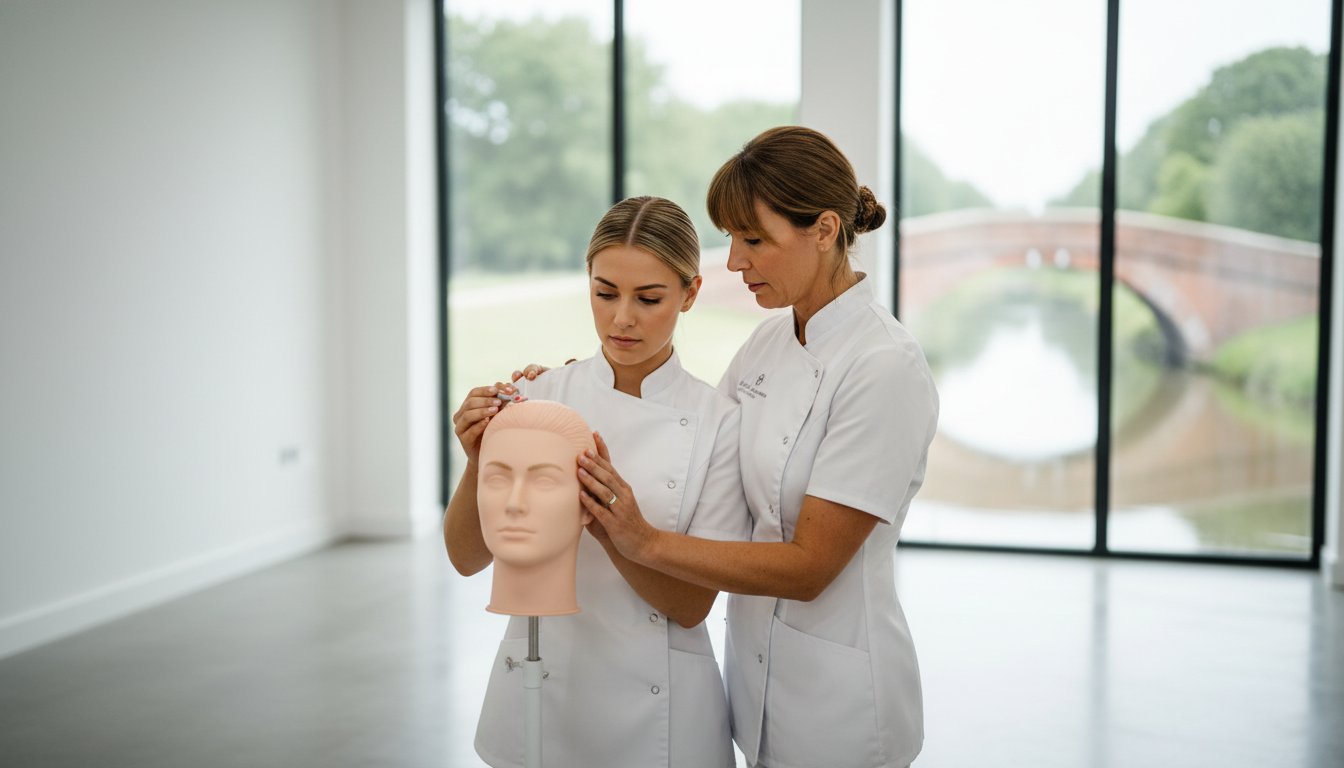
Mentorship serves as the foundation of your new career. While many providers offer a standard two-day course, we recognise that true mastery takes time and guided reflection. A short course might teach you the mechanics of an injection, but it won’t teach you how to manage complex facial disharmony or build the confidence to handle rare complications. Our approach bridges the gap between traditional beauty rituals and clinical precision, treating every procedure as both a scientific necessity and an artistic endeavour. You’ll train on a minimum of six live models in our supervised facility, ensuring you’ve refined your technique under the watchful eye of an expert artisan before you treat your first solo client.
Bespoke Learning for the Ambitious Therapist
- Intimate Class Sizes: We maintain a strict 1:1 or 2:1 student-to-tutor ratio during practical injection days to ensure your hand is guided with absolute precision.
- Digital Theory Portal: Access over 40 hours of comprehensive online modules, allowing you to master anatomy and physiology at your own pace before arriving for clinical practice.
- Professional Community: You’ll join a network of practitioners who share your commitment to subtle, harmonious results and ethical practice.
Your Journey to Becoming the ‘Best Version’ of a Professional
Success in aesthetics isn’t just about technical skill; it’s about how you frame your new expertise to your existing community. We view your career as a long-term partnership in helping clients age gracefully. When you return to your clinic, you aren’t just a therapist; you’re a specialist capable of delivering luminous, natural-looking results that enhance a client’s inherent beauty. We provide the scripts and communication strategies you need to introduce these advanced treatments to your loyal 10-year client base with confidence and transparency. Ready to start your transition? Explore our OFQUAL Regulated Courses and take the first step toward your new professional identity.
Elevate Your Career to the Gold Standard of Aesthetics
The landscape of British beauty is shifting toward clinical precision. Navigating the pathway to aesthetics for beauty therapists requires more than just passion; it demands a commitment to accredited excellence. By 2026, the distinction between standard treatments and advanced clinical practice will be defined by OFQUAL Regulated Level 4, 5, and 7 qualifications. These credentials ensure you’re prepared for the rigorous standards of the UK market and the expectations of a more discerning clientele.
Success isn’t just about technical skill. It’s about the artistry of natural-looking results. Whether you’re exploring our suite of over 25 CPD accredited specialist courses or pursuing a full regulated diploma, your training should be as bespoke as the treatments you’ll provide. We focus on refined, subtle enhancements that empower your clients to feel like the best version of themselves. Our expert-led training prioritises safety and artistic discernment, helping you bridge the gap between beauty and medicine with quiet confidence.
Begin your bespoke pathway to aesthetics with Beauty Worx
Your evolution into a trusted aesthetic artisan starts today. We’re here to guide you through every step of this rewarding professional journey.
Frequently Asked Questions
Can a beauty therapist do a Level 7 aesthetics course?
Yes, beauty therapists can enrol in a Level 7 aesthetics course if they hold a Level 3 Beauty Therapy qualification and complete the necessary bridge units. This postgraduate-level qualification follows the standards set by the JCCP in 2016 to ensure clinical excellence. It provides a formal pathway to aesthetics for beauty therapists, allowing you to master advanced injectables with academic rigour. You’ll typically progress through Levels 4, 5, and 6 to build the foundational knowledge required for this master-level achievement.
What is the fastest way for a non-medic to get into aesthetics?
The fastest route for a non-medic is an “Access to Aesthetics” fast-track programme, which usually takes 6 to 9 months to complete. These intensive courses combine Level 3 Anatomy and Physiology with foundational training in anti-wrinkle injections and dermal fillers. While speed is attractive, your reputation relies on the safety and precision of your work. Most practitioners find this 40-week investment provides the necessary confidence to launch a boutique clinic. It’s a focused journey toward professional independence.
Do I need a Level 3 in Beauty Therapy to start aesthetics training?
You generally need a Level 3 Beauty Therapy qualification or an equivalent science-based background to begin your training journey. Most UK insurance providers, such as Hamilton Fraser or Cosmetic Insure, require this prerequisite before they’ll offer indemnity cover for injectable treatments. If you don’t have this, a 12-week Level 3 Anatomy and Physiology course serves as a vital bridge. This ensures you understand the complex facial structures before starting your pathway to aesthetics for beauty therapists. It’s the essential first step in your professional evolution.
Is a CPD certificate enough to get insurance for fillers in the UK?
A standalone CPD certificate is often insufficient for non-medics to secure insurance for dermal fillers in the current UK market. Since the Department of Health and Social Care began its licensing consultation in September 2023, insurers have shifted toward demanding Ofqual-regulated qualifications like a Level 4 or 5. You’ll need a robust portfolio of evidence to prove your clinical competence to premium providers. This ensures your practice remains both prestigious and protected. Relying on basic certificates can leave your business vulnerable to shifting regulations.
How much can a beauty therapist earn after moving into aesthetics?
A beauty therapist moving into aesthetics can expect to earn between £40,000 and £75,000 in their first two years of full-time practice. While a standard facial might command £50, a single dermal filler treatment often starts at £200 for 45 minutes of work. Highly skilled practitioners in cities like London or Manchester can generate over £100,000 annually by offering bespoke treatment plans. Your income reflects your artistry and the premium nature of the results you provide. It’s a lucrative transition that rewards your dedication.
What happens if I have a complication and I’m not a nurse or doctor?
You must have a pre-arranged emergency protocol and a formal relationship with a clinical prescriber to manage complications like vascular occlusions. Non-medics should join professional support networks like the ACE Group, which provides 24/7 emergency advice and clinical guidance. You’ll need immediate access to Hyaluronidase, a prescription-only medicine used to dissolve fillers in an emergency. Safety is the foundation of a luxury service. Being prepared ensures your clients feel secure as they embark on their aesthetic journey with you.
Will the new UK licensing laws stop beauty therapists from injecting?
The new UK licensing laws, introduced via the Health and Care Act 2022, won’t stop beauty therapists from injecting but will mandate stricter training and premises standards. This upcoming scheme will likely categorise procedures using a “traffic light” system to determine the required level of supervision. Practitioners who hold regulated Level 4 to 7 qualifications will be best positioned to meet these 2025 requirements. It’s a positive shift toward a more professional, transparent industry. Your expertise will be formally recognised and celebrated.
How do I find a prescriber for my aesthetics clinic?
You can find a prescriber through specialist networking platforms like Aesthetic Associates or by connecting with local nurses and doctors through pharmacy databases. Major suppliers like Church Pharmacy or Med-fx often facilitate these professional introductions for their account holders. You’ll typically pay a consultation fee, ranging from £30 to £50 per patient, for prescription-only medicines like neurotoxins. This partnership is a cornerstone of your clinical practice. It ensures every treatment is delivered with the highest level of medical oversight and integrity.


Related Posts








 Reviews