What if the secret to a truly refreshed appearance lies not in what you freeze, but in what you carefully preserve? While many practitioners feel confined to the traditional three-area foundation, the modern patient seeks a more holistic, sophisticated approach to facial harmony. You likely understand the frustration of seeing a “frozen” result when you were aiming for vitality, or perhaps you feel a lingering hesitation when considering off-label regions. Mastering advanced botulinum toxin techniques is the essential evolution from treating individual lines to sculpting the entire face with the precision of a true artisan.
This guide empowers you to bridge the gap between basic injections and the Level 7 standard of clinical excellence. You’ll discover how to navigate the latest 2026 advancements, including the clinical application of newly available toxins like Letybo and the rapid onset of Relfydess. We will detail the protocols for full-face rejuvenation, from masseter softening to the Nefertiti lift, ensuring you can deliver the subtle, natural results that define high-end aesthetic practice. It’s time to elevate your craft and provide the bespoke, restorative care your clients deserve.
Key Takeaways
- Move beyond basic three-area treatments to embrace a holistic approach that views the face as a single, interconnected canvas of vitality.
- Master advanced botulinum toxin techniques to refine the jawline and neck, utilizing specialized protocols like the Nefertiti lift for a contoured, youthful silhouette.
- Gain a deeper understanding of facial muscle dynamics to safely perform off-label procedures that provide the subtle, natural-looking results high-end clients demand.
- Explore the nuances of micro-dosing and dilution strategies to improve skin texture and offer preventative care without sacrificing natural expression.
- Learn how to elevate your professional standing in response to 2026 regulations by pursuing recognized clinical qualifications and Level 7 standards of excellence.
What Defines Advanced Botulinum Toxin Techniques in 2026?
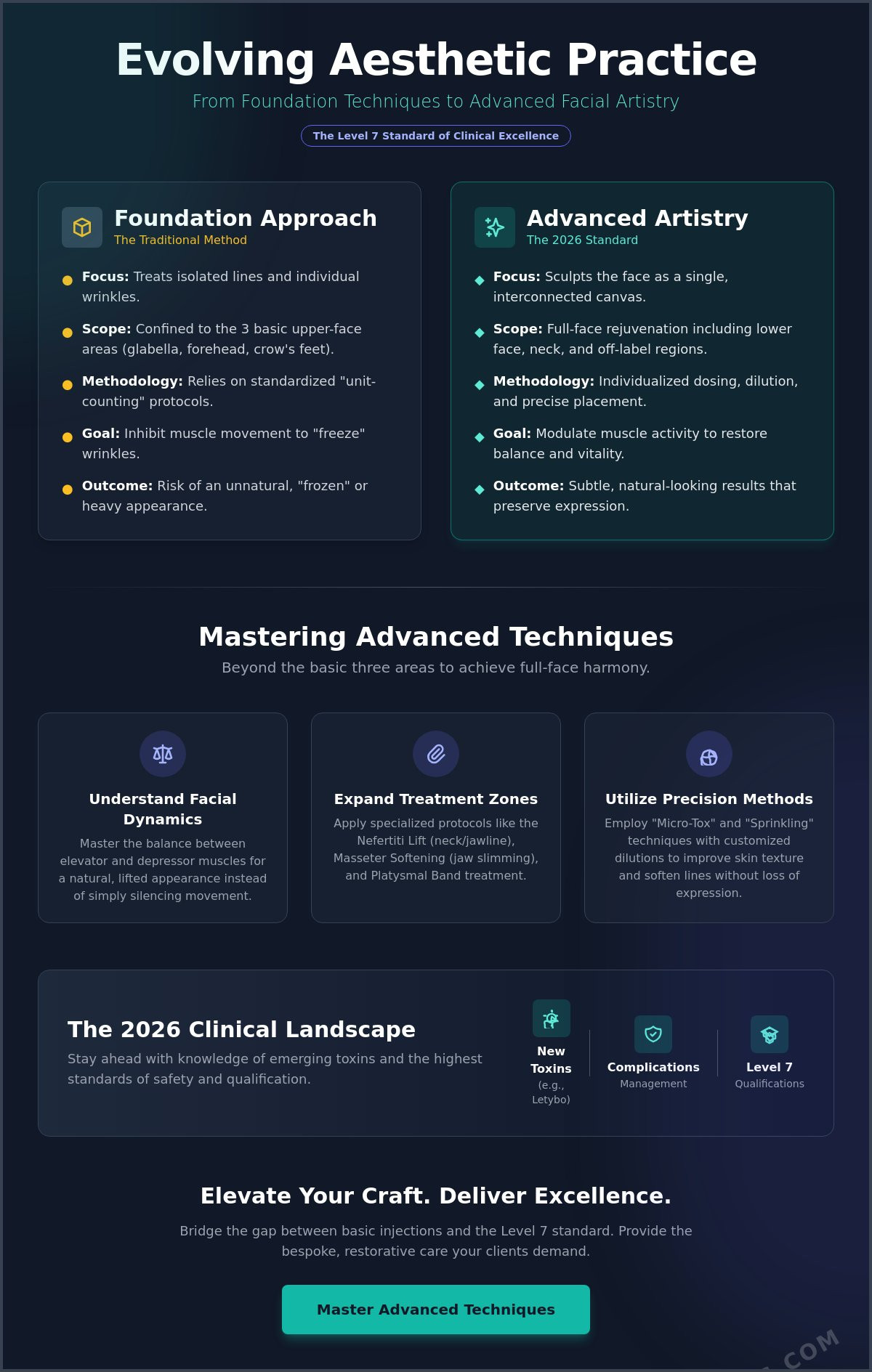
The transition from a foundation practitioner to a master of facial artistry is marked by a profound shift in perspective. While basic treatments focus on isolated muscle groups in the upper face, advanced botulinum toxin techniques require a comprehensive understanding of the face as a dynamic, interconnected system. In 2026, the industry has moved away from the binary concept of “frozen” versus “wrinkled.” We now prioritize the restoration of balance and the enhancement of natural features through strategic, purposeful placement. This clinical evolution demands that we look past the surface to understand how every injection influences the delicate tug-of-war between facial elevators and depressors.
Modern standards emphasize individualized dosing over the outdated, standardized “unit-counting” protocols of the past. A thorough Botulinum Toxin Overview reveals that while the core mechanism of neuro-modulation remains consistent, the artistry lies in the practitioner’s ability to adjust dilution and depth for each unique patient. We no longer simply inhibit muscle movement; we modulate it to achieve a look that is both rested and authentic. This level of discernment is what separates a clinical technician from an expert artisan.
The Evolution of Neurotoxin Application
The aesthetic landscape has undergone a beautiful transformation. The heavy, immobile foreheads that once defined the industry have been replaced by “micro-tox” and “sprinkling” trends that favor subtlety. These methods involve placing smaller, more frequent doses to soften lines while preserving the patient’s ability to communicate emotion. We are also seeing a significant expansion into the lower face and neck. Treating the masseters for jaw slimming or the platysmal bands for a lifted silhouette represents the new frontier of advanced botulinum toxin techniques. It is a pursuit of vitality rather than an attempt to stop time entirely. Precision matters.
Foundation vs. Advanced: A Clinical Comparison
The transition from foundation to advanced practice is fundamentally a move from the treatment of isolated lines to the integration of full-face harmony. Foundation work typically stays within the safe zones of the glabella, forehead, and crow’s feet, using standard depths. Advanced work, however, requires precise control over product spread and a deep knowledge of varying injection depths to target specific muscle fibers. Because these procedures often involve off-label areas with higher vascularity or proximity to critical nerves, practitioners must ensure their skills are backed by a robust complications management course. Safety and artistry are two sides of the same coin.
The Anatomy of Artistry: Beyond the Basic Three Areas
True facial artistry requires seeing the face as a delicate equilibrium of opposing forces. Every movement is a result of the constant tug-of-war between elevator muscles, which pull the features upward, and depressor muscles, which draw them down. When we apply advanced botulinum toxin techniques, we aren’t just silencing a muscle; we’re tipping the scales of this balance to create a more harmonious, lifted appearance. This nuanced approach allows for a bespoke transformation that respects the patient’s unique facial architecture and ethnic variations, moving away from the “one-size-fits-all” injection patterns of the past.
Upper Face Refinements
A sophisticated brow lift is more than a simple injection. It involves a strategic release of the lateral orbicularis oculi to allow the frontalis to lift the brow’s tail, or a medial adjustment to create a more open, refreshed gaze. Precision is paramount here. An incorrect placement in the frontalis can lead to the lateral fibers overcompensating, resulting in the unnatural “Spock brow.” Conversely, addressing the “jelly roll”—the hypertrophic lower eyelid muscle—requires an exceptionally light touch to avoid interfering with the eye’s natural drainage. According to clinical research on Advanced Botulinum Toxin Techniques, mastering these anatomical nuances is what ensures predictable, elegant outcomes.
The Mid-Face and Nasal Region
Moving into the mid-face, we address the often-overlooked “bunny lines” caused by the nasalis muscle. Treating these with precision prevents compensatory wrinkling in the surrounding areas, maintaining a smooth transition across the bridge of the nose. For patients concerned with a “gummy smile,” we target the Levator Labii Superioris Alaeque Nasi (LLSAN) muscle group. This subtle relaxation allows the upper lip to rest more gracefully, showing less of the gingival tissue. We can also achieve a non-surgical nasal tip lift by relaxing the depressor septi nasi, which prevents the nose from dipping during speech or smiling.
This mid-face balance is particularly effective when used to complement lip augmentation filler treatments. By performing a “lip flip”—relaxing the orbicularis oris—we can gently evert the vermillion border to reveal more of the lip’s natural pink tissue. It creates the illusion of volume while maintaining an authentic pout. This integrated approach ensures that the enhancement feels like a natural extension of the patient’s own beauty, rather than an obvious addition. It is this level of detail that defines the modern practitioner’s journey toward clinical excellence.
Lower Face Rejuvenation: Advanced Protocols for the Jawline and Neck
True full-face artistry is often defined by the practitioner’s ability to refine the lower third of the face, an area where subtle adjustments yield the most profound impact on a patient’s profile. While foundational training focuses on the upper face, advanced botulinum toxin techniques allow us to address the dynamic pull of the lower muscles, restoring a sense of structure and elegance. This shift requires a meticulous understanding of the depressor muscles, which, when left unchecked, can lead to a heavy jawline or a perpetually downturned mouth. By strategically relaxing these areas, we don’t just soften lines; we lift the entire aesthetic narrative of the face.
The transition to lower face work demands a heightened level of clinical discernment. We focus on three primary goals: refining the jawline, smoothing the chin, and lifting the oral commissures. Addressing the Depressor Anguli Oris (DAO) muscle, for instance, allows the corners of the mouth to rest in a more neutral, pleasant position. Similarly, treating the mentalis muscle eliminates the “orange peel” texture on the chin, creating a smoother, more refined silhouette that complements the patient’s natural features. It’s a process of subtraction that adds significant vitality to the overall appearance.
Sculpting the Jawline and Masseters
Masseter reduction has become a cornerstone of lower face contouring, offering both aesthetic slimming and functional relief for those suffering from bruxism. Success in this area depends on identifying the “safe zone” to avoid the risorius muscle, which controls the lateral pull of the smile. Staying posterior to the anterior border of the masseter ensures that the patient’s smile remains authentic and unaffected. Practitioners must also consider long-term dosing; while muscle atrophy provides the desired slimming effect, consistent high-dose treatments require monitoring for potential localized changes in mandibular bone density over several years. A tailored approach is always the safest path.
Neck Rejuvenation and the Nefertiti Protocol
The Nefertiti Lift is perhaps the most celebrated application of advanced botulinum toxin techniques for the lower face. By placing precise injections along the jawline and into the vertical platysmal bands, we release the downward pull on the lower face. The result is a sharper, more defined mandibular border and a visibly smoother neck. This protocol is particularly effective for candidates with good skin elasticity who seek a non-surgical alternative to redefine their profile. Achieving this level of synergy between the jawline and the neck is essential for creating a cohesive result that integrates seamlessly with the patient’s broader facial aesthetics. It is about creating a fluid transition from the chin to the décolletage.
The Science of Precision: Dosage, Dilution, and Safety
Achieving clinical excellence requires a mastery of the fluid dynamics behind every injection. While foundation courses provide a safe starting point, advanced botulinum toxin techniques involve a sophisticated understanding of how dilution ratios and product selection dictate the final aesthetic outcome. It isn’t just about the volume of units delivered; it’s about the concentration and the resulting “halo” of effect that defines the precision of your work. This level of control allows you to navigate the face with the confidence of an expert artisan.
The debate over dilution is central to advanced practice. While a standard 2.5ml saline ratio offers predictable results for larger areas like the frontalis, hyper-concentrated dilutions, such as 1ml or 1.25ml, are often preferred for intricate work. This reduced spread is vital when targeting the Depressor Anguli Oris or performing a subtle lateral brow lift, where even a millimeter of unintended diffusion can lead to undesirable outcomes. Conversely, the rise of micro-dosing, often termed “Baby Botox,” utilizes highly diluted toxin to improve skin texture and offer preventative care. This technique targets the superficial dermis rather than the deep muscle, softening the appearance of fine lines while maintaining full facial expression.
Managing diffusion risk is particularly critical in the periorbital region, where precision acts as a safeguard against complications like ptosis. An expert practitioner knows that the most powerful tool in their kit is often the ability to say “no.” When a client’s skin laxity outweighs their muscular activity, or when a request compromises anatomical safety, maintaining professional integrity is paramount. It’s about protecting the client’s long-term journey toward self-confidence and ensuring every treatment is an ongoing partnership in self-care.
Advanced Product Selection
Practitioners must choose their tools with an eye for their unique properties. Botox is often favored for its localized precision, whereas products like Azzalure may offer a slightly wider spread, making them excellent for broader areas like the platysma. The molecular weight and the presence of complexing proteins in a toxin significantly influence its diffusion characteristics and clinical behavior within the targeted tissue. Bocouture, being a “pure” toxin without complexing proteins, offers its own set of clinical advantages in terms of reduced immunogenicity and predictable onset.
Consultation and Patient Management
The consultation is a delicate exchange of trust where expectations are aligned with clinical reality. We focus on the “art of the subtle change,” reassuring clients that the goal is enhancement, not drastic transformation. Detailed photography and documentation are non-negotiable when implementing advanced botulinum toxin techniques for full-face cases, allowing both the practitioner and the client to track the nuanced progress of a treatment plan. Before any needle is placed, we carefully assess the balance between skin laxity and muscular activity, ensuring the chosen protocol harmonizes with the patient’s natural features.
Ready to refine your clinical precision? Explore our advanced aesthetic training to master these sophisticated protocols.
Elevating Your Practice with Advanced Aesthetics Training
As we navigate the regulatory shifts of 2026, the distinction between a casual practitioner and a dedicated professional has never been clearer. Mastering advanced botulinum toxin techniques is a significant milestone, but your technical artistry must be anchored by recognized accreditation to remain viable. The industry’s move toward mandatory licensing in the UK means that simple certificates of attendance no longer provide the security your career requires. For those who view their practice as a lifelong craft, the path to clinical excellence leads directly to formal, regulated education that mirrors the high-end nature of the services provided.
The Path to Level 7 Mastery
The framework of OFQUAL-regulated qualifications provides a structured journey that ensures both practitioner safety and patient trust. Transitioning from a foundation level to a Level 7 Diploma in Aesthetics represents a commitment to the highest standards of clinical practice. This diploma is widely considered the industry gold standard. It provides the academic depth and clinical rigor required by leading insurance providers in a landscape that increasingly scrutinizes off-label applications. By following a clear progression from Level 4 through to Level 7, you build a robust foundation of knowledge that supports the complex full-face treatments discussed throughout this guide.
True mastery isn’t found in a textbook or through a screen. It’s cultivated through hands-on mentorship with live models in a controlled clinical environment. This supervised experience is where the science of dosage meets the art of placement, allowing you to read the unique nuances of each face under the guidance of an expert artisan. This level of practical immersion is essential for developing the confidence to perform sophisticated procedures safely. It’s the difference between following a map and truly knowing the terrain.
Professional Longevity in Aesthetics
Future-proofing your career involves more than just learning new injection points; it’s about positioning yourself within a premium bracket where your expertise justifies higher consultation fees and fosters deep client retention. As UK licensing requirements become more stringent, practitioners with advanced, accredited training will find themselves at a distinct advantage. You aren’t just selling a one-off treatment. You’re offering a sophisticated, long-term partnership in self-care and graceful aging. High-end clients seek the reassurance that their practitioner possesses the highest level of clinical discernment.
Offering specialized, high-ticket services allows you to increase revenue per client while delivering the transformative, natural results that modern patients demand. This expertise transforms your practice into a destination for those who value artistic discernment as much as clinical safety. Explore our Advanced Anti-Wrinkle Injection Course and start your journey to mastery to begin your evolution into a Level 7 practitioner and secure your place at the forefront of the aesthetic industry.
Sculpting the Future of Your Aesthetic Practice
Transitioning from a foundation injector to a master artisan is a journey of refining both your clinical eye and your technical precision. You’ve explored how advanced botulinum toxin techniques allow for a sophisticated balance of facial dynamics, moving beyond simple wrinkle reduction to achieve true full-face rejuvenation. By mastering the nuances of the lower face, the subtleties of the lip flip, and the precise science of dilution, you position yourself as a trusted specialist in an increasingly competitive market.
As you look toward the regulatory landscape of 2026, securing your reputation through accredited excellence is essential. We invite you to view our Advanced Aesthetics Training Courses to elevate your craft. As an OFQUAL Regulated Level 7 Training Provider, we offer CPD Accredited Advanced Masterclasses and expert mentorship from lead clinical practitioners. This is your opportunity to join an ongoing partnership in professional mastery and clinical safety. Your journey toward becoming a distinguished aesthetic artisan starts with a single, purposeful step toward excellence. We look forward to supporting your growth.
Frequently Asked Questions
What are considered advanced botulinum toxin areas?
Advanced areas include any region beyond the traditional upper face foundation of the glabella, forehead, and crow’s feet. These sophisticated treatments target the mid-face, lower face, and neck, including the masseters for jaw slimming, the platysmal bands for the Nefertiti Lift, and the Depressor Anguli Oris to lift the corners of the mouth. Precision work like the “lip flip” and nasal tip lifting also fall into this category.
Is it safe for non-medics to perform advanced toxin techniques?
Safety in aesthetics is defined by the depth of a practitioner’s clinical training and their adherence to regulated standards. In 2026, the industry emphasizes OFQUAL-regulated pathways, such as the Level 7 Diploma, to ensure all practitioners possess the anatomical knowledge required for complex procedures. It’s essential that any professional performing these treatments has a robust background in complications management and operates within a safe, clinical environment.
How long does it take to master advanced injection protocols?
Technical mastery is a gradual evolution that extends well beyond the initial classroom setting. While a dedicated masterclass provides the essential framework, most practitioners find it takes several months of consistent, supervised practice to develop the “artistic eye” needed for full-face sculpting. True competence is built through a high volume of diverse cases and an ongoing commitment to advanced clinical mentorship.
What is the difference between foundation and advanced toxin training?
Foundation training provides the essential skills to treat the upper face using standardized patterns and depths. In contrast, training in advanced botulinum toxin techniques explores the complex “tug-of-war” between facial muscles and introduces variable dilution ratios for greater precision. This advanced level shifts the focus from simply softening wrinkles to strategically contouring the face and restoring overall structural harmony.
Can advanced toxin techniques replace the need for dermal fillers?
These treatments are complementary tools rather than direct replacements for one another. While neurotoxins excel at modulating muscle movement to lift and smooth the skin, dermal fillers are necessary to restore lost volume and provide structural support. An expert practitioner often integrates both modalities into a single, bespoke treatment plan to achieve the most authentic and balanced rejuvenation results.
What are the risks of injecting in the lower face and neck?
The lower face and neck contain a high density of critical nerves and muscles that control essential functions like smiling, speaking, and swallowing. Risks include temporary asymmetry if the toxin spreads to the risorius muscle or localized weakness if placement in the platysma is too deep. These risks are minimized through meticulous anatomical knowledge and a deep understanding of product diffusion and “diffusion risk” management.
How do I choose the right advanced aesthetics course?
Select a program that prioritizes OFQUAL-regulated qualifications and offers extensive hands-on experience with live models. A high-quality course should provide a clear pathway toward a Level 7 Diploma and be led by expert clinical practitioners who can offer personalized mentorship. Ensure the curriculum is updated with 2026 standards, including the latest data on new toxins like Letybo and Relfydess.
Will I need special insurance for advanced toxin treatments?
Most insurance providers require specific proof of accredited training before they’ll extend coverage to “off-label” or advanced injection sites. It’s vital to update your indemnity policy as you integrate advanced botulinum toxin techniques into your practice. Maintaining a Level 7 standard of training often makes this process smoother, as it demonstrates a commitment to the highest tier of clinical safety and professional excellence.











 Reviews