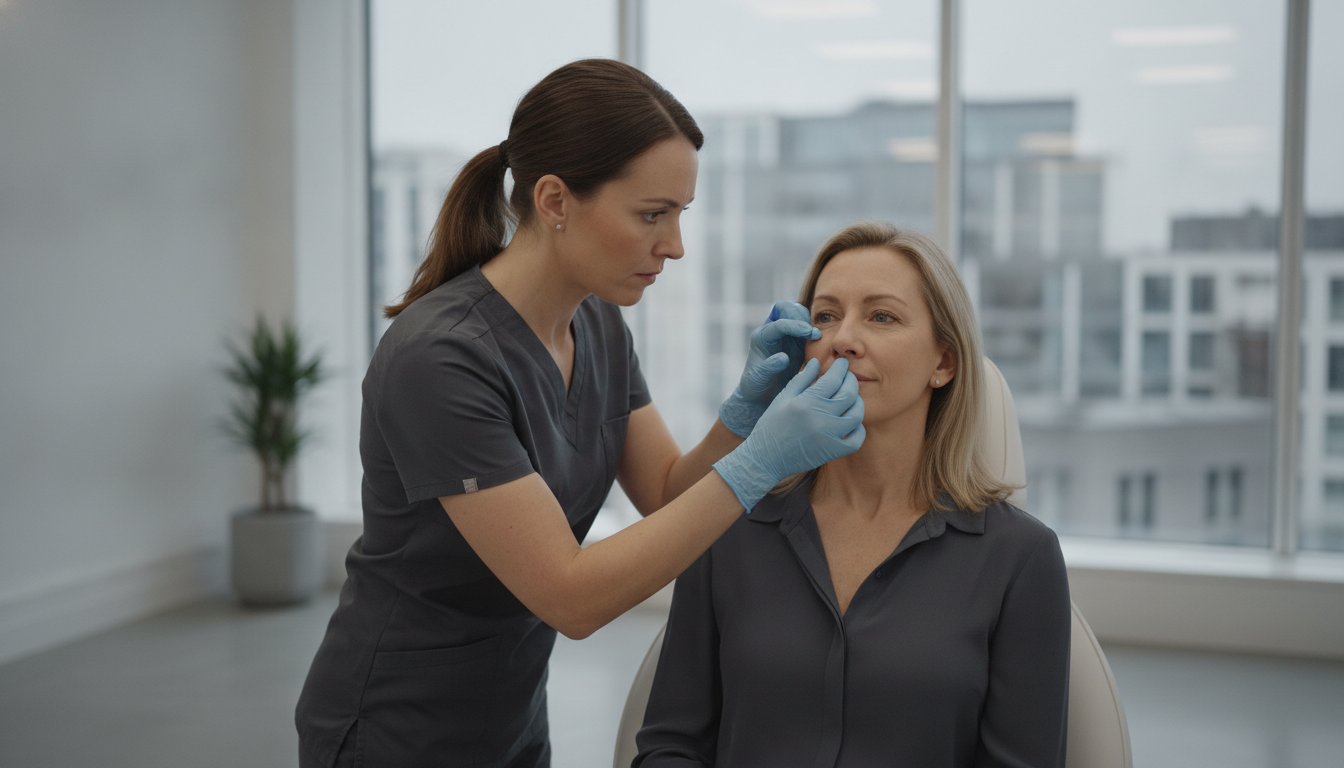

The difference between a standard filler treatment and a truly transformative structural rejuvenation isn’t just the volume of product used; it’s the precision of the architectural blueprint. Transitioning from a proficient injector to a master facial architect requires a shift in perspective that balances clinical safety with a refined aesthetic eye. If you’ve felt a flicker of anxiety when approaching high-risk zones like the temples or struggled to create a seamless, natural jawline, you’re certainly not alone. Enrolling in an advanced facial contouring course represents the pivotal step toward overcoming these technical hurdles and embracing the artistry of full-face harmonization.
We understand that managing complex, multi-syringe treatments can feel daunting, especially when you’re trying to communicate the value of such sophisticated work to your clients. This article explores how mastering advanced needle and micro-cannula techniques will empower you to deliver the subtle, authentic results your patients crave. We’ll preview the essentials of a holistic facial assessment and discuss how specialized training builds the confidence needed to navigate high-risk anatomy safely. You’ll discover how to transition from individual treatments to comprehensive package plans that reflect your expertise and elevate your clinical revenue.
Key Takeaways
- Move from treating isolated wrinkles to mastering the art of full-face structural harmonization for a more sophisticated, holistic result.
- Discover how an advanced facial contouring course provides the technical expertise to navigate complex anatomy using both micro-cannulas and traditional needles.
- Refine your clinical assessment skills by integrating the Golden Ratio to ensure every enhancement preserves the client’s unique, inherent features.
- Safeguard your practice by identifying anatomical danger zones and implementing rigorous safety protocols for high-risk facial regions.
- Identify the regulatory pathways, such as the Level 7 Diploma, that elevate your professional standing and clinical foundation in an increasingly scrutinized industry.
Defining the Art of an Advanced Facial Contouring Course
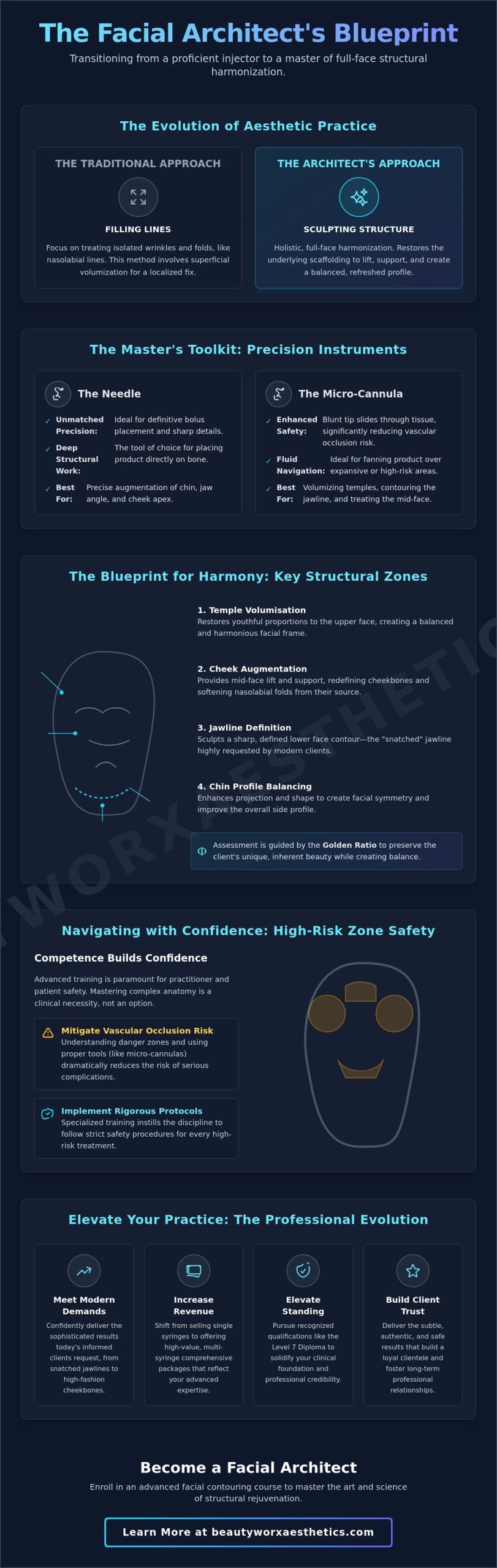
True mastery in aesthetics isn’t found in a single syringe but in the ability to perceive the face as a cohesive, three-dimensional landscape. While foundational training teaches us how to soften a specific fold, an advanced facial contouring course elevates the practitioner to the role of a structural architect. It’s a fundamental shift from treating isolated shadows to performing full-face structural harmonization. Instead of simply filling a line, you’re restoring the underlying scaffolding that defines youth and vitality. This transition requires a move away from “filling” and toward “sculpting,” where every injection is a deliberate step toward a balanced, refreshed profile.
This sophisticated approach encompasses a broad clinical scope, including cheek augmentation, jawline definition, chin profile balancing, and temple volumisation. Foundational knowledge often stops at the superficial layers, but the complex three-dimensional planes of the face require a deeper understanding of how volume in one area affects the light and shadow in another. As an artisan, your goal isn’t to create an artificial mask; it’s to use clinical expertise to restore what time has subtly diminished. This level of precision mirrors the anatomical rigor found in Plastic surgery, where the focus remains on structural integrity and aesthetic balance. You aren’t just an injector; you’re a guide helping clients navigate their journey toward self-confidence.
The Evolution of Dermal Filler Techniques
Aesthetic practice has moved far beyond the days of basic nasolabial softening or standard lip augmentation filler. Modern techniques prioritize deep-plane injections that provide genuine structural support rather than superficial volumisation. By placing product strategically on the bone or within deep fat pads, you can achieve a ‘Liquid Facelift’ effect. This method lifts sagging tissues and redefines the mid-face without the heavy, overfilled appearance that often results from less advanced approaches. It’s about sophisticated placement that respects the natural movement of the face.
Why Practitioners are Upskilling in 2026
The aesthetic landscape in 2026 is defined by a highly informed patient base. Clients no longer ask for “a bit of filler”; they request the “snatched” jawlines and high-fashion cheekbones they see in high-end editorial work. Upskilling through an advanced facial contouring course allows you to meet this demand while differentiating yourself from a saturated market of foundation-level injectors. Safety remains the ultimate driver. Understanding the intricate layers of the face is a clinical necessity that ensures you can deliver these high-impact results while maintaining the highest standards of patient care. Excellence in this field is a choice, not an accident.
Mastering the Toolkit: Precision Cannula and Needle Techniques
The transition from basic filler application to sophisticated facial sculpting requires more than just an eye for beauty; it demands technical mastery over your instruments. In an advanced facial contouring course, the focus shifts toward understanding the unique physical properties of both needles and micro-cannulas. Each tool serves a specific clinical purpose. While needles offer unmatched precision for deep, structural work, the micro-cannula has revolutionized the industry by offering a safer, more fluid way to navigate the face’s delicate landscape. Choosing the right tool isn’t just a matter of preference; it’s a calculated decision based on the target layer and the desired aesthetic outcome.
The Micro-Cannula Advantage
Blunt-tip technology has become the gold standard for treating expansive or high-risk regions. By sliding through tissues rather than cutting them, micro-cannulas significantly reduce the risk of vascular occlusion. This is particularly vital when working in the mid-face or jawline. One of the most elegant techniques you’ll refine is the ‘single entry point’ method. By creating a tiny pilot hole, you can access multiple compartments, such as the chin and the length of the jawline, from one location. This approach minimizes trauma, reduces swelling, and ensures a more comfortable experience for the client. It’s the hallmark of a refined, professional touch.
Supraperiosteal Bolus vs. Subcutaneous Fanning
Precision often requires the use of a sharp-tip needle, specifically when performing supraperiosteal bolus injections. To create a genuine lift in the cheeks or a defined chin profile, the product must be placed directly onto the bone. This deep placement provides the necessary scaffolding to support the overlying soft tissue. Conversely, subcutaneous fanning with a cannula allows for smooth transitions and the softening of harsh contours. Success lies in managing product integration. You must choose a dermal filler with the appropriate G-Prime. A high-viscosity gel is essential for bone-mimicking structure, while a softer gel ensures natural movement in the more mobile areas of the face.
Developing this level of technical discernment is a journey that separates the artist from the technician. If you’re ready to refine these skills under expert guidance, our Advanced Dermal Filler Course provides the hands-on environment needed to master these complex modalities. By understanding the ‘why’ behind every entry point, you ensure that every treatment is as safe as it is beautiful. Your ability to select the right viscosity for each facial compartment ensures results that aren’t just visible, but naturally integrated.
The Science of Symmetry: Advanced Assessment and Proportions
Achieving a result that feels both transformative and entirely natural begins long before the first entry point is made. Developing an “Aesthetic Eye” is the core focus of an advanced facial contouring course, moving beyond simple correction toward the intentional design of the face. This involves visualizing the final result by analyzing the interplay between light and shadow across the skin’s surface. By understanding how light hits the high points of the face, you can restore vitality without creating the heavy, artificial appearance that often stems from a lack of foresight. It’s about seeing the potential for balance in every unique profile.
Modern facial aesthetics relies heavily on the Golden Ratio, or Phi, to guide these enhancements. This mathematical principle of proportion helps ensure that the width of the cheeks, the length of the jaw, and the projection of the chin remain in perfect harmony. We also focus on the Ogee Curve, that gentle S-shaped sweep from the brow down to the cheekbone. Restoring this curve is the secret to high-end cheek contouring that looks youthful rather than overfilled. However, a static assessment is only half the story. You must perform a dynamic assessment, observing how the filler integrates during animation. Real faces move, and your work must maintain its grace whether the client is smiling, speaking, or at rest.
Masculinisation vs. Feminisation Techniques
Structural rejuvenation is never a one-size-fits-all approach. For those seeking masculinisation, the goal is often an “Alpha Male” jawline characterized by sharp angles, increased width at the gonial angle, and a strong, projected chin. Conversely, feminisation focuses on softening the chin profile and elevating the lateral malar fat pad to create a delicate heart-shaped face. By respecting these gender-specific bone structures, you avoid the “over-filled” look and instead preserve the client’s inherent identity. It’s about refinement, not replacement. Mastering these distinct pathways in an advanced facial contouring course allows you to tailor your artistry to the individual’s specific goals.
The Holistic Consultation Process
A successful outcome depends on managing expectations through a comprehensive, full-face approach. During the consultation, we use photographic assessment from 45-degree and 90-degree angles to map out a precise treatment plan. This allows the client to see their profile as others do, making it easier to explain why a multi-syringe treatment might be necessary for true harmonization. By communicating a “less is more” philosophy, you build a partnership based on trust and authenticity. This ensures the client feels safe and pampered, knowing their journey toward self-confidence is in expert hands. You aren’t just selling a treatment; you’re providing a knowledgeable guide for their long-term aesthetic care.
Elevating Safety: Managing Complexities in High-Risk Zones
Clinical excellence is defined as much by the complications we avoid as the beauty we create. Within the curriculum of an advanced facial contouring course, safety is treated not as a secondary concern, but as a sophisticated art form in its own right. Transitioning into full-face structural work requires an intimate, almost intuitive understanding of the face’s “Danger Zones.” The facial artery, the temporal artery, and the infraorbital nerve represent critical milestones in your anatomical map. Navigating these regions demands a blend of technical precision and unwavering clinical vigilance, ensuring that every enhancement remains as safe as it is transformative.
While micro-cannulas offer a significant safety buffer, certain structural results still require the precision of a needle. In these instances, rigorous aspiration protocols are non-negotiable. You must know exactly when and how to check for vessel entry before a single bolus is delivered. Because the stakes are higher in advanced contouring, we view a complications management course as an essential companion to your training. Having Hyaluronidase on hand is only the beginning; you must be prepared to execute the high-dose pulse protocol with the quiet confidence of an expert. Safety is the foundation of the luxury experience we provide to our clients.
Anatomy of the Temple and Mid-Face
Safe temple volumisation relies on a mastery of the “Five-Layer Model” of the face. Understanding the depth of the temporal fascia allows you to place product where it provides maximum lift without compromising the underlying vessels. Similarly, deep-plane jawline injections require a meticulous approach to avoid the facial nerve. Recognizing the early signs of vascular compromise, such as livedo reticularis or unusual blanching in distal areas, is vital. This level of anatomical discernment ensures you can push the boundaries of aesthetic rejuvenation while maintaining a pristine clinical environment.
Post-Treatment Care and Long-Term Vigilance
The client’s journey doesn’t end when they leave your chair. Educating them on “red flag” symptoms like persistent pain or skin mottling is a hallmark of professional care. Follow-up appointments are more than just a courtesy; they are essential for assessing product integration and ensuring that the symmetry you’ve achieved remains perfect as the filler settles. Under the 2026 UK licensing regulations introduced via the Health and Care Act 2022, rigorous documentation and insurance are now more critical than ever. Protecting your practice is just as important as protecting your clients. If you’re ready to master these advanced protocols, our Complications Management Course provides the ultimate peace of mind for the ambitious practitioner.
Professional Evolution: Integrating Advanced Contouring into Your Practice
The journey toward becoming a master aesthetician doesn’t end with the mastery of a cannula; it’s a continuous evolution of your professional identity. While an advanced facial contouring course provides the technical blueprint for structural rejuvenation, your long-term success depends on how you integrate these sophisticated skills into a sustainable clinical practice. It’s about moving beyond the cycle of short-term CPD workshops and embracing a pathway that reflects your commitment to excellence. By grounding your artistry in recognized qualifications, you don’t just improve your results; you elevate your entire brand in the eyes of a discerning, high-end clientele.
The Pathway to Clinical Excellence
In a landscape where regulations are becoming increasingly stringent, the value of an OFQUAL regulated aesthetics course cannot be overstated. While standard masterclasses offer a quick glimpse into specific techniques, a Level 7 Diploma provides the ultimate clinical foundation. This regulated qualification ensures you’ve met rigorous standards in both theory and practice, allowing you to build a comprehensive portfolio of live-model treatments under expert supervision. This formal recognition acts as a hallmark of safety and skill, distinguishing you from foundation-level injectors. At Beauty Worx Aesthetics, we believe the learning process is an ongoing partnership. Our mentorship ensures you have access to a community of high-level practitioners, providing support long after your initial training is complete.
Marketing Your New Skills
Attracting the luxury demographic requires a shift in how you present your services to the world. Instead of marketing “fillers” by the syringe, focus on the narrative of structural harmonization and subtle restoration. Your “Before and After” imagery should showcase the elegance of a redefined jawline or the vitality of a restored cheek contour, emphasizing the preservation of the client’s inherent features. By positioning yourself as a specialist in sophisticated rejuvenation, you move away from commodity pricing and toward high-value, bespoke treatment plans. Clients seeking a premium experience aren’t looking for the lowest price; they’re looking for the quiet confidence of an expert artisan. Pricing your expertise through bundled packages allows you to deliver holistic results while significantly increasing your revenue per client, reflecting the true value of your advanced facial contouring course.
Redefining Your Clinical Artistry
Embracing the role of a facial architect allows you to move beyond the limitations of basic treatments and offer the sophisticated, natural-looking results that modern clients demand. By mastering the delicate balance of structural support and soft tissue integration, you ensure that every profile you sculpt is both harmonious and authentic. This journey is as much about safety as it is about beauty; understanding the complex layers of the face and the nuances of high-risk zones provides the quiet confidence necessary to perform these transformative procedures with ease.
Choosing an advanced facial contouring course is a commitment to your professional evolution and the safety of your patients. As an OFQUAL Regulated Training Provider, we offer expert-led clinical mentorship and CPD Accredited Certifications designed to support your growth at every stage. We invite you to Elevate your expertise with our Advanced Dermal Filler Masterclass and join a community of practitioners dedicated to the highest standards of clinical excellence. Your transition from technician to trusted artisan starts here, and we’re honored to guide you toward a future of refined, self-assured practice.
Frequently Asked Questions
What is the difference between a foundation filler course and an advanced facial contouring course?
A foundation course typically focuses on softening isolated lines like the nasolabial folds or performing basic lip work. In contrast, an advanced facial contouring course teaches you to treat the face as a whole, focusing on structural areas like the jawline, chin, and temples. You’ll move beyond simple filling to understand deep-plane anatomy and the sophisticated interplay of light and shadow across the facial profile.
Can non-medics enrol in an advanced facial contouring course in the UK?
Non-medics can often enrol provided they meet specific entry requirements, such as a Level 4 qualification in a related field. However, the UK’s 2026 licensing scheme under the Health and Care Act 2022 emphasizes formal, accredited education. We recommend checking the Beauty Worx Aesthetics prerequisites for the Level 5 or Level 7 pathways to ensure you’re following the most secure and professional route for your career evolution.
Is it better to use a cannula or a needle for jawline and cheek contouring?
Most practitioners use a combination of both to achieve the most authentic results. A micro-cannula is often the gold standard for jawline fanning because it minimizes trauma and reduces the risk of vascular compromise in high-risk zones. Sharp needles remain essential for supraperiosteal bolus injections where you need to create a firm, structural lift directly on the bone, such as the chin or lateral cheek.
How many syringes of filler are typically used in a full facial contouring treatment?
A comprehensive facial harmonization typically requires between 4 and 8 syringes of dermal filler. While this sounds like a significant amount, the product is distributed across multiple compartments, including the cheeks, jawline, and chin, to create a subtle and balanced rejuvenation. Every treatment is highly customized, ensuring that volume is restored only where it’s clinically necessary to preserve the client’s inherent features.
What are the most common risks associated with advanced dermal filler treatments?
Common risks include temporary bruising, swelling, and minor asymmetry as the product integrates with the tissue. More serious but rare complications include vascular occlusion, where product enters a blood vessel. This is why our training emphasizes high-risk anatomy and aspiration protocols. Having a complications management plan and reversing agents like Hyaluronidase on hand is a non-negotiable standard for any advanced practitioner.
Will I receive a recognized qualification after completing the advanced contouring masterclass?
You’ll receive a CPD accredited certification upon completion, which is a recognized industry standard for professional development. For those seeking the highest level of formal recognition at Beauty Worx Aesthetics, our advanced facial contouring course can act as a component of an OFQUAL regulated Level 7 Diploma. These qualifications ensure you’re prepared for the 2026 UK licensing requirements, providing a transparent and reliable foundation for your clinical practice.
How long does a facial contouring treatment typically last for the client?
Results from a structural rejuvenation treatment typically last between 12 and 18 months. The longevity depends on the specific G-Prime of the product used and the client’s individual metabolic rate. High-viscosity fillers used for bone-mimicking structure in the jawline and cheeks tend to last longer than softer gels. We recommend periodic follow-up appointments to monitor product integration and maintain the graceful aging process.
What is the ‘Golden Ratio’ and how is it used in aesthetic training?
The Golden Ratio, or Phi (1:1.618), is a mathematical principle used to assess facial proportions and symmetry. In aesthetic training, it acts as a guide for visualizing the ideal relationship between different facial features, such as the width of the nose compared to the lips. By applying this “Aesthetic Eye,” you can ensure that enhancements remain in perfect harmony with the client’s unique bone structure, avoiding an artificial or overfilled appearance.













 Reviews