
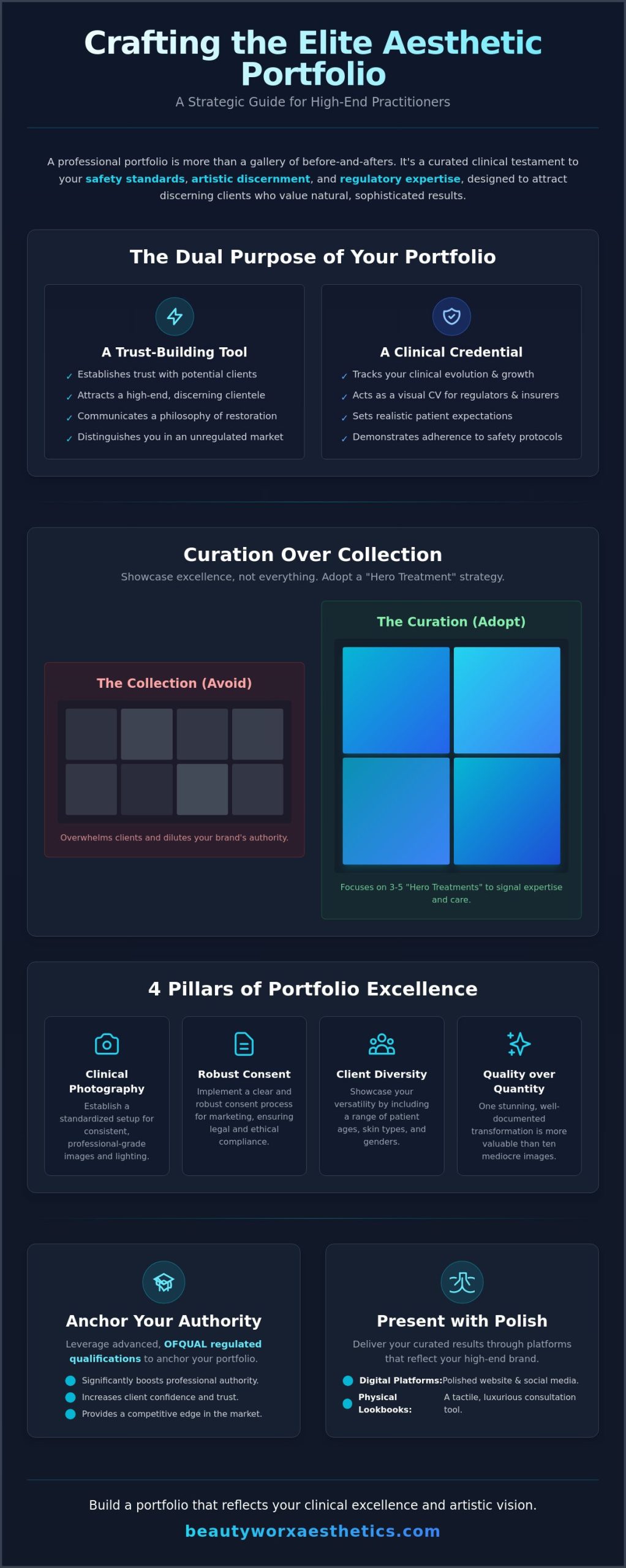
A professional aesthetic portfolio is far more than a digital gallery of before and after images; it is a curated clinical testament to your safety standards, artistic discernment, and regulatory expertise. While many practitioners feel the pressure of transitioning from student work to professional results, the true challenge often lies in balancing high-end visual appeal with the strict requirements of the Modernization of Cosmetics Regulation Act. You might feel uncertain about capturing the perfect light or navigating the nuances of patient consent for marketing, but building an aesthetic treatment portfolio that resonates with sophisticated clients is a skill that can be mastered with precision.
We understand that your work is a delicate blend of science and art. This guide will teach you how to curate a clinical portfolio that demonstrates sophisticated artistry and expert-level results while ensuring total regulatory compliance. You will learn a clear framework for documenting patient journeys legally, moving beyond simple snapshots to create a polished narrative of restoration. We will explore how to elevate your social proof through meticulous documentation, helping you attract high-end clients who value the safety and subtle, natural enhancements you provide.
Key Takeaways
- Understand the dual role of your portfolio in establishing trust and tracking clinical excellence as you transition from training to professional practice.
- Implement a “Hero Treatment” strategy to focus your brand on the specific procedures that best demonstrate your artistic discernment and technical skill.
- Establish a standardized clinical setup and a robust consent process to ensure your patient documentation meets both aesthetic and legal standards.
- Learn why building an aesthetic treatment portfolio anchored in OFQUAL regulated qualifications significantly boosts your professional authority and client confidence.
- Explore the most effective ways to present your results through polished digital platforms and tactile physical lookbooks to enhance the consultation experience.
The Strategic Purpose of an Aesthetic Treatment Portfolio
A professional portfolio serves as the definitive bridge between your initial aesthetic courses and the realization of a thriving, high-end practice. It is your most potent tool for communicating a philosophy of restoration over alteration. In a digital-first market, this collection of work is often the first interaction a potential client has with your brand. It must convey safety, precision, and artistry before a single word is spoken during a consultation. Building an aesthetic treatment portfolio allows you to move beyond being a provider of services to becoming a trusted partner in a client’s long-term journey toward self-confidence.
Your portfolio functions as a live record of your clinical evolution. It’s not just a gallery; it’s a tracking system for your technical growth and a testament to your commitment to natural-looking results. High-end clients aren’t looking for drastic changes. They’re seeking a practitioner who understands the subtle nuances of facial harmony and the preservation of their inherent features. By showcasing a consistent history of discreet enhancements, you position yourself as a specialist who prioritizes the client’s emotional well-being as much as their physical outcome.
Beyond Marketing: The Clinical Credential
Your portfolio acts as a visual CV that demonstrates your adherence to the highest standards within Aesthetic medicine. This documentation is increasingly essential for insurance providers and regulatory bodies, proving that your results are consistently safe and professionally documented. For the practitioner, it cultivates the “expert artisan” persona, reflecting a meticulous eye for detail and a deep respect for clinical protocols. Crucially, these images help set realistic patient expectations. When you can show a client a similar journey to their own, you build a foundation of transparency and trust that is vital for a successful long-term relationship.
Building Trust in an Unregulated Market
In the UK’s current regulatory environment, building an aesthetic treatment portfolio is a proactive way to distinguish yourself from less qualified practitioners. It provides a window into the person behind the needle, showing the deliberate care you take with every patient. By highlighting a specific clinical niche, such as restorative dermal fillers or precision anti-wrinkle treatments, you attract individuals who value your unique discernment. This consistency is the most effective antidote to industry stigma. It proves that your practice is built on a foundation of safety, cleanliness, and a profound understanding of human anatomy, ensuring your clients feel both pampered and protected.
Curation vs. Collection: Selecting Treatments for Your Brand
A cluttered gallery of every procedure you’ve ever performed can overwhelm a prospective client. Instead, focus on a “Hero Treatment” strategy by selecting three to five procedures that represent your highest level of artistry and technical skill. When building an aesthetic treatment portfolio, the goal is to curate a narrative of excellence rather than a mere collection of snapshots. This approach allows you to highlight your specific clinical niche, whether that involves restorative dermal fillers or precision anti-wrinkle work. By showing fewer, higher-quality results, you signal to high-end clients that your practice is defined by discernment and meticulous care.
Diversity is another hallmark of a professional portfolio. Ensure your work showcases a range of patient ages, skin types, and genders to demonstrate your versatility as a practitioner. A luxury brand thrives on the “less is more” philosophy. One stunning, well-documented transformation is worth more than ten mediocre images. This selective process helps you maintain an aspirational yet accessible brand image, where every result feels like a bespoke solution tailored to the individual’s unique features. It’s about quality, not quantity.
Highlighting Advanced Injectables
Moving beyond simple volume, your portfolio should highlight artful lip augmentation filler results that respect natural proportions and facial balance. Include profile balancing work, such as chin and jawline contouring, to demonstrate a three-dimensional understanding of facial harmony. Citing the importance of Regulated Training and Certification, your images should reflect a deep knowledge of anatomy and safety. Don’t forget to include long-term results from three to six months post-treatment. These follow-up images prove the longevity and stability of your work, providing the reassurance that sophisticated clients seek before booking.
Integrating Skin Rejuvenation and Wellness
Documenting the subtle glow of polynucleotide treatment proves your commitment to cellular-level health and skin vitality. These results often show a cumulative effect, so presenting a series of images over several sessions can be incredibly persuasive. Integrating wellness results, such as those discussed in vitamin b12 injection training, adds holistic value to your clinical brand. It frames your services as a partnership in self-care rather than a series of one-off transactions. Refining your selection is the first step toward clinical excellence. If you’re looking to master these advanced techniques, consider exploring our comprehensive aesthetic training options to elevate your future portfolio.
The Clinical Standard: Photography, Lighting, and Legal Compliance
Building an aesthetic treatment portfolio requires a level of discipline that mirrors your clinical precision. It is not enough to simply capture a well-timed snapshot; you must create a standardized record that stands up to both artistic and medical scrutiny. This process begins with a robust clinical consent process, where you clearly distinguish between images used for medical records and those intended for marketing. By securing specific permissions for social media and website use, you protect your practice while respecting the patient’s privacy journey. This transparency is the first step in establishing a professional partnership based on mutual trust.
Consistency is the hallmark of a high-end brand. You should standardize your “studio” setup by dedicating a specific area of your clinic to photography, ensuring that every before and after image is captured against a neutral, non-distracting background. Use fixed lighting to eliminate shadows that might distort the authentic texture of the skin or the placement of volume. Developing a “signature angle,” such as a specific three-quarter view that highlights jawline definition or cheek projection, becomes your brand’s hallmark. This repetition allows prospective clients to easily compare results, proving that your successes are the product of skill rather than fortunate lighting.
Technical Mastery of Aesthetic Photography
To achieve professional clarity, you must master the technical nuances of clinical imagery. Lighting is your most critical tool; it should be diffused and consistent to avoid creating artificial shadows that could be mistaken for bruising or poor product integration. Standardize your focal lengths, ideally using a 50mm or 85mm lens to prevent the facial distortion common with wide-angle smartphone cameras. Whether you use a high-end DSLR or a medical-grade photography app, the goal is an honest comparison that reflects the subtle, natural-looking results your clients expect. This level of detail affirms your status as an expert artisan who values accuracy over artifice.
GDPR and Legal Safeguards
In a regulated environment, your portfolio must be supported by a GDPR-compliant storage system that ensures patient imagery is encrypted and secure. Drafting water-tight consent forms is essential; these documents must be explicit about where the images will be displayed and for how long. You must also have a clear protocol for the “Right to be Forgotten,” allowing patients to request the removal of their images at any time. Most importantly, never use filters or excessive editing. Authentic clinical results are the only way to combat the stigma of unregulated practice and prove that your work is both safe and effective. Honesty in your imagery is the ultimate affirmation of your clinical excellence.
Leveraging Advanced Qualifications to Anchor Your Portfolio
The true weight of your clinical results is anchored in the depth of your education. While striking imagery captures the eye, your certifications provide the narrative of safety and precision that sophisticated clients demand. Integrating OFQUAL regulated training into your presentation transforms a simple gallery into a professional credential. When building an aesthetic treatment portfolio, aligning your visual results with high-level qualifications ensures that every before and after is viewed through the lens of medical-grade expertise. This synergy between education and outcome distinguishes the expert artisan from the casual practitioner, creating a foundation of trust that is essential for a high-end practice.
Your portfolio should serve as a testament to the science behind the art. By explicitly linking your results to your complications management course certification, you demonstrate a proactive commitment to patient welfare. This transparency is particularly vital in the UK’s evolving regulatory landscape, where practitioners are increasingly scrutinized on their ability to manage adverse events. Highlighting your proficiency in safety protocols proves that your work is not just beautiful, but fundamentally secure. It frames your practice as a sanctuary where clients feel both pampered and protected.
Visualising Clinical Safety
A professional portfolio should document the entire patient journey, not just the final result. Including “During Treatment” photographs allows you to showcase your sterile technique and the meticulous nature of your clinical setup. These images act as a silent affirmation of your professionalism, showing potential clients the care you take to ensure their safety. You might also include “Healing Progress” photos to educate patients on the reality of downtime. This honest approach manages expectations and positions you as a knowledgeable guide who supports the client through every stage of their transformation, from the initial consultation to the final, radiant outcome.
The Authority of the Level 7 Practitioner
Your Level 7 status represents the pinnacle of non-surgical training, and this should be reflected in how you present your work. Use your portfolio captions to explain the clinical reasoning behind your choices, moving beyond surface-level descriptions to discuss facial anatomy and product rheology. This depth of information highlights the difference in quality between a foundation-level injector and an advanced practitioner. A portfolio structured this way is prepared for medical-legal scrutiny and appeals to the discerning client who values academic rigor. If you are ready to elevate your clinical standing, explore our Level 7 Diploma options to anchor your professional journey in excellence.
Presenting Your Portfolio to High-End Clients
The final stage of building an aesthetic treatment portfolio involves the art of presentation. This is where your clinical evidence meets the client’s emotional aspirations. A high-end client expects a seamless experience that mirrors the quality of the treatments themselves. Whether they are browsing your work on a high-resolution mobile screen or flipping through a tactile lookbook in your clinic, the presentation must exude the same quiet confidence and meticulous detail as your practice. Your portfolio is not just a record of the past; it’s a persuasive vision of what’s possible for the person sitting in front of you.
Maintaining a professional “grid” on social media acts as a living portfolio that evolves alongside your clinical skills. It offers a window into your daily commitment to safety and artistry. However, the digital space is only one half of the equation. In the sanctuary of your clinic, a physical portfolio or a dedicated tablet provides a focused, high-quality environment for deeper contemplation. This transition from public browsing to private consultation is where trust is solidified and treatment plans are confirmed. When building an aesthetic treatment portfolio, remember that the medium is as important as the message.
The Digital Experience
To achieve a youthful, rested appearance, you can demonstrate the cumulative effects of skin boosters through a series of high-resolution images that capture the skin’s evolving vitality. You should categorize your results by specific concerns, such as “Restorative Anti-Ageing” or “Precision Contouring,” to help clients find the journey that resonates with their personal goals. Using video and reels is particularly effective for showing the dynamic movement of the face post-filler, proving that your results remain natural even in motion. Speed is a form of luxury; ensuring your website has high-speed loading and flawless mobile responsiveness is essential for retaining the interest of a discerning audience.
The In-Clinic Consultation Tool
During a consultation, your portfolio becomes an interactive guide that helps navigate the client’s options without pressure. Using an iPad or a beautifully bound physical book allows you to walk clients through cases that mirror their own profile. By stating, “Here is a patient with a similar skin type and bone structure to yours,” you provide a personalized roadmap that reduces anxiety and builds confidence. This tailored approach closes the loop between the client’s concerns and your expert solution. A strong, well-presented portfolio doesn’t just showcase work; it directly leads to treatment conversion by providing the definitive social proof that your results are both authentic and achievable.
Cultivating Your Legacy of Clinical Excellence
Your journey toward a thriving, high-end practice is defined by the evidence of your expertise. Building an aesthetic treatment portfolio is not a one-time task; it’s a continuous process of refinement that reflects your growing clinical discernment and artistic vision. By prioritizing meticulous documentation, standardized photography, and the highest legal safeguards, you create a narrative of safety that resonates with the most sophisticated clients. This curated record proves that your results are never accidental. They’re the intentional outcome of a specialist who views their craft as both a science and a dedicated art form.
True authority in this industry is anchored in recognized education that stands up to scrutiny. We invite you to elevate your portfolio with our Level 7 Diploma in Clinical Aesthetics, where you’ll benefit from OFQUAL Regulated Qualifications and the guidance of expert lead practitioners. Our commitment to clinical excellence in Lancashire ensures you have the support needed to transform your clinical results into a professional hallmark. Take the next step in your career with the quiet confidence that comes from master-level training. Your future clients are waiting for the subtle, authentic transformations only a trusted artisan can provide.
Frequently Asked Questions
Do I need a professional camera to build an aesthetic portfolio?
You don’t necessarily need a professional DSLR to begin building an aesthetic treatment portfolio, but you do need a professional approach to lighting and angles. Most modern smartphones possess the resolution required for digital galleries. The priority is ensuring you use a dedicated space with consistent, diffused light to avoid any shadows that might obscure the subtle, refined details of your clinical work.
How do I get my first portfolio photos if I don’t have many clients yet?
When starting your journey, the most effective way to secure initial imagery is by inviting portfolio models for specific procedures. You can offer these treatments at a reduced rate in exchange for their consent to use high-quality, standardized documentation. This allows you to focus on capturing the precise, natural-looking results that will eventually attract your ideal high-end clientele.
Is it legal to use patient photos on Instagram in the UK?
It is legal to share patient images on social media in the UK only if you have obtained explicit, written consent that specifically mentions Instagram and other public platforms. Your consent forms must be GDPR-compliant and separate from your general medical records. This transparency ensures your patients feel respected and safe throughout their emotional journey toward self-confidence.
Should I include photos of complications I have managed in my portfolio?
Including evidence of complications you’ve successfully managed can be a powerful trust-building tool for discerning clients. It demonstrates your commitment to safety and your technical proficiency in handling the complexities of aesthetic medicine. By showing the resolution process, you affirm your status as a responsible, expert artisan who prioritizes the long-term well-being of every individual.
How often should I update my aesthetic treatment portfolio?
You should aim to refresh your portfolio at least every few months to reflect your evolving clinical skills and the latest techniques. A stagnant gallery can suggest a lack of professional growth. Regular updates ensure that your building an aesthetic treatment portfolio remains a living testament to your current standards of excellence and your dedication to the craft.
Can I use “stock” before and after photos provided by product manufacturers?
Using stock photos from manufacturers is generally discouraged as it fails to demonstrate your personal artistry and technical skill. High-end clients seek authenticity and want to see the specific, subtle enhancements you have personally achieved. Relying on your own original work establishes a sense of reliability and transparency that stock imagery simply cannot provide.
What is the best way to ask a patient for consent to use their photos?
The best time to discuss photography is during the initial consultation, where you can frame it as a vital part of tracking their clinical progress. Explain that high-quality images help you monitor their results and ensure the highest standards of care. Most patients are happy to assist when they understand that documentation is a hallmark of a professional, detail-oriented practitioner.
Should I show my prices alongside my portfolio images?
For a luxury clinical brand, it’s often more effective to keep pricing separate from your portfolio images. High-end aesthetics focus on the highly customized nature of the service and the preservation of inherent features rather than a transactional price point. Discussing fees during a private consultation allows you to emphasize the value of your expertise and the bespoke nature of the treatment plan.












 Reviews