
What if the upcoming shift in aesthetics regulation isn’t a barrier to your success, but a gateway to a more prestigious, protected career? As the 2026 licensing deadline approaches, many practitioners are asking: can non medics do botox uk 2026? You likely feel the weight of this uncertainty while trying to interpret the Department of Health and Social Care’s proposed “red, amber, green” framework. It’s natural to wonder if your current training will hold its value or if you’ll be restricted from offering the transformative results your clients love. Your commitment to enhancing natural beauty deserves a clear, secure future.
This guide provides the definitive legal requirements and professional pathways you need to follow to remain fully compliant. You’ll discover a structured roadmap to the new licensing standards, ensuring you can continue your journey as a trusted artisan of subtle, harmonious facial restoration. We’ll explore the specific qualifications recognized by the 2026 scheme, giving you the peace of mind to focus on what truly matters; the luminous, refreshed confidence of your clients.
Key Takeaways
- Navigate the transformative 2026 National Licensing Scheme to ensure your practice reflects the perfect harmony of clinical safety and high-end aesthetic artistry.
- Gain definitive clarity on the government’s Amber category requirements to understand exactly how can non medics do botox uk 2026 within the new legal framework.
- Identify the precise educational pathway, including Level 4 and 5 certifications, necessary to provide the sophisticated, natural-looking results your clients desire.
- Master the legal nuances of prescribing partnerships for neurotoxins, ensuring your boutique service remains a trusted haven of professional excellence.
- Transition your business from a service provider to a luxury aesthetic partner, focusing on bespoke client journeys that celebrate and enhance natural beauty.
The 2026 Aesthetics Landscape: Can Non-Medics Still Practice?
The UK aesthetics industry underwent a seismic shift between 2022 and 2026, transitioning from a self-regulated “wild west” to a sophisticated, statutory framework. If you’re asking can non medics do botox uk 2026, the answer is a definitive yes, provided they hold the correct credentials. The landscape is no longer defined by a divide between medical and beauty backgrounds, but by the distinction between those who are licensed and those who are not. This evolution ensures that every client’s journey toward a refreshed, luminous appearance is grounded in absolute clinical safety.
The legal foundation for this transformation is the Health and Care Act 2022, which granted the Secretary of State the power to introduce a mandatory licensing scheme for non-surgical cosmetic procedures. By 2026, this scheme has fully matured, replacing “unregulated” practice with a rigorous “regulated non-medical” category. We’ve moved away from the reductive term “non-medic,” which often failed to reflect the skill of experienced professionals. Instead, the industry has embraced the title of Licensed Aesthetic Practitioner. This shift in terminology mirrors the bespoke, meticulous nature of modern aesthetics, where artistry and safety are inseparable.
The Purpose of the National Licensing Scheme
The primary goal of the 2026 licensing scheme is to standardise hygiene and safety across every clinic in the UK. It’s no longer enough to join a voluntary register. Practitioners must now hold a personal license, and their treatment rooms must hold a premises license. This dual-layered protection ensures that 100% of practitioners meet the same high standards, regardless of their initial career path. It creates a harmonious environment where the focus remains on enhancing your natural beauty within a secure, professional setting.
Who Qualifies as a Non-Medical Practitioner?
The pathway to becoming a Licensed Aesthetic Practitioner is now clearly defined and strictly monitored. Beauty therapists who have achieved their Level 3 foundations can progress through regulated access routes to reach the required proficiency levels. This structured approach values previous experience while demanding new, specific competencies in skin anatomy and toxin management.
- Level 3 Foundations: The mandatory starting point for beauty professionals.
- Regulated Access Routes: Specific bridging qualifications for career-changers.
- Clinical Oversight: Continued collaboration with prescribing professionals for toxin treatments.
The question of can non medics do botox uk 2026 is now answered by a practitioner’s commitment to these educational standards, ensuring you receive a subtle, expert touch every time.
The Traffic Light System: Where Does Botox Sit?
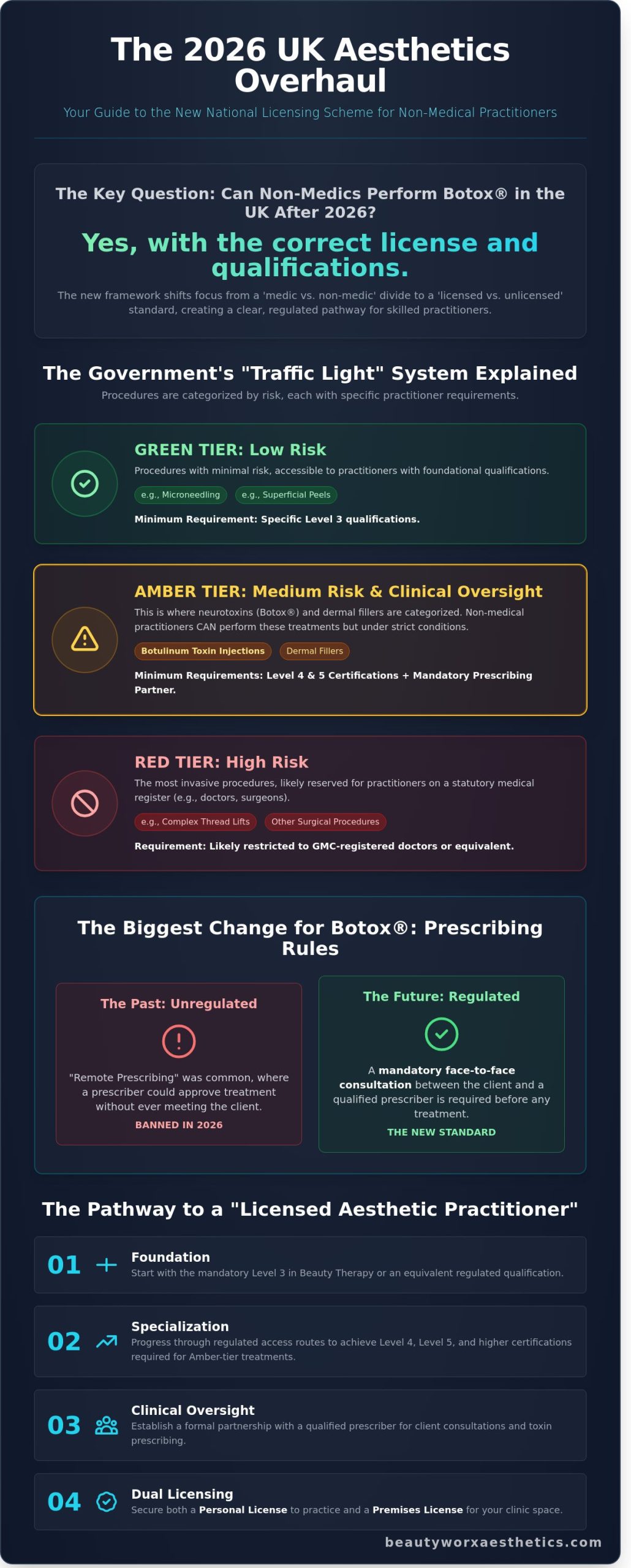
The UK government is refining the aesthetic landscape to ensure every client enjoys a safe, luminous result. Central to this transformation is a tiered licensing scheme introduced under the Health and Care Act 2022. This framework categorizes treatments into Green, Amber, and Red tiers based on their complexity and potential risk. For those asking can non medics do botox uk 2026, the answer lies within the Amber classification. This category identifies procedures that require a higher level of clinical scrutiny to maintain the harmonious balance between beauty and safety.
According to the House of Commons Library briefing, the goal is to standardize care across the 13,000 plus aesthetic businesses currently operating in England. While Green procedures like superficial chemical peels or microneedling remain accessible to entry-level therapists with specific Level 3 qualifications, Botox is firmly situated in the Amber tier. This means the journey to a refreshed appearance involves more than just a skilled hand; it requires a structured medical foundation.
Amber Category Requirements
The Amber status signifies that while non-medical practitioners can perform the treatment, they must work under strict clinical oversight. By 2026, every client seeking a subtle, youthful glow through neurotoxins must undergo a mandatory face-to-face consultation with a qualified prescriber. This ensures a bespoke treatment plan is crafted based on your unique facial anatomy. The new regulations explicitly ban “remote prescribing.” This means a doctor or nurse prescriber can’t simply sign off on a vial over a video call; they must be physically present to assess the client before the non-medic proceeds with the injection.
The Red Category Restriction
Certain procedures are now reserved exclusively for regulated healthcare professionals to protect patient wellbeing. These Red category treatments include high-risk interventions such as thread lifts, silicone injections, or deep-layer fillers in high-risk zones. These require the deep anatomical knowledge of a medical specialist to avoid vascular complications. Ensuring your clinic respects these boundaries is essential for a secure, supportive experience. If you’re looking for a trusted partner in your aesthetic journey, you can explore our bespoke treatment menu to see how we prioritize your safety and natural radiance.
Staying on the right side of these boundaries isn’t just about legal compliance. It’s about providing the peace of mind that comes with professional excellence. As we approach the 2026 deadline, the distinction between a simple beauty treatment and a clinical procedure becomes clearer. It ensures that the question of can non medics do botox uk 2026 is answered with a focus on rigorous standards and client health.
The Regulated Pathway: How to Become a Licensed Practitioner
Transitioning into the world of aesthetics requires a commitment to both clinical excellence and artistic precision. It’s no longer enough to attend a weekend workshop; the industry is moving toward a future defined by rigorous standards and patient safety. The UK government’s new licensing scheme will formalize this transition by 2026, creating a clear, tiered structure for education. Many aspiring practitioners ask, can non medics do botox uk 2026, and the answer lies in following this specific educational map.
- Step 1: Level 4 Foundation – This initial stage focuses on the intricate layers of facial anatomy and skin rejuvenation. It provides the essential biological knowledge needed to understand how treatments interact with the body.
- Step 2: Level 5 Certificate in Aesthetic Practice – You’ll advance your technical skills here, moving into deeper skin health and more complex non-injectable clinical treatments.
- Step 3: Level 7 Diploma – This is the definitive qualification for injectable treatments, covering everything from pharmacology to advanced injection techniques.
- Step 4: Local Authority Licensing – Once your education is complete, you’ll apply for an individual practitioner licence. This acts as your formal permission to practice within your specific jurisdiction.
- Step 5: Statutory Premises Standards – Your clinical space must meet strict hygiene and safety protocols. These standards mirror medical theater requirements to ensure a sterile, luxurious environment for every client.
The Importance of Ofqual Regulation
In previous years, a simple “CPD-only” certificate might have seemed like a shortcut into the industry. That era is ending. By 2026, licensing authorities won’t accept these unmapped certificates as proof of competence. You must ensure your qualifications are recognized on the Regulated Qualifications Framework (RQF). Ofqual-regulated courses are the only way to guarantee your training is scrutinized for quality. It’s vital to verify your training provider’s accreditation on the Ofqual register before you invest. This ensures your path to licensing remains clear and protected.
Bridging the Gap: The Level 7 Diploma
The Level 7 Diploma is widely regarded as the “Master’s level” of aesthetic education. It’s a transformative step that separates the hobbyist from the specialist. You’ll dive deep into clinical facial anatomy, the pharmacology of neurotoxins, and the critical management of complications. For a non-medic, holding a Level 7 qualification is a powerful statement of intent. It provides a significant competitive advantage, signaling to your clients that you possess the meticulous skill required for subtle, harmonious results. This level of training turns a procedure into a bespoke experience, fostering the trust that’s essential for a long-term partnership in self-care.
Navigating the Prescribing Dilemma for Non-Medics
Botulinum Toxin is classified as a Prescription-Only Medicine (POM) under the Human Medicines Regulations 2012. This legal status creates a specific hurdle for practitioners without prescribing rights. Even as the industry moves toward the 2026 licensing scheme, the fundamental rule remains: a non-medic cannot legally stock or buy Botox without a prescription tied to a specific patient. To operate within the law, practitioners must form a partnership with a Designated Prescriber, such as a GMC-registered doctor or an Independent Nurse Prescriber. This professional oversight ensures that the answer to whether can non medics do botox uk 2026 remains a “yes,” provided they follow a strict clinical chain of custody.
Sourcing products correctly is the hallmark of a professional artisan. Reliable practitioners only use UK-regulated pharmacies that maintain “cold-chain” storage, ensuring the toxin remains at the required 2 to 8 degrees Celsius. Buying from unregulated “black market” websites is illegal and dangerous. It compromises the delicate, luminous results clients expect and puts the practitioner at risk of criminal prosecution. A transparent partnership with a prescriber is the only way to guarantee a safe, high-end experience.
The Consultation Process
The law requires a face-to-face assessment between the prescriber and the client before any product is ordered. Remote prescribing via video call was banned by the GMC in 2012 and remains a serious breach of professional standards. This initial meeting allows the prescriber to review the medical history and ensure the treatment plan is harmonious with the client’s health. It creates a collaborative loop where the practitioner executes the art, while the prescriber provides the clinical foundation. Statistics from the Joint Council for Cosmetic Practitioners (JCCP) indicate that 85% of adverse incidents occur when this face-to-face step is ignored.
Complications Management
Every bespoke treatment journey must be anchored in safety. Non-medics are required to have a robust complications protocol and a direct line to their prescriber for emergency support. While Botox complications are rare, the practitioner must have immediate access to emergency kits and prescription-only medicines like Hyaluronidase for filler-related issues. Having a medical support network allows the practitioner to remain calm and meticulous during high-pressure situations. It transforms a standard service into a luxury, medical-grade experience where the client feels truly protected.
Elevating Your Practice: The Future of Clinical Aesthetics
The landscape of aesthetics is shifting away from transactional, high-volume clinics toward a model defined by artistry and clinical rigor. As the industry approaches the April 2026 deadline, the question of can non medics do botox uk 2026 becomes less about survival and more about excellence. Practitioners who embrace these upcoming licensing standards aren’t just ticking boxes; they’re positioning themselves as elite providers. You’re moving from being a technician to a trusted partner in a client’s emotional journey. This partnership focuses on the “best version of you” rather than an artificial, overfilled look. Your regulated status acts as a badge of luxury. It tells the 78% of discerning clients who now prioritize safety over cost that your clinic is a sanctuary of professional excellence.
The Business of Professionalism
Discerning clients expect more than a needle; they seek a harmonious enhancement that respects their unique anatomy. Investing in Continuous Professional Development (CPD) ensures you stay at the forefront of advanced techniques, such as subtle periorbital rejuvenation or refined facial contouring. By the time the new regulations fully land in 2026, the market will have split. Those competing on price will struggle. Those offering bespoke, education-led care will thrive. Professionalism is your most valuable currency. It builds the trust required for long-term loyalty and luminous, natural-looking results. It’s about creating an atmosphere where clinical safety meets sensory luxury.
Your Journey with Beauty Worx
Building a career in the new regulatory climate requires a structured approach that mirrors the high-end environment you aspire to create. Our Level 4, 5, and 7 pathways provide a clear roadmap for your career, ensuring you meet every requirement before the can non medics do botox uk 2026 transition is complete. Training in our centre offers more than just technical skills; it provides an immersive experience in a luxury clinical setting. You’ll learn the nuances of patient psychology and artistic discernment from the start. To begin your transition into the new era of aesthetics, organise your career consultation and discover our Level 7 pathways today.
Mastering the Future of Clinical Excellence
The landscape of aesthetic medicine is shifting toward a more regulated, clinical future. By April 2026, the Department of Health and Social Care will implement a mandatory licensing scheme that clarifies the question of how can non medics do botox uk 2026 by establishing clear clinical benchmarks. This transition centers on the Traffic Light System, where neurotoxin treatments will require a minimum Level 7 qualification to ensure clinical safety and professional excellence. You don’t have to navigate these legislative shifts alone. Transitioning your career requires more than just technical skill; it demands a partnership with a recognized Ofqual Regulated Training Centre.
Our program provides 1:1 Expert Practitioner Mentorship within a Sophisticated Boutique Learning Environment designed to elevate your artistry. Choosing the right path today ensures your practice remains both compliant and prestigious as the industry evolves. We’re here to guide your journey toward becoming a trusted, expert artisan in this flourishing field. Explore our Ofqual Regulated Level 7 Diploma for Non-Medics
You’re building a legacy of safety and refinement, and your luminous future in aesthetics starts with this pivotal step.
Frequently Asked Questions
Is it illegal for non-medics to do Botox in the UK in 2026?
No, it isn’t illegal, provided the practitioner holds the mandatory license required by the Health and Care Act 2022. The 2026 licensing scheme requires all practitioners to meet specific education and hygiene standards. Non-medics can still provide treatments if they satisfy the Department of Health and Social Care criteria. This ensures your journey toward a refreshed appearance remains safe and professionally supervised.
Do I need a Level 7 qualification to perform injectables as a non-medic?
Yes, the Joint Council for Cosmetic Practitioners and the government have indicated that a Level 7 Diploma will be the standard for non-medics by 2026. This postgraduate-level qualification ensures you possess the clinical depth to achieve harmonious, subtle results safely. It covers 277 hours of rigorous learning and assessment. Holding this credential allows you to offer bespoke enhancements with the quiet confidence of a true artisan.
What is the “Amber” category in the new aesthetics licensing scheme?
The “Amber” category refers to medium-risk procedures like Botox and dermal fillers that must be performed under clinical oversight or by licensed practitioners with specific qualifications. According to the 2023 government consultation, these treatments require a higher tier of regulation than “Green” category services like chemical peels. This structure protects your emotional well-being by ensuring only trained specialists handle neurotoxins in a meticulously professional environment.
Can a beauty therapist still get insurance for Botox in 2026?
Yes, beauty therapists can obtain insurance, but only if they provide proof of their government-mandated practitioner license and valid Level 7 credentials. Major insurers like Hamilton Fraser updated their 2024 policies to reflect these upcoming requirements. Without a license, your insurance will be void, leaving both you and your client’s luminous results unprotected. Maintaining 100% compliance ensures a secure, luxury experience for every individual you treat.
How much does an aesthetics practitioner licence cost under the new rules?
While final figures are pending, local authorities are expected to set license fees between £300 and £600 annually, mirroring existing Special Treatment Licenses. You’ll also need to account for the cost of a premises license, which often ranges from £150 to £450 depending on your specific borough. These investments are essential for establishing your boutique as a beacon of safety. They guarantee your artistry is backed by official recognition.
Can I still use a prescriber if I am a non-medical injector?
You must still use a prescriber because Botox remains a Prescription Only Medicine under the Human Medicines Regulations 2012. A face-to-face consultation with a doctor, nurse, or dentist is mandatory for every new client before you can perform the treatment. This collaborative approach ensures the question of can non medics do botox uk 2026 is answered with a focus on medical integrity. It preserves client safety while you focus on their aesthetic journey.
What happens if I practice without a licence after the 2026 deadline?
Practicing without a license after the 2026 enforcement date will result in criminal prosecution and unlimited fines under the Health and Care Act. Local authorities will have the power to shut down non-compliant clinics immediately. This strict enforcement protects the industry’s reputation and ensures every client receives treatment in a professional setting. Staying compliant is the only way to safeguard your career and your clients’ trust in your expert hands.
Are dermal fillers regulated the same way as Botox in 2026?
Yes, dermal fillers are now classified under the same licensing umbrella as Botox to ensure consistent safety across all injectable treatments. The government’s 2023 response to the aesthetics consultation confirmed that fillers will no longer be unregulated medical devices. They now require the same licensing and hygiene standards as neurotoxins. This change ensures that your pursuit of a youthful, contoured profile is always managed with clinical precision and artistic care.


Related Posts








 Reviews