
The era of the “weekend workshop” in aesthetics has officially ended, replaced by a rigorous new standard that demands more than just a certificate on the wall. As the UK aesthetic landscape matures, the distinction between a practitioner who simply performs treatments and a clinical artist who commands trust has never been more vital. You likely feel the weight of the August 2025 government announcement; it’s natural to feel anxious about whether your current approach to CPD for aesthetic nurses will withstand the transition to the 2026 licensing scheme.
We understand the confusion that arises when choosing between standard accredited courses and OFQUAL-regulated qualifications. This guide provides a definitive roadmap to mastering your professional development, ensuring your practice remains both legally compliant and clinically exceptional. We will explore how to transition toward high-level training, such as the Level 7 Diploma in Clinical Aesthetic Injectable Treatments, while refining the subtle, artistic touch that defines a luxury patient experience. You’ll discover how to align your skills with the upcoming risk-based licensing categories, allowing you to meet new regulatory requirements with confidence and grace.
Key Takeaways
- Distinguish between standard accreditation and OFQUAL-regulated qualifications to ensure your clinical practice aligns with the 2026 licensing standards.
- Learn how to strategically curate your CPD for aesthetic nurses to evolve from a clinical practitioner into a sophisticated, expert artisan.
- Map your professional journey from foundational skin health to advanced mastery with the Level 7 Diploma in Clinical Aesthetic Injectable Treatments.
- Understand the ethical necessity of a Complications Management Course to safeguard your patients and uphold the highest clinical standards.
- Discover the benefits of long-term mentorship and training within a luxury environment that reflects the premium service your clients deserve.
The Evolution of CPD for Aesthetic Nurses: Beyond the NHS Framework
The traditional understanding of Continuing Professional Development (CPD) has undergone a profound transformation as the aesthetics market matures in 2026. In the structured environment of the NHS, learning is often a reactive response to clinical necessity or institutional protocols. In the private sector, however, the focus shifts toward a proactive mastery of both science and artistry. For a dedicated practitioner, CPD for aesthetic nurses is the vehicle that facilitates the transition from a task-oriented clinical role to that of a trusted, expert artisan. It’s about moving beyond the simple administration of a treatment to curate a bespoke journey of self-confidence for every client.
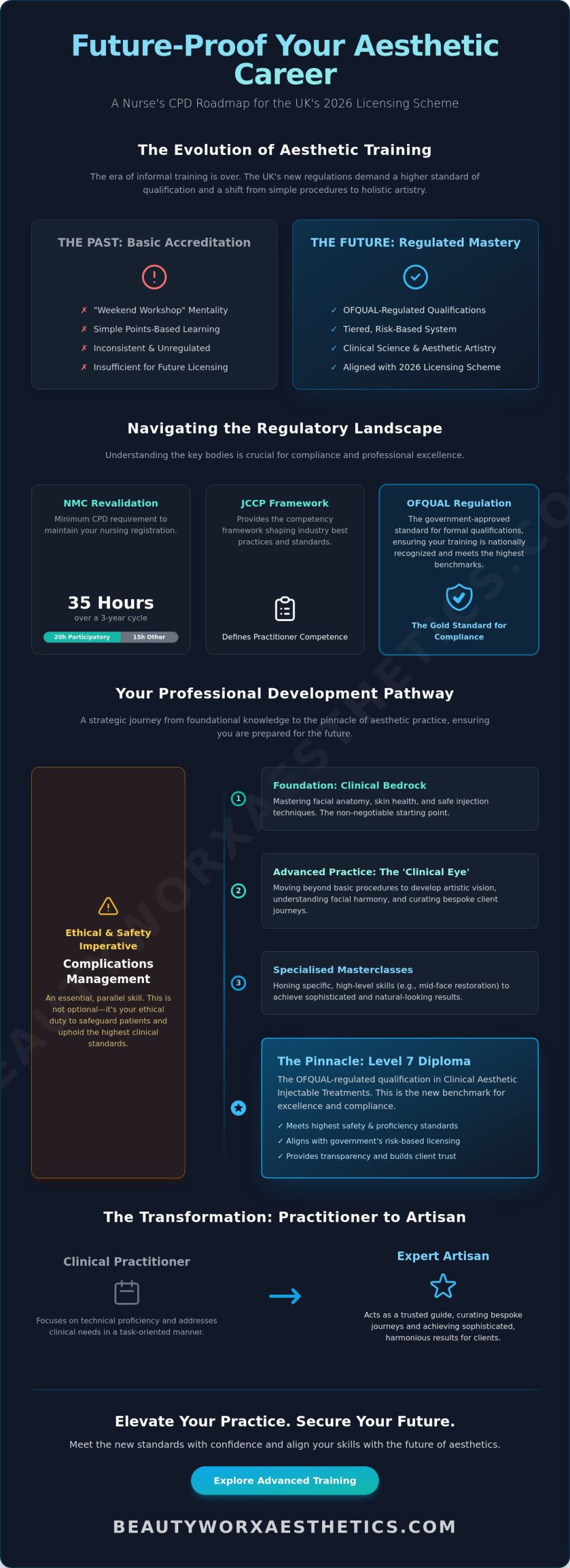
Maintaining your registration with the Nursing and Midwifery Council (NMC) requires a minimum of 35 hours of CPD over a three-year revalidation cycle. Within this requirement, at least 20 hours must be participatory learning. While these are the baseline rules, a sustainable private practice requires a more robust approach. True professional development in this field involves a deep dive into the nuances of facial anatomy and the subtle preservation of a client’s inherent features. It’s this commitment to ongoing education that builds the quiet confidence necessary to thrive in a high-end, luxury environment.
The Shift from Clinical Necessity to Aesthetic Artistry
A radiant, balanced profile is the ultimate goal of any aesthetic intervention, and achieving this requires a vision that extends beyond basic clinical safety. Transitioning from treating patients to serving clients involves a significant psychological shift. You aren’t merely addressing a medical concern; you’re acting as a knowledgeable guide in a partnership of self-care. Advanced CPD for aesthetic nurses bridges the gap between technical proficiency and sophisticated results by developing your “clinical eye.” This specialized discernment allows you to recognize how enhancing the mid-face can restore a youthful vitality without creating an artificial appearance. It’s the difference between a standard procedure and a customized restoration of harmony.
Future-Proofing Your Career Against UK Licensing Changes
The regulatory landscape is shifting toward greater oversight, making it essential to align your education with upcoming standards. Following the government’s confirmation on August 7, 2025, the new licensing scheme under the Health and Care Act 2022 is fundamentally changing how practitioners must operate. A simple “points-based” approach to learning is no longer sufficient to meet the expectations of insurers or local authorities. The industry is moving toward a tiered, risk-based system where high-risk procedures require formalized, level-based qualifications. Investing in an OFQUAL-regulated Level 7 Diploma in Clinical Aesthetic Injectable Treatments ensures that your practice remains compliant with secondary legislation and provides the transparency that modern clients demand. This strategic approach to your education guarantees that your skills are recognized as meeting the highest benchmarks of safety and proficiency.
Navigating the Regulatory Landscape: JCCP, NMC, and OFQUAL
The regulatory structure of the aesthetics industry is becoming increasingly formalized, moving away from the fragmented oversight of previous years. For those pursuing CPD for aesthetic nurses, understanding the hierarchy of educational standards is now a professional necessity rather than an elective choice. While the sector has historically relied on voluntary registers, the government’s confirmation of the new licensing scheme on August 7, 2025, signals a definitive shift toward mandatory, statutory oversight. This transition, rooted in the Health and Care Act 2022, ensures that every practitioner meets a consistent, high-level benchmark of safety and proficiency.
The Joint Council for Cosmetic Practitioners (JCCP) remains a pivotal influence in shaping these standards and defining practitioner competence. Their JCCP Competency Framework provides a clear, structured map of the skills and knowledge required across different treatment modalities. The JCCP recommends that all practitioners undertake at least 35 hours of relevant CPD over a three-year period, a figure that mirrors the NMC’s revalidation requirements. This alignment ensures that your professional development isn’t just a box-ticking exercise; it’s a meaningful advancement of your clinical artistry that carries weight with regulators and peers alike.
What is an OFQUAL Regulated Qualification?
The distinction between a CPD-accredited certificate and an OFQUAL-regulated qualification is often where professional confusion begins. A standard certificate typically confirms attendance or the acquisition of basic knowledge, whereas a regulated diploma involves rigorous external assessment, standardized learning outcomes, and verified clinical hours. This level of scrutiny is why insurers and regulatory bodies increasingly favor qualifications listed on the Regulated Qualifications Framework (RQF). OFQUAL regulation serves as the definitive benchmark for educational integrity and quality assurance in the aesthetics sector. As the government implements its risk-based licensing scheme, it’s widely anticipated that high-risk injectable treatments will require a Level 7 qualification. Choosing a Level 7 Diploma in Clinical Aesthetic Injectable Treatments ensures your education possesses the longevity and recognized status needed for the future of your practice.
The Role of the NMC in Aesthetic Practice
Even in a private, luxury setting, your primary accountability remains to the Nursing and Midwifery Council. Adhering to “The Code” is essential when balancing clinical safety with commercial objectives. This includes the absolute requirement for in-person consultations before prescribing any prescription-only medications, such as anti-wrinkle treatments; remote prescribing is fundamentally incompatible with these standards. Professional indemnity also requires careful attention. Many nurses discover that standard Royal College of Nursing (RCN) cover doesn’t extend to private aesthetic practice. Securing specialist insurance that recognizes your specific CPD for aesthetic nurses is a critical step in protecting both your patients and your professional reputation.
Core CPD Pillars: From Foundation to Level 7 Mastery
A flourishing career in aesthetics is built upon a sequence of intentional, progressive choices. For most practitioners, the journey begins with comprehensive aesthetic courses that provide the essential building blocks of clinical practice. Effective CPD for aesthetic nurses involves far more than attending disparate workshops; it requires a structured ascent from surface-level skin health to deep-tissue restoration. By mastering foundational techniques before advancing to complex injectables, you ensure that every treatment is underpinned by a profound understanding of tissue viability and patient safety.
The curriculum of a modern aesthetic nurse often starts with skin rejuvenation. Establishing a clinical foundation through a Level 4 Certificate in Skin Needling or Chemical Peel Training allows you to address the skin’s texture and tone before considering structural changes. As your confidence grows, the progression naturally moves toward injectable treatments, starting with Foundation Anti-Wrinkle Injections and Dermal Filler courses. Integrating wellness through Vitamin B12 Injection Training further enhances your portfolio, allowing you to offer a holistic approach that prioritizes the client’s internal vitality alongside their external radiance.
The Level 7 Diploma in Clinical Aesthetic Injectables
The Level 7 Diploma in Clinical Aesthetic Injectable Treatments remains the gold standard for those seeking to reach the pinnacle of professional recognition. This postgraduate-level qualification dives deep into complex facial anatomy, the ethics of elective procedures, and advanced injection techniques that produce subtle, natural-looking results. A critical component of this mastery is supervised clinical practice. Working with live models under expert guidance ensures that your technical precision is matched by artistic discernment. In a competitive national market, holding a Level 7 qualification acts as a confident affirmation of your expertise, providing the transparency and assurance that high-end clients expect in 2026.
Skin Rejuvenation as a CPD Foundation
A radiant complexion is the ultimate canvas for any injectable work. Mastering polynucleotide treatment has become a vital part of CPD for aesthetic nurses, offering a sophisticated method for cellular-level repair and hydration. These regenerative treatments work in perfect synergy with chemical peels and skin boosters to create a healthy environment for fillers and anti-wrinkle injections. Prioritizing skin health as the essential precursor to any structural enhancement ensures that results are not only beautiful but also sustainable. It reflects the mindset of a trusted artisan who understands that true restoration begins at the cellular level.
Specialised CPD: Advanced Masterclasses and Safety
Once you have established a firm clinical foundation, the path to becoming a trusted specialist involves refining the delicate nuances of clinical artistry. In 2026, the standard for CPD for aesthetic nurses has shifted toward specialized masterclasses that emphasize the preservation of inherent beauty over drastic, artificial change. This journey requires a profound understanding of advanced facial anatomy, particularly when navigating high-risk zones where precision is paramount. It involves developing the quiet confidence to curate a result that feels both restorative and entirely authentic to the individual.
Every professional consultation is an emotional journey toward self-confidence. A sophisticated practitioner recognizes that managing patient expectations is as vital as the procedure itself. Advanced CPD for aesthetic nurses now integrates the psychology of aesthetics, training practitioners to identify signs of body dysmorphia and ensure that every intervention supports the client’s long-term well-being. This empathetic approach transforms a routine appointment into a bespoke partnership in graceful aging, moving beyond the technical to address the person behind the profile.
Mastering the Art of the Lip Augmentation
The lips are a vital focal point of facial harmony, requiring a meticulous balance between volume and structure. While specific trends like the Russian Lip technique offer distinct aesthetics, the expert artisan prioritizes a result that honors the client’s natural features. By exploring advanced lip augmentation filler techniques, you learn to customize treatments that provide subtle enhancement without compromising balance. This level of detail-oriented care is what defines a premium service in a quiet, high-end environment.
Complications Management: The Safety Net
Clinical excellence is inseparable from an unwavering commitment to safety. There is a clear ethical imperative to complete a complications management course, which provides the skills to act decisively if an adverse event occurs. Identifying vascular occlusions early and mastering the use of hyaluronidase within emergency protocols are non-negotiable skills for the modern professional. This safety net isn’t just a regulatory requirement; it’s the foundation of your reputation as a safe, meticulously professional practitioner. Building this trust ensures your clients feel pampered and protected throughout their entire aesthetic experience.
Secure your professional reputation by enrolling in our Complications Management Course to ensure your practice remains a sanctuary of safety and clinical excellence.
The Beauty Worx Approach: Elevating Your Professional Journey
The environment where you learn often dictates the standard of the practice you build. At Beauty Worx Aesthetics, we believe that training should mirror the high-end, luxury clinical setting your clients expect. It’s about more than just technical instruction; it’s about immersing yourself in an atmosphere that balances clinical expertise with a sophisticated, pampered experience. This approach to CPD for aesthetic nurses helps you internalize the “expert artisan” mindset, ensuring that your professional presence is as polished as the subtle, natural-looking results you provide. By learning within a space that prioritizes artistic discernment, you’re better equipped to guide your clients through their own emotional journeys toward self-confidence.
Professional excellence in 2026 isn’t a destination, but a continuous commitment to restoration and enhancement. Our curriculum is designed to move at a steady, fluid pace, mirroring the contemplative nature of a private consultation. We focus on individualized improvement, teaching you to preserve the client’s inherent features rather than pursuing drastic change. This dedication to authentic results acts as a guarantee of quality, helping you build a loyal patient base that trusts your meticulous attention to detail and your unwavering focus on safety and cleanliness.
Mentorship and Long-Term Career Support
In an industry where many practitioners operate independently, the value of a supportive community is immeasurable. We believe your relationship with a training academy shouldn’t end at certification; it should evolve into an ongoing partnership in professional growth. Access to a national network of expert practitioners and educators provides the mentorship necessary to maintain rigorous clinical standards as you grow. This continuous support system is vital for navigating the complexities of solo practice, offering a reliable sounding board for clinical decisions. It ensures you’re never truly alone as you help your clients navigate the long-term process of graceful aging and self-care.
Choosing Your Path to Excellence
Every nurse’s journey is unique, and your professional development should reflect your specific career aspirations. Whether you’re establishing a foundation with a Level 5 Certificate in Aesthetic Practice or refining your artistry in a Lip Masterclass, your path should be intentional and logical. A truly holistic practice often looks beyond surface-level aesthetics to support a client’s internal vitality. Integrating vitamin b12 injection training into your portfolio allows you to offer a comprehensive wellness experience that complements your clinical work. This broad expertise establishes you as a versatile specialist, capable of addressing both the visible signs of aging and the underlying factors of well-being.
The future of the aesthetics industry belongs to those who view their craft as both a science and an art form. By choosing a trusted partner for your CPD for aesthetic nurses, you’re investing in a career that is resilient, compliant, and deeply rewarding. Elevate your professional journey today and join a community that celebrates the delicate balance of clinical rigour and high-end luxury.
Shaping the Future of Your Aesthetic Practice
The transition from a clinical practitioner to a sophisticated aesthetic artisan is a journey of continuous refinement and strategic education. By aligning your professional development with the 2026 licensing standards and prioritizing OFQUAL-regulated qualifications, you don’t just meet regulatory requirements; you build a sanctuary of safety and luxury for your clients. We’ve explored how a structured approach to CPD for aesthetic nurses ensures your career remains resilient in a shifting market, moving you beyond foundational skills toward the mastery of subtle, natural results.
Your path to excellence is supported by our CPD accredited training centre, where we offer expert clinical mentorship from lead practitioners who view aesthetics as both a science and an art form. Whether you’re seeking to establish your credentials or refine advanced techniques, we provide the environment and expertise to help you thrive. Explore our OFQUAL-regulated Level 7 Diploma and advanced CPD courses to elevate your practice with the quiet confidence of a true specialist. The future of aesthetics is bright for those who commit to this level of meticulous professional care.
Frequently Asked Questions
Is CPD mandatory for aesthetic nurses in the UK?
CPD is a mandatory requirement for all registered nurses to maintain their professional standing with the NMC. Every three years, you must demonstrate 35 hours of learning to revalidate. Beyond these regulatory basics, the new licensing scheme confirmed in August 2025 will require practitioners to prove ongoing competence. Engaging in structured CPD for aesthetic nurses ensures you meet these evolving legal standards while maintaining the safety and artistry of your clinical practice.
What is the difference between a CPD-accredited course and an OFQUAL-regulated one?
A CPD-accredited course provides a certificate of attendance or completion, often validated by a private body. In contrast, an OFQUAL-regulated qualification, such as a Level 7 Diploma, is part of the national Regulated Qualifications Framework. These regulated paths undergo rigorous external quality assurance and standardized assessment. As the industry moves toward formal licensing, regulated qualifications are increasingly recognized as the gold standard for insurance and professional longevity in a competitive market.
Can I practice aesthetics with only a foundation course?
While a foundation course in anti-wrinkle injections or dermal fillers currently allows you to begin your practice, the regulatory environment is shifting. The government’s risk-based licensing scheme will likely categorize procedures into Green, Amber, and Red tiers. Practitioners should aim for higher-level qualifications to ensure they can continue performing medium to high-risk treatments as standards rise. Building upon a foundation with advanced training is essential for long-term clinical success and meeting future insurance expectations.
How many CPD hours do I need for my NMC revalidation in aesthetics?
You are required to complete a minimum of 35 hours of CPD over your three-year revalidation cycle. At least 20 of these hours must be participatory, involving interaction with other healthcare professionals. For those specializing in this field, the JCCP also recommends 35 hours specifically relevant to your scope of practice. Documenting these hours meticulously is vital for demonstrating your commitment to safe, expert-led care. This process confirms your dedication to maintaining clinical excellence and patient safety.
Does my RCN indemnity insurance cover my aesthetic practice?
Standard Royal College of Nursing (RCN) indemnity insurance generally does not cover private, non-surgical cosmetic procedures. You must secure specialist medical malpractice insurance tailored specifically to your aesthetic services. Most insurers will require proof of recognized training, such as an OFQUAL-regulated diploma, before providing cover for high-risk injectable treatments. It’s your professional responsibility to ensure your policy is active and covers every treatment modality you offer. This protection is a cornerstone of a safe, meticulously professional practice.
What is the Level 7 Diploma in aesthetics and do I need it?
The Level 7 Diploma in Clinical Aesthetic Injectable Treatments is a postgraduate-level qualification that covers advanced anatomy, ethics, and clinical practice. While not currently a legal requirement for all, it’s the anticipated benchmark for the Amber tier of the new licensing scheme. Holding this diploma distinguishes you as a highly qualified specialist. It provides the transparency and reassurance that modern, high-end clients demand when choosing a practitioner for their subtle, natural-looking facial restoration.
How do I choose a reputable CPD provider for aesthetics?
Selecting a provider requires careful scrutiny of their clinical leadership and accreditation status. A reputable academy should offer OFQUAL-regulated qualifications and be an established training centre. Look for programs led by expert clinical practitioners who provide hands-on mentorship with live models in a professional setting. Avoid providers that offer fast-track schemes without rigorous assessment. These may not meet the upcoming 2026 licensing requirements or provide the depth of knowledge needed for safe, artistic practice.
Can I perform botox and fillers if I am not a nurse prescriber?
You can perform these treatments as a non-prescriber, but you must work alongside a qualified prescriber for anti-wrinkle injections. The prescriber must conduct an in-person consultation with the client before any prescription is issued; remote prescribing is not permitted under professional standards. Dermal fillers are currently medical devices, but the upcoming licensing changes may introduce stricter oversight. Many practitioners choose to pursue further CPD for aesthetic nurses to gain the autonomy needed for a bespoke private practice.













 Reviews