
By July 2026, the transition from a self-regulated industry to a strictly licensed profession will reach its peak. You’ve likely felt the growing weight of uncertainty as the UK government moves toward mandatory licensing for all non-surgical cosmetic procedures. It’s natural to worry that your hard-earned skills might be sidelined by shifting legislation. Understanding the nuances of CPD vs Ofqual regulated aesthetic courses is no longer just a professional choice; it’s a vital step to ensure your practice remains both legal and insurable.
We’re here to help you move past the confusion and build a career on a foundation of true clinical excellence. This article clarifies how the upcoming licensing scheme impacts your daily work and your long-term growth. We’ll examine why Ofqual-regulated diplomas are becoming the gold standard for practitioners who seek clinical authority. You’ll discover how to align your training with the new risk categories so your investment leads to a secure, recognized, and flourishing aesthetic practice. This is about more than just compliance; it’s about the quiet confidence that comes from being a master of your craft.
Key Takeaways
- Prepare for the transition to mandatory UK licensing by understanding how regulatory changes in 2026 redefine professional standards.
- Evaluate the structural differences between CPD vs Ofqual regulated aesthetic courses to select a path that guarantees both clinical authority and long-term insurability.
- Learn why rigorous assessment methods, such as supervised clinical hours and OSCEs, are becoming the prerequisite for local authority licensing.
- Discover a clear educational roadmap that guides you from Level 4 skin needling through to the prestigious Level 7 Diploma in Clinical Aesthetic Injectable Treatments.
- Gain the insights needed to protect your investment and build a practice that balances artistic intuition with the highest levels of safety and compliance.
The 2026 Aesthetics Landscape: Why the CPD vs Ofqual Debate Matters Now
The UK aesthetics sector has matured into a space where clinical precision and artistic discernment are non-negotiable. We’ve moved beyond the era of voluntary registration, entering a period where mandatory licensing defines the professional standard. This transformation is largely driven by the Joint Council for Cosmetic Practitioners (JCCP), which has set a high bar for patient safety and practitioner accountability. As clients become increasingly educated about the procedures they seek, their demand for visible, high-level qualifications has intensified. They aren’t just looking for a treatment; they’re looking for a trusted specialist who can demonstrate a commitment to excellence.
This shift in consumer awareness is why the debate regarding CPD vs Ofqual regulated aesthetic courses is so critical for your career. To truly understand the weight of these qualifications, it’s helpful to look at the role of Ofqual. As the non-ministerial department regulating qualifications in England, their oversight ensures that your training meets rigorous national standards. It provides the clarity and balance needed to transition from a skilled technician to a recognized clinical authority.
The Impact of National Licensing on Practitioners
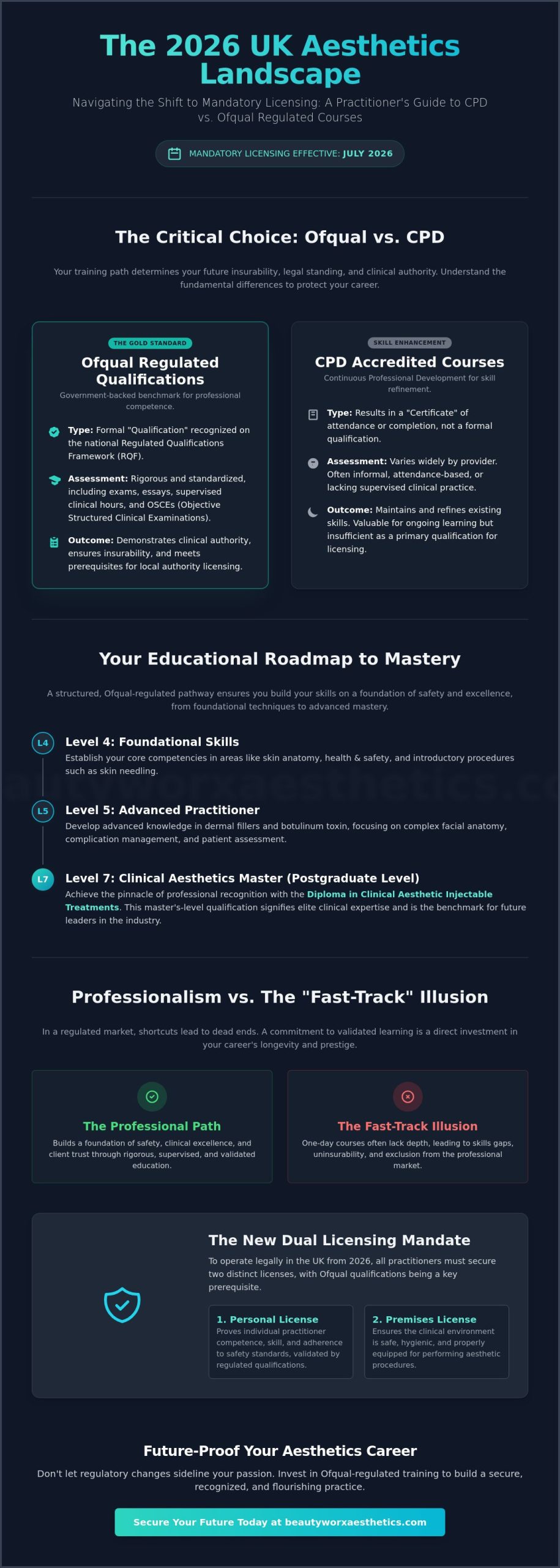
Under the current licensing scheme, practitioners must hold both a personal license and a premises license to operate legally. These requirements aren’t merely administrative hurdles; they’re safeguards designed to ensure every environment is as safe as it is welcoming. Holding regulated qualifications acts as a professional passport, allowing you to practice with confidence across the UK. Without these recognized credentials, you risk being uninsurable and excluded from the market. In a regulated environment, the peace of mind that comes from compliance is the ultimate luxury for any practitioner.
Professionalism vs. The Fast-Track Illusion
The “fast-track” culture that once promised quick entry into the industry is being replaced by a demand for clinical depth. One-day courses often lack the supervised clinical practice required to master complex facial anatomy and complication management. An expert artisan doesn’t look for shortcuts; they value the long-term process of refinement. By choosing rigorous, validated learning over the fast-track illusion, you don’t just learn a skill. You build a foundation of safety and restorative beauty. This commitment to high-level education transforms your clinic into a sanctuary of trust, where clients feel both pampered and protected. Ultimately, your choice between CPD vs Ofqual regulated aesthetic courses will determine the longevity and prestige of your professional journey.
Understanding the Framework: Defining Ofqual Regulation and CPD Accreditation
Choosing between CPD vs Ofqual regulated aesthetic courses requires an understanding of how each framework supports your professional identity. While both paths contribute to your growth, they serve distinct purposes in a clinical career. Ofqual, the Office of Qualifications and Examinations Regulation, acts as the guardian of educational integrity. To understand why this matters, one should consult the official government page for Ofqual, which details how they maintain public confidence in the reliability of qualifications across England. Conversely, Continuing Professional Development (CPD) is a fluid methodology designed to help you maintain and refine your existing skills as the industry evolves.
The structural difference lies in the depth of the curriculum versus the accumulation of learning hours. Ofqual-regulated courses are formal “qualifications” that require rigorous validation. CPD activities result in “certificates” of attendance or completion. Both are valuable, yet they occupy different tiers in the hierarchy of clinical authority. Mastery requires both foundational strength and constant refinement.
What is an Ofqual-Regulated Qualification?
An Ofqual-regulated qualification is a government-backed benchmark of professional competence that ensures a practitioner has met rigorous national standards of safety and skill. These qualifications sit on the Regulated Qualifications Framework (RQF), which categorizes learning into levels of increasing complexity. For instance, our Level 5 Certificate in Aesthetic Practice represents a significant step up from introductory skin care. Awarding bodies like Qualifi provide external quality assurance, ensuring that every student is assessed fairly and consistently. This oversight guarantees that your credentials carry weight with insurers and regulatory bodies alike. Precision is the priority.
The Vital Role of CPD in Ongoing Excellence
While Ofqual qualifications build your house, CPD provides the fine artistry that makes it unique. It’s the essential tool for mastering specific, high-demand techniques like the Russian Lip technique or staying updated on the latest product innovations. High-quality CPD offers genuine educational value by focusing on safety updates and subtle restorative methods. It prevents your skills from stagnating. To identify reputable CPD, look for providers who prioritize clinical depth over marketing hype. If you’re looking to elevate your current skill set, our Complications Management Course provides the vital safety knowledge every modern practitioner needs. Excellence is a lifelong pursuit.
The Critical Differences: Assessment, Insurance, and Clinical Authority
Distinguishing between CPD vs Ofqual regulated aesthetic courses requires looking beyond the syllabus and into the methods used to validate your expertise. While Continuing Professional Development is vital for staying current, it often relies on attendance or basic quizzes. In contrast, Ofqual-regulated pathways demand a rigorous portfolio of evidence and Objective Structured Clinical Examinations (OSCEs). This isn’t just about passing a test; it’s about demonstrating repeatable, safe, and artistic results under the watchful eye of a clinical lead. The requirement for supervised live model hours ensures that your first solo treatment isn’t a gamble, but a confident continuation of your training.
Your clinical authority is built on the strength of your foundational training. A Level 7 diploma doesn’t just provide a certificate; it grants you a seat at the table with medical peers. It signifies that your journey involved critical appraisal and a deep understanding of facial architecture. This level of recognition is becoming the benchmark for those who view aesthetics as both a science and a high-end art form. It’s the difference between being a practitioner and being an expert artisan.
Rigor vs. Attendance: The Reality of Assessments
Evidence-based learning is the cornerstone of any regulated diploma. Unlike “attendance only” certificates, which are increasingly rejected by professional bodies, regulated qualifications require you to prove your competence through critical analysis. This academic rigor is what prepares you for the complexities of complications management. When you understand the “why” behind every needle placement, you can offer your clients a level of safety that is as restorative as the results themselves. True mastery isn’t found in a one-day wonder; it’s found in the meticulous validation of your skills.
Securing Professional Indemnity in 2026
Top-tier insurers are tightening their criteria, often making a distinction between CPD vs Ofqual regulated aesthetic courses when determining eligibility. For non-medics especially, an Ofqual pathway is often the only route to securing robust clinical cover. As the industry moves toward mandatory licensing, your qualification level will directly impact your insurance premium costs and the depth of your policy. Future-proofing your practice means choosing a path that major insurance providers recognize and respect. This proactive approach gives you the peace of mind to focus on your craft, knowing your professional reputation is protected by a solid regulatory foundation. Security is the ultimate foundation for creativity.
Navigating Your Career Path: From Foundation to Level 7 Mastery
Viewing CPD vs Ofqual regulated aesthetic courses as a simple binary choice overlooks the power of a tiered progression. Successful practitioners recognize that building a career in aesthetics is a journey of refinement, where each level of education adds a new layer of clinical depth and artistic intuition. This structured approach ensures that you’re never just performing a procedure; you’re applying a sophisticated understanding of facial architecture and patient safety. By following a regulated pathway, you transform your practice from a series of transactions into a respected clinical career.
- Level 4: Your entry point into the world of advanced skin rejuvenation. This stage focuses on anatomy, physiology, and the fundamentals of skin health.
- Level 5: A bridge that deepens your understanding of advanced aesthetic practice, preparing you for more complex clinical environments.
- Level 7: The prestigious gold standard. This level focuses on clinical injectable treatments, demanding the highest level of critical appraisal and practical skill.
The Ofqual Pathway for Non-Medics and Medics
The Level 7 Diploma provides a university-equivalent standard of education that is recognized across the medical and aesthetic industries. For those without a prior medical background, Levels 4 and 5 act as essential scaffolding, providing the anatomical knowledge required to practice safely. Interestingly, even experienced medical professionals are now opting for Level 7 to validate their specific aesthetic expertise. It demonstrates a commitment to the unique nuances of cosmetic medicine that general medical training may not cover. It’s about establishing undeniable clinical authority.
When to Choose CPD for Skill Refinement
Once your regulated foundation is firmly in place, CPD becomes your most valuable tool for artistic refinement. It’s the ideal route for pursuing niche wellness services, such as Vitamin B12 injection training, or mastering a specific manufacturer’s product line. A blended education model is often the most effective strategy. You maintain a regulated core for licensing and insurance purposes, while using accredited CPD masterclasses to stay at the forefront of innovation. This combination allows you to offer highly customized, subtle results that keep your clients returning. Mastery is a continuous process of learning and restoration.
If you’re ready to build your career on a foundation of recognized excellence, explore our Level 4 Certificate in Skin Needling to begin your professional ascent today.
Future-Proofing Your Practice with Beauty Worx Aesthetics
At Beauty Worx Aesthetics, we view the choice between CPD vs Ofqual regulated aesthetic courses as the cornerstone of your professional identity. Our philosophy is rooted in the belief that clinical precision should always meet the intuitive touch of an artisan. We don’t just teach procedures; we cultivate specialists who understand how to enhance a client’s inherent features with grace and restorative balance. By offering both regulated diplomas and elite masterclasses, we ensure your education is as comprehensive as it is refined.
Investing in excellence is the most significant decision you’ll make for your long-term career security. We provide a mentorship that extends beyond the classroom, supporting your journey as you navigate the complexities of the 2026 licensing landscape. Our role is to act as a knowledgeable guide, helping you build a practice that clients trust for its safety and artistic discernment. This ongoing partnership frames your education not as a one-off transaction, but as a commitment to graceful aging and professional mastery. Your growth is our priority.
The Beauty Worx Standard of Education
Our training environment mirrors the calm, sophisticated atmosphere of our high-end clinical facilities. To ensure your clients achieve a look of subtle, effortless vitality, we focus on the anatomical precision required for every procedure. You’ll learn from expert practitioners who view facial aesthetics as both a science and an art form. We prioritize small class sizes and extensive live model practice to ensure you develop the quiet confidence needed for clinical success. This meticulous attention to detail ensures that every treatment you perform is discreet, tailored, and safe.
Your Next Steps Toward Clinical Distinction
Moving toward a distinguished career is a journey we take together. We invite you to book a consultation to discuss your personalized training pathway, ensuring your choices align with your aspirations for clinical authority. By joining our community, you align yourself with practitioners dedicated to safety and natural-looking results. Your career deserves a foundation of regulated excellence. It’s the most valuable asset you’ll ever own. Let’s begin the process of building your legacy in aesthetics today.
Securing Your Future as a Clinical Artisan
The landscape of UK aesthetics has reached a pivotal moment of transformation. As we approach the anticipated 2026 licensing deadline, the distinction between CPD vs Ofqual regulated aesthetic courses becomes the defining factor for your enduring success. By prioritizing a structured educational pathway, you don’t just achieve legal compliance; you gain the profound peace of mind that comes from being fully insurable and professionally recognized. True mastery is born from this symphony of clinical precision and the refined intuition of a specialist.
Your journey toward clinical distinction deserves a partner committed to your long-term growth. At Beauty Worx Aesthetics, we offer OFQUAL Regulated Level 4, 5, and 7 Diplomas alongside over 25 CPD Accredited Masterclasses to support every stage of your professional progression. You’ll benefit from the meticulous mentorship of our lead clinical practitioners, ensuring your skills are as safe as they are sophisticated. Explore our OFQUAL regulated qualifications and elite CPD courses to begin your ascent today.
The future of aesthetics belongs to those who view their craft as both a science and a high-end art form. We’re ready to help you build a career defined by excellence and grace.
Frequently Asked Questions
Is a CPD certificate legally enough to perform Botox and fillers in 2026?
A CPD certificate alone will likely be insufficient to practice legally once the new UK licensing scheme is fully implemented, with the industry anticipating a July 2026 deadline. This transition moves aesthetics from voluntary standards to a mandatory framework where Ofqual-regulated qualifications are the expected benchmark for practitioner licenses. Holding a regulated diploma ensures you meet the government’s mandatory training requirements for high-risk procedures.
What is the difference between a Level 5 and a Level 7 aesthetics qualification?
The primary difference lies in the clinical scope and the depth of anatomical study. Our Level 5 Certificate in Aesthetic Practice focuses on advanced skin rejuvenation and bridging the gap into clinical environments. The Level 7 Diploma in Clinical Aesthetic Injectable Treatments represents the postgraduate-equivalent gold standard, specifically designed for those performing complex anti-wrinkle and dermal filler treatments with total precision.
Can I get insurance with only CPD-accredited aesthetics training?
Securing robust professional indemnity with only CPD-accredited training is becoming a significant challenge as we approach 2026. When comparing CPD vs Ofqual regulated aesthetic courses, top-tier insurers increasingly favor regulated pathways to ensure their policyholders meet rigorous safety standards. For non-medics especially, holding an Ofqual-regulated qualification is often the only way to guarantee long-term, comprehensive clinical cover.
How long does it take to complete an Ofqual-regulated Level 7 Diploma?
Completing a Level 7 Diploma typically requires between 6 and 18 months of dedicated study and practice. This timeline isn’t just an administrative requirement; it’s a commitment to mastery that allows you to build a meticulous clinical portfolio. It ensures you’ve completed the necessary supervised hours to transition from a student to a confident, expert artisan in the field of injectables.
Are non-medics allowed to enroll in Ofqual-regulated aesthetics courses?
Non-medics are absolutely welcome to enroll in regulated pathways, provided they follow the structured progression designed for clinical safety. By starting with a Level 4 Certificate in Skin Needling and moving through Level 5, you build the essential anatomical foundation required to excel. This path ensures that your transition into advanced aesthetics is supported by the same level of academic rigor as your medical peers.
What happens if the UK government introduces new licensing laws and I only have CPD?
If you hold only CPD certificates when the new licensing laws take effect, you may find yourself unable to obtain the mandatory practitioner license required to operate legally. This oversight could lead to your practice being sidelined or becoming uninsurable. Choosing CPD vs Ofqual regulated aesthetic courses wisely now prevents the risk of a wasted investment and ensures your career is built on a foundation of permanent compliance.
Do Ofqual-regulated courses include practical training on live models?
Yes, supervised practice on live models is a mandatory and vital component of our Ofqual-regulated qualifications. Unlike some attendance-based certificates that rely on theory or mannequins, these courses require you to demonstrate your technical precision in a real-world clinical setting. This hands-on experience is essential for developing the artistic discernment and safety protocols that define a high-end practitioner.
Why are Ofqual-regulated courses more expensive than CPD-only courses?
The investment reflects the extensive resources required for external quality assurance and the high level of clinical oversight provided. Regulated courses involve rigorous assessment processes and government-backed validation that ensure your competence meets national standards. You’re not just paying for a certificate; you’re investing in a recognized clinical authority and the long-term security of your professional reputation.












 Reviews