
What if the complex documentation standing between you and your professional peak wasn’t a bureaucratic hurdle, but the definitive proof of your clinical artistry? Many practitioners feel a deep sense of overwhelm when faced with the meticulous nature of evidence gathering. It’s natural to feel concerned that a single missed detail might stall your progress, especially when navigating the nuances of different awarding bodies. Mastering the level 7 aesthetics portfolio requirements is more than a box-ticking exercise; it’s a commitment to the subtle, natural-looking results that define a true specialist.
You deserve a clear path to professional recognition that mirrors the calm, high-end environment you provide for your clients. This guide offers a comprehensive breakdown of the forty clinical cases and academic reflections needed to complete your Level 7 Diploma in Clinical Aesthetic Injectable Treatments. We’ll explore the specific evidence required for your toxin and filler cases, providing you with the confidence that your practice aligns with the UK’s evolving regulatory standards. By the end of this article, you’ll have a structured roadmap to turn your clinical experience into a masterpiece of professional excellence.
Key Takeaways
- Understand why the Level 7 Diploma is the gold standard for clinical excellence, ensuring your practice meets the highest OFQUAL-regulated safety standards for long-term professional success.
- Master the practical logistics of documenting 40 clinical cases, including the vital balance between observed and performed treatments for both Botox and dermal fillers.
- Gain clarity on the academic expectations of the level 7 aesthetics portfolio requirements, moving beyond simple descriptions to achieve true critical appraisal in your short answer questions and essays.
- Learn how to avoid common portfolio referrals by perfecting your clinical photography and ensuring every piece of evidence is meticulously signed and verified by your supervisor.
- Explore how personalized mentorship can streamline your journey, providing the one-to-one clinical support necessary to complete your cases with confidence, artistry, and poise.
Understanding the Level 7 Aesthetics Portfolio: The Gold Standard of Clinical Evidence
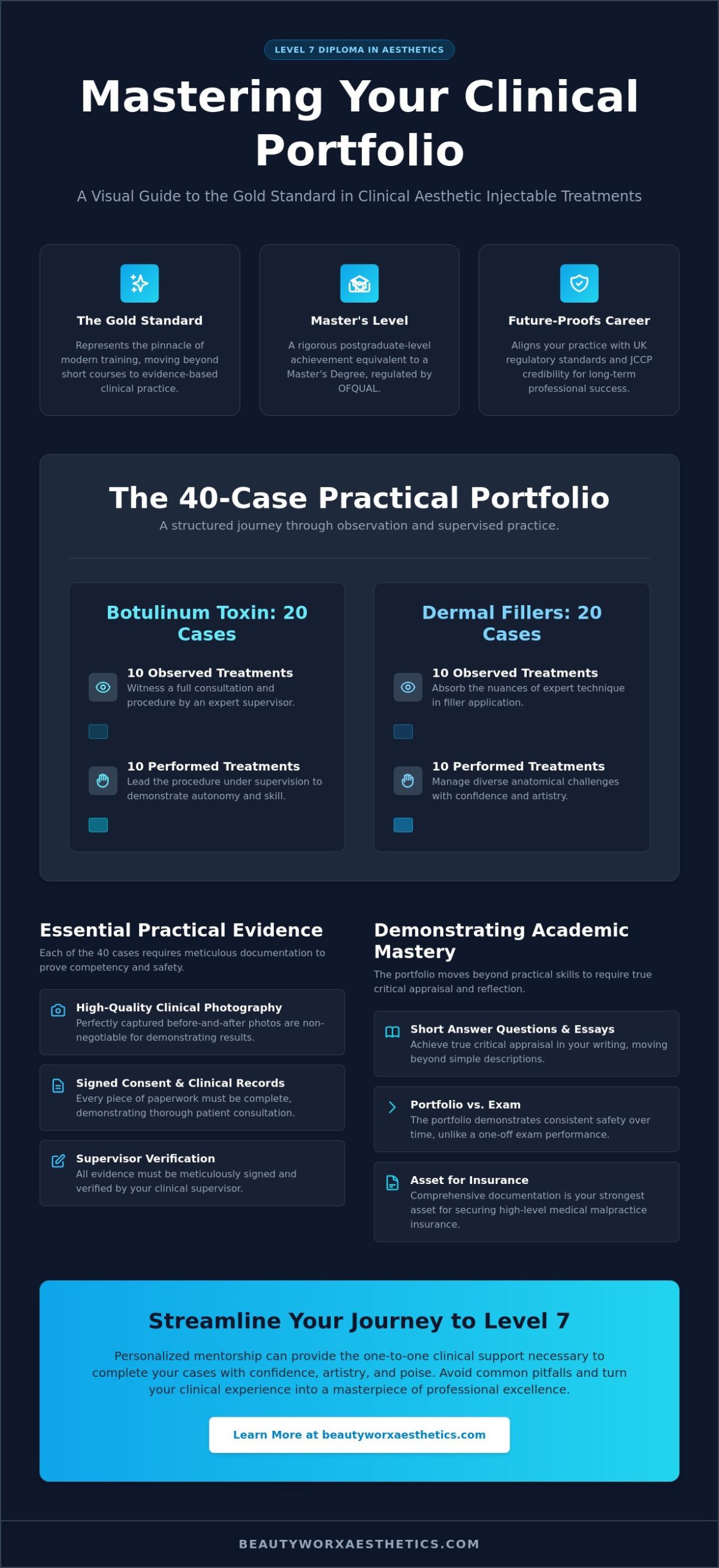
The Level 7 Diploma in Clinical Aesthetic Injectable Treatments represents the pinnacle of modern training. It signals a decisive departure from the era of rapid, superficial “short courses” and moves toward a future rooted in evidence-based clinical practice. This qualification isn’t just a certificate; it’s a rigorous postgraduate-level achievement equivalent to a master’s degree. At its heart lies the clinical portfolio. Far from being a mere collection of paperwork, it serves as a living document of your professional evolution. It captures your growing discernment and your commitment to the delicate balance of safety and artistry in Aesthetic medicine.
This shift reflects a broader industry trend toward longevity and wellness. Practitioners are no longer just injecting; they are acting as trusted guides in a client’s emotional journey toward self-confidence. Your portfolio becomes the silent witness to this partnership, documenting the subtle, natural-looking results that define your personal brand. It moves you away from the sterile coldness of clinical checklists and toward a more empathetic, patient-centered approach that prioritizes long-term vitality over temporary change.
The Role of OFQUAL and JCCP in Your Career
Regulatory bodies like OFQUAL provide a framework that ensures patient safety and professional longevity. By choosing a regulated qualification, you’re future-proofing your career against potential legislative shifts in the UK. Being on the JCCP register provides an additional layer of credibility, distinguishing you as a practitioner who values transparency. While CPD-accredited certificates offer valuable updates, they lack the comprehensive oversight of an OFQUAL-regulated diploma. This distinction is vital for those who view their craft as a lifelong partnership in self-care and graceful aging.
Portfolio vs. Exam: Why Documentation is Your Strongest Asset
Standard exams capture only a single moment of performance, often under significant stress. In contrast, the level 7 aesthetics portfolio requirements demand a cumulative depth that proves consistent clinical safety over time. You don’t just perform a treatment once; you demonstrate a pattern of expert care across 40 distinct clinical cases. This documentation acts as your strongest asset when securing high-level medical malpractice insurance. Meeting these level 7 aesthetics portfolio requirements provides a clear roadmap for your professional growth, transforming your daily work into a structured narrative of clinical excellence and artistic discernment.
The Practical Portfolio Requirements: Documenting 40 Clinical Cases
To reach the pinnacle of clinical excellence, you must move beyond theory into the tangible world of patient care. The level 7 aesthetics portfolio requirements mandate a total of 40 clinical cases. This isn’t just a number. It’s a structured journey designed to ensure you’ve witnessed and managed a diverse range of anatomical challenges. By treating various areas, such as the periorbital region or the mid-face, you demonstrate the clinical breadth necessary to practice with true discernment. This cumulative experience transforms you from a student into an expert artisan who understands the nuances of facial harmony.
Observation vs. Supervised Practice: The Critical Split
The 40 cases are divided into two distinct categories: Botulinum Toxin and Dermal Fillers. For each modality, you’ll need to document 10 observed treatments and 10 performed treatments. A valid observation involves watching an expert clinical supervisor conduct a full consultation and procedure, allowing you to absorb the nuances of their technique. When you transition to the 10 performed cases, you’ll take the lead. While your supervisor remains present to ensure safety, you’re expected to demonstrate a high level of autonomy. They’ll ultimately sign off on your competency, certifying that your skills meet rigorous national criteria.
Essential Evidence: Photos, Consent, and Clinical Notes
Precision is paramount when gathering evidence. Your clinical photography must be standardized, using consistent lighting and angles to clearly show the subtle, restorative changes in your patients. These “before and after” images are more than just portfolio fillers; they’re vital clinical records. You’ll also need to manage comprehensive medical histories and signed consent forms for every patient. This level of detail is increasingly important given the evolving UK regulation of non-surgical cosmetic procedures. Within these files, your clinical notes act as the narrative thread of the patient journey, detailing every decision made from initial assessment to post-treatment care.
Reflective Practice: The Key to Passing the Practical Units
Success in your practical units depends on your ability to look back. For every treatment you perform, you’ll write a clinical reflection. This isn’t just a summary of what happened. It’s an honest appraisal of your performance, where you identify what went well and where you could refine your approach. This habit of self-critique is deeply linked to effective complications management. It proves you’re a practitioner who prioritizes safety and continuous improvement. If you’re feeling overwhelmed by these level 7 aesthetics portfolio requirements, our team at Beauty Worx can provide the structured mentorship you need to succeed.
The Academic Portfolio: Critical Appraisal and Theoretical Mastery
While the 40 clinical cases form the practical heart of your journey, the academic component provides the intellectual scaffolding that supports every needle placement. The level 7 aesthetics portfolio requirements extend far beyond simple observation; they demand a rigorous engagement with Short Answer Questions (SAQs) and long-form essays. You’re expected to move past basic descriptions of procedures. Instead, you’ll engage in “Critical Appraisal,” a sophisticated process of evaluating the strengths and limitations of various clinical approaches. This ensures that your practice isn’t just a series of learned movements, but a considered application of scientific principles.
A true artisan understands the canvas beneath the surface. Your portfolio must document a profound understanding of facial anatomy, integrating knowledge of muscle layers and intricate vascular maps with your injection technique. It’s about more than avoiding complications. It’s about achieving that elusive, natural-looking restoration that honors the client’s inherent features. This theoretical mastery transforms your work from a transaction into a specialized craft, providing the quiet confidence that comes from deep, evidence-based knowledge.
Demonstrating Advanced Facial Anatomy Knowledge
Level 7 demands a deeper dive into the delicate architecture of the face. You’ll need to demonstrate a precise grasp of “danger zones” where vascular compromise is a risk. By documenting your understanding of these high-stakes areas, you prove your commitment to patient safety. This depth of knowledge is what elevates a standard treatment into the art of facial aesthetics, where every enhancement is guided by a meticulous map of the individual’s unique anatomy.
Evidence-Based Practice and Literature Reviews
To satisfy the level 7 aesthetics portfolio requirements, your writing must be anchored in peer-reviewed research. You’ll move from simply learning a technique to critically analysing a modality through the lens of current clinical studies. This involves sourcing and citing high-quality evidence to justify your clinical decisions. Aligning your work with the JCCP Competency Framework ensures your practice remains at the forefront of the industry. Staying current with safety updates and emerging trends isn’t optional; it’s a hallmark of the professional excellence required for this master’s-level qualification.
Navigating the Challenges: How to Build a Submission-Ready Portfolio
Building a submission-ready portfolio is an exercise in meticulous detail. It requires a level of organizational discipline that matches your clinical precision. Many practitioners find the volume of the level 7 aesthetics portfolio requirements daunting, particularly when balancing a full patient list with academic study. The most common reason for a portfolio referral isn’t a lack of skill; it’s usually a lapse in documentation. Missing signatures, undated forms, or inconsistent terminology can stall your progression just as you reach the finish line. Approaching this task with the quiet confidence of a specialist ensures your hard work is reflected in a flawless final submission.
Common Portfolio Pitfalls and How to Avoid Them
A frequent error involves “generic” reflections. Your assessors are looking for individual patient insight, not a repetitive description of the procedure. Each case should highlight the unique anatomical considerations or the specific emotional journey of that client. Ensure every clinical signature is dated correctly at the time of treatment. Retrospective signing is often easy to spot and can lead to immediate referral. Consistency is your ally; ensure the medical terminology you use in your long-form essays aligns perfectly with your practical clinical notes to project an image of artistic discernment.
Time Management and Data Privacy in Aesthetics
Managing 40 patients alongside a busy career requires a strategic, fluid approach. Don’t let a backlog build up. Documenting your cases in real-time ensures that the nuances of the consultation are fresh in your mind, capturing the vitality and clarity of the clinical encounter. This discipline also extends to your role as a data controller. You’re legally responsible for the sensitive information you collect. Secure, encrypted storage for your patient portfolios is a clinical necessity, not an optional extra. GDPR compliance protects both you and your clients, maintaining the professional trust that is so vital in our industry.
Before you consider your work complete, conduct a thorough final audit. This self-review is your last defense against administrative errors that could delay your professional recognition. Use this checklist to ensure your submission meets the highest standards:
- Are all 40 cases present and correctly categorized between toxin and filler?
- Is every consent form signed and dated by both the practitioner and the patient?
- Do your “before and after” photos maintain consistent lighting, background, and positioning?
- Have you cross-referenced your SAQs with the latest peer-reviewed evidence and clinical guidelines?
Navigating these level 7 aesthetics portfolio requirements is a significant milestone in your professional evolution toward clinical excellence. If you’re looking for a supportive environment where clinical expertise meets luxury education, explore our Level 7 Diploma in Clinical Aesthetic Injectable Treatments to begin your journey with confidence and poise.
Elevating Your Journey: Mentorship and Portfolio Support at Beauty Worx
At Beauty Worx, we believe that your education should be as refined as the results you provide for your clients. Our approach creates a sanctuary where clinical expertise meets the elegance of luxury training, ensuring you feel both safe in your decisions and pampered in our upscale environment. Completing the level 7 aesthetics portfolio requirements is a journey of professional transformation, and it shouldn’t be traveled alone. We view the Level 7 Diploma as a lifelong partnership in professional excellence, acting as a knowledgeable guide to help you navigate your options without pressure.
The 40-case requirement is a significant undertaking that demands steady focus and meticulous detail. One-to-one mentorship is the foundation of our program, providing you with the dedicated attention needed to master complex anatomical challenges with grace. Our aesthetic courses are intentionally structured to facilitate this success, moving at a pace that invites trust-building and careful contemplation. We ensure that every case you document is a reflection of your growing expertise and your ability to deliver results that suggest vitality and balance.
The Importance of Expert Clinical Supervision
Our mentors offer real-time feedback during your supervised practice, providing the steady, fluid rhythm necessary for clinical growth. This hands-on support builds the “quiet confidence” of a specialist who views their craft as both a science and an art form. In an environment that prioritizes artistic discernment, you’ll learn to preserve a client’s inherent features while achieving subtle, restorative improvements. This empathetic guidance ensures your documentation for the level 7 aesthetics portfolio requirements reflects a high-end, meticulous standard of care that prioritizes the patient’s emotional journey.
Beyond the Diploma: Building a Professional Legacy
Your completed portfolio is more than a formal requirement for graduation. It’s a career-long reference for clinical best practice that you’ll return to for years to come. It documents your transition from a student to an expert artisan, serving as a permanent testament to your commitment to safety, cleanliness, and artistic discernment. This narrative of clinical excellence becomes your professional legacy, framing your services not as one-off transactions but as an ongoing partnership in self-care and graceful aging. It’s a guarantee to your future clients that your work is discreet, tailored, and rooted in the highest standards of the industry.
For practitioners ready to commit to the highest professional standards and secure their place at the forefront of the industry, the journey toward mastery begins here. We invite you to join us in a setting that celebrates both the science of injectable treatments and the art of the aesthetic encounter.
Your Path to Professional Distinction
Your journey toward becoming a recognized expert in clinical aesthetics is defined by more than just technical skill; it’s a commitment to the highest standards of patient safety and artistic discernment. By mastering the level 7 aesthetics portfolio requirements, you transition from an injector to a trusted artisan, capable of delivering the subtle, natural-looking results that modern clients desire. You’ve seen how documenting 40 clinical cases and engaging in critical academic appraisal ensures your practice remains both safe and evidence-based.
At Beauty Worx, we provide a sophisticated training environment and expert clinical mentorship to help you navigate this complex path with poise. Our OFQUAL regulated qualifications offer a secure foundation for your professional longevity, ensuring you’re prepared for any future industry shifts. It’s time to transform your clinical documentation into a definitive record of your expertise and your dedication to the craft.
Enrol in the Level 7 Diploma and Begin Your Clinical Portfolio Today
We’re here to guide you through every reflection and every injection, supporting your evolution toward a career defined by clinical excellence and quiet confidence.
Frequently Asked Questions
How many cases do I need for my Level 7 aesthetics portfolio?
You must complete 40 clinical cases to satisfy the level 7 aesthetics portfolio requirements. This total includes a mandatory split between 20 botulinum toxin treatments and 20 dermal filler treatments. Within each of these categories, you’ll need to document 10 observed cases and 10 cases performed under direct supervision. This structure ensures you develop the quiet confidence of a specialist before practicing independently.
Can I use previous treatments I have performed towards my Level 7 portfolio?
Previous treatments performed outside of your regulated course cannot be used toward your portfolio. Every case must be witnessed and signed off by an approved clinical mentor to guarantee that your technique aligns with current national standards. This ensures that every entry in your portfolio is a verified reflection of your clinical evolution and commitment to patient safety and artistic discernment.
What happens if my Level 7 portfolio is referred or rejected?
If your portfolio is referred, don’t feel discouraged; it’s a natural part of the clinical learning process. You’ll receive specific feedback from your assessor highlighting areas that need refinement, such as missing signatures or a need for deeper critical appraisal in your essays. Once you’ve addressed these points, you can resubmit your work for final marking and professional recognition.
How long do I have to complete the Level 7 aesthetics portfolio?
The timeframe for completion typically ranges from 6 to 36 months, though most practitioners finalize their work within 12 to 24 months. This flexibility allows you to balance your busy career with the meticulous documentation required for clinical excellence. It’s an aspirational journey that invites a steady, fluid pace rather than a rushed approach to your professional development.
Do I need to find my own models for the 40 clinical cases?
You should check with your specific training provider regarding model provision for your 40 clinical cases. While some luxury educational environments assist with model sourcing, others require you to find your own patients to ensure a diverse range of anatomical challenges. Sourcing your own models can often help you build the long-term client partnerships that define a successful aesthetic career.
Is the Level 7 portfolio different for medics and non-medics?
The level 7 aesthetics portfolio requirements are standardized by awarding bodies to ensure a consistent level of competence across the industry. While entry criteria for the diploma itself may vary depending on your professional background, the clinical evidence required remains the same. This ensures that every practitioner holding the qualification has proven their ability to meet rigorous, master’s-level standards regardless of their starting point.
What clinical evidence is required for the dermal filler section of the portfolio?
For the dermal filler section, you’ll need to provide standardized “before and after” photography, comprehensive medical histories, and signed consent forms. Each of the 20 filler cases must also include detailed clinical notes that act as a narrative thread for the patient’s journey. This evidence proves your ability to achieve subtle, restorative results while maintaining the highest levels of clinical safety.
How do I ensure my portfolio is GDPR compliant?
To ensure GDPR compliance, you must act as a responsible data controller by using secure, encrypted storage for all patient records. Pseudonymize patient data where possible and ensure that your consent forms explicitly cover the use of their information for educational assessment purposes. This meticulous approach to privacy protects your clients’ emotional journey and reinforces the professional trust essential to your practice.










 Reviews