What if the defining mark of an aesthetic artisan isn’t found in the forehead, but in the sophisticated architecture of the jawline and neck? Many practitioners reach a plateau where they feel more like technicians than artists, limited by the safety of standard three-area treatments while fearing the risks of smile asymmetry or speech impediments. It’s a common crossroads in a clinician’s journey, yet it’s exactly where the most transformative growth begins.
By investing in comprehensive lower face botox training, you’ll bridge the gap between basic competency and true clinical mastery. We’ll show you how to treat the chin, jaw, and platysmal bands with the delicate precision that commands higher fees and fosters deep patient trust. You’ll discover how to deliver predictable, natural-looking results that preserve your patient’s inherent beauty rather than masking it. It’s about moving toward a future where your clinical confidence matches your creative vision.
As the UK prepares for the mandatory licensing scheme taking effect in July 2026, securing your expertise through advanced qualifications is no longer just an option; it’s a necessity for a thriving practice. This guide outlines the technical skills, safety protocols, and professional milestones you need to lead the industry with grace and authority.
Key Takeaways
- Understand the vital distinction between upper face smoothing and the functional complexity of lower face musculature to ensure patient safety and comfort.
- Learn how to master sophisticated indications like the Depressor Anguli Oris (DAO) to achieve subtle, life-changing results that restore a patient’s natural vitality.
- Discover why advanced lower face botox training is the essential bridge that transforms a standard aesthetics technician into a highly sought-after clinical artisan.
- Evaluate the long-term benefits of pursuing an OFQUAL regulated Level 7 Diploma to future-proof your practice ahead of the 2026 licensing changes.
- Gain insight into the dynamic assessment techniques required to maintain perfect facial balance and provide the bespoke results that modern patients demand.
Beyond the Basics: Why Lower Face Botox Training is the Essential Next Step
Transitioning from the forehead to the chin is more than just a geographic shift on the face; it’s a profound evolution in your clinical perspective. While foundation courses focus on the relative safety of the upper third, lower face botox training invites you to master the intricate architecture of the muscles below the malar bone. This is where the true artistry of facial rejuvenation happens. By understanding how Botulinum toxin interacts with the dynamic muscle groups of the jaw and neck, you move away from simple line-chasing toward a holistic approach to facial harmony.
The Shift from Upper to Lower Face Dynamics
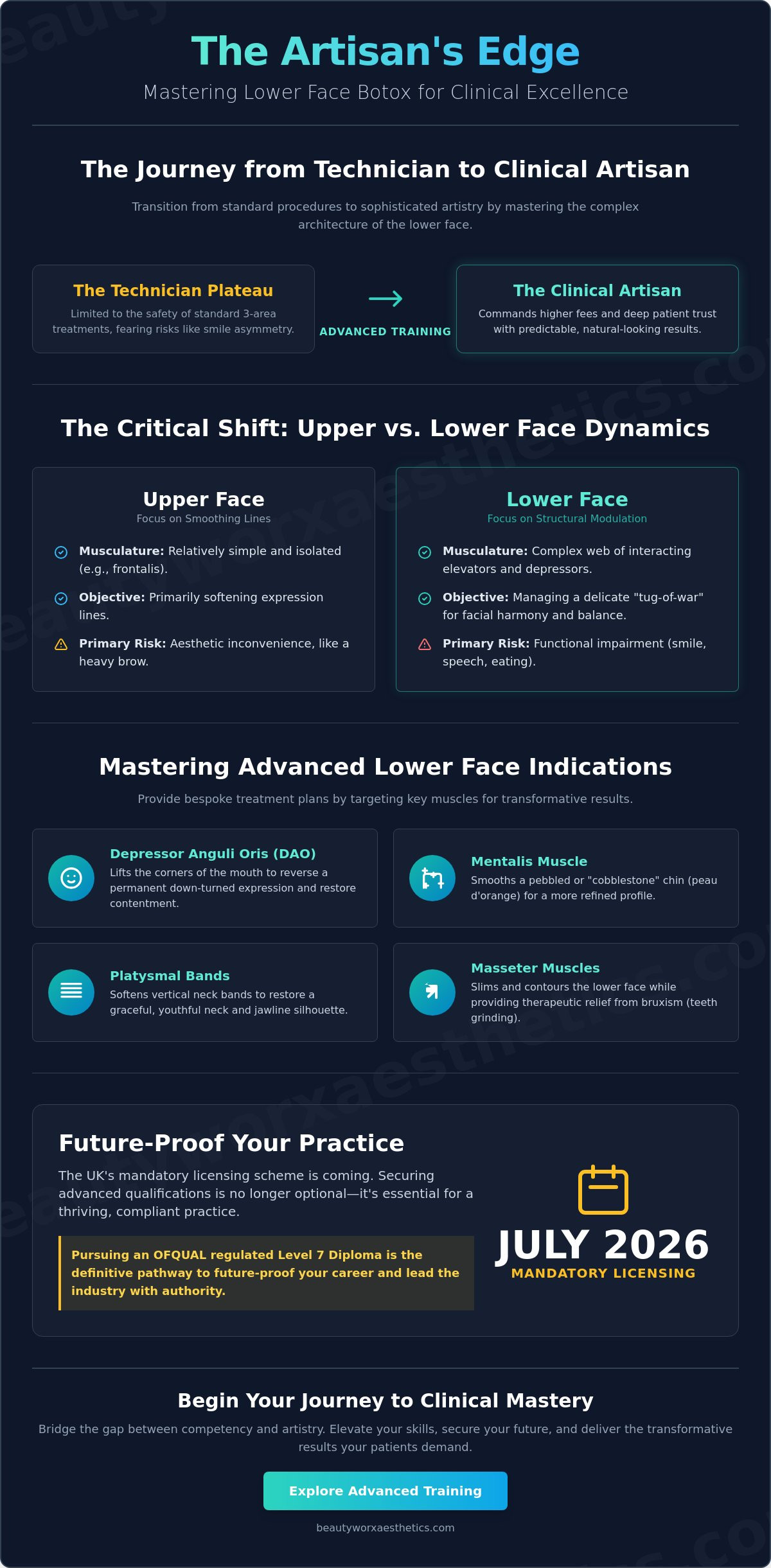
The stakes change significantly when you move below the cheekbones. In the upper face, a slightly heavy brow is an aesthetic inconvenience; in the lower face, a misplaced injection can impair a patient’s ability to smile, speak, or even eat properly. You’re no longer just softening expression lines; you’re managing a delicate tug-of-war between elevator and depressor muscles. A sophisticated understanding of these antagonistic relationships is vital to prevent the dreaded frozen or asymmetrical look. Mastery here requires rigorous patient selection, as the structural support of the skin and the patient’s unique dental anatomy play a much larger role in the final aesthetic outcome.
This advanced skill set serves as a critical bridge. It takes you from the basic three areas toward the comprehensive excellence required for a Level 7 Diploma. It’s the moment you stop being a technician and start being a clinical artisan, a journey we explore in depth within our guide to aesthetic courses for the modern practitioner.
Commercial Benefits for Your Aesthetics Practice
From a business perspective, the ability to offer full-face rejuvenation creates a clear distinction between your practice and budget providers who only treat standard areas. Patients seeking a refined, refreshed appearance often don’t want their forehead smoothed in isolation. They want a balanced profile and a lifted jawline. These are your most loyal clients. They aren’t looking for a quick fix; they’re looking for a long-term partnership in graceful aging. Mastering these areas allows you to address common concerns that foundation training misses:
- The DAO: Lifting the corners of the mouth to reverse a permanent down-turned expression.
- The Mentalis: Smoothing a pebbled or cobblestone chin for a more refined profile.
- The Platysma: Softening neck bands to restore a graceful, youthful silhouette.
- The Masseters: Slimming the lower face while providing relief from nocturnal grinding.
Mastering these complex indications allows you to provide bespoke treatment plans that address the patient’s entire emotional journey toward self-confidence. Your specialized expertise in high-risk areas naturally justifies a more premium pricing structure that reflects the years of training and artistic discernment required to deliver safe, beautiful results.
Complex Anatomy and Precision: Mastering Lower Face Indications
Expertise in the lower face requires a shift from superficial smoothing to structural modulation. During advanced lower face botox training, you’ll explore the sophisticated interplay between muscles that govern our most essential human expressions. Unlike the frontalis, which acts largely in isolation, the muscles of the lower face are a complex web of elevators and depressors. Precision here is paramount. You aren’t just treating a line; you’re influencing the mechanical balance of the entire lower facial structure.
Restoring a patient’s natural vitality often begins with the Depressor Anguli Oris (DAO). By precisely targeting this muscle, you can release the downward pull on the mouth corners, subtly shifting an expression from one of fatigue to one of quiet contentment. Similarly, treating the Mentalis muscle addresses the “peau d’orange” or cobblestone texture of the chin. This procedure doesn’t just smooth the skin; it refines the entire profile. For patients seeking a more defined silhouette, the “Nefertiti Lift” utilizes toxins in the Platysma bands to sharpen the jawline and soften the transition to the neck, creating a sculpted elegance that was once only achievable through surgery.
Targeting the Perioral Area Safely
The perioral region is a high-stakes environment where millimetres matter. The “Lip Flip” has become a signature request, using minute doses to relax the Orbicularis Oris and gently roll the vermillion border outward. It’s a delicate alternative to dermal fillers for those seeking a subtle enhancement. Precision is equally vital when correcting a “gummy smile” by targeting the Levator Labii Superioris Alaeque Nasi (LLSAN). To ensure a safe botulinum toxin injection, you must master the exact depth and dosage required to avoid impacting a patient’s speech or ability to eat comfortably. One misplaced unit can significantly alter the symmetry of a smile.
The Masseter Muscle: Aesthetic and Functional Balance
Treating the masseter muscle offers a unique intersection of aesthetic refinement and functional relief. While many patients seek jawline slimming to achieve a more heart-shaped facial contour, others find profound relief from the discomfort of bruxism. Success in this area relies on identifying the anatomical “Safe Zone.” You must stay within the borders of the masseter to avoid the Risorius muscle, which controls the lateral pull of the smile. Misplacing a dose here can lead to a devastating loss of facial symmetry. If you’re ready to master these intricate techniques, our aesthetic courses provide the clinical environment and expert guidance needed to refine your practice with confidence.
Artistic Balance: How Lower Face Injections Transform Patient Outcomes
Clinical precision is the foundation of your practice, but artistic discernment is its pinnacle. While foundation courses teach you to identify and treat isolated wrinkles, advanced lower face botox training empowers you to view the face as a living, breathing canvas. In the lower third, the goal isn’t the total eradication of movement. Instead, it’s about restoring a sense of balance and vitality. You’re looking to soften the visual cues of fatigue and gravity, ensuring that every result feels like a natural extension of the patient’s inherent beauty.
Mastering this area requires a sophisticated approach to patient assessment. A face at rest tells only half the story. You must evaluate the lower face in motion, observing how muscles interact during speech, laughter, and expression. Static assessment identifies where lines have etched into the skin, but dynamic assessment reveals the overactive muscle groups that cause them. This dual perspective allows you to create a bespoke treatment plan that addresses the root cause of ageing rather than just the symptoms, ensuring that the results remain authentic and discreet.
Restoring the “Triangle of Youth”
Ageing is often defined by a structural shift from an upright triangle, where volume sits high in the cheeks, to an inverted one, where the weight pulls toward the jawline. Advanced toxin treatments are essential tools in combating this downward pull. By selectively relaxing the depressor muscles, you can subtly lift the facial architecture. For a truly rejuvenated profile, many practitioners find success in combining DAO injections with lip augmentation filler. This multi-modality approach addresses both the muscle activity pulling the mouth corners down and the volume loss that contributes to a tired appearance. It’s a sophisticated way to restore the “Triangle of Youth” without ever looking overdone.
Avoiding the “Over-Treated” Look
The lower face is a region where the “less is more” philosophy isn’t just a suggestion; it’s a rule for safety and aesthetics. Because these muscles are vital for functional movements, micro-dosing, or “Baby Botox,” is often the superior choice for perioral areas. The objective is to reduce muscle overactivity while maintaining the patient’s ability to express themselves fully. A successful treatment is one where the patient looks rested and refreshed, yet their friends and family can’t quite pinpoint why. This level of subtlety is what differentiates a clinical artisan from a technician. It requires a deep understanding of dosage and depth, ensuring that every unit of toxin serves a clear, aesthetic purpose without compromising facial character.
This journey toward artistic mastery begins with a transparent consultation. Managing expectations is crucial. You aren’t promising a frozen, line-free face, but rather a subtle restoration of harmony. When patients understand the emotional journey toward self-confidence is a partnership, they value your expertise as a guide rather than just a provider of a service.
Evaluating Quality: What to Look for in Advanced Aesthetics Training
Choosing the right educational pathway is perhaps the most critical decision in your professional journey. While a one-day CPD workshop might offer a brief introduction, it rarely provides the depth required for high-stakes procedures in the lower third of the face. Advanced lower face botox training should be an immersive experience that prioritizes patient safety as much as aesthetic outcomes. You’re looking for a programme that doesn’t just teach you where to inject, but why a specific anatomical approach is necessary for that individual patient’s unique features.
A truly professional curriculum must include a robust complications management course module. In the lower face, where muscle activity is tied to essential functions like speech and expression, the ability to identify and mitigate adverse effects is what separates a novice from an expert. Ongoing mentorship and access to a clinical support network are also vital. These resources ensure you’re never navigating complex cases in isolation, providing a safety net as you transition into advanced practice.
The Importance of OFQUAL Regulation
Regulation is the cornerstone of trust in the aesthetics industry. An OFQUAL regulated qualification, such as the Level 7 Diploma in Clinical Aesthetic Injectable Treatments, provides a level of professional security that simple attendance certificates cannot match. It signals to insurers and patients alike that you’ve met rigorous national standards for clinical excellence. In the current UK regulatory landscape, an OFQUAL certificate acts as a definitive credential that future-proofs your practice against the mandatory licensing changes taking effect from July 2026. This level of certification protects your professional reputation and ensures your patients feel safe in your care. It’s an investment in your career longevity that pays dividends in both patient trust and clinical confidence.
Practical Experience and Live Models
Injecting a silicone mannequin can’t replicate the nuance of human anatomy. Live model practice is non-negotiable for mastering the lower face. You need to feel the resistance of real tissue and observe how different skin types and ages respond to neurotoxin. Supervised practice allows you to assess a variety of facial structures under the watchful eye of a specialist, building the clinical confidence required to treat real patients. It’s during these hands-on sessions that you learn to appreciate the subtle differences in muscle strength and skin laxity that dictate your final results. You’ll learn to adjust your technique in real-time, a skill that’s impossible to acquire through a screen or a textbook.
If you’re ready to elevate your practice with a qualification that commands respect, explore our range of aesthetic courses and take the next step toward clinical mastery.
The Beauty Worx Pathway: Elevating Your Practice to Level 7 Excellence
Choosing where to refine your craft is a decision that defines the future of your practice. At Beauty Worx Aesthetics, we provide a sophisticated environment for our aesthetic courses, where the atmosphere mirrors the high-end clinical settings our students aspire to lead. Our advanced anti-wrinkle programme is designed for practitioners who are no longer satisfied with the status quo. It’s a meticulous journey into clinical mastery, created for those who view their work as a delicate art form. By prioritizing a deep understanding of facial aesthetics, we ensure that every graduate possesses the discernment to enhance a patient’s features while preserving their inherent character.
Our specialized lower face botox training is conducted in small, intimate groups. This ensures a personalized learning experience where every movement is guided by an expert hand. We focus on the subtle details that create transformative results, from the precise depth of an injection to the artistic balance of the jawline. You’ll learn to navigate the complexities of the lower face with the quiet confidence of a specialist, moving beyond basic treatments to offer comprehensive rejuvenation that resonates with your most discerning patients.
Mentorship Beyond the Classroom
We don’t view our students as temporary visitors. Instead, we foster an ongoing partnership in your professional growth. Our commitment to your career extends far beyond the final day of your course. You’ll gain access to an elite network of expert practitioners and educators who provide the clinical support necessary to navigate complex cases. We’ll also help you transition your new skills into a profitable clinic service, ensuring that your investment in lower face botox training translates into tangible practice growth and enhanced patient loyalty. It’s a supportive journey toward becoming a trusted, expert artisan in your field.
Enrolling in Your Advanced Future
Securing your place in an evolving industry requires a clear, structured pathway. To enroll in our advanced training, practitioners typically need to have completed a foundation anti-wrinkle injections course and hold a background in healthcare or a relevant aesthetic practice. Our enrollment process for the Level 7 Diploma in Clinical Aesthetic Injectable Treatments is designed to be seamless and transparent. We’ll guide you through the prerequisites and clinical requirements, ensuring you’re prepared for the postgraduate-level rigour that defines our academy. With the mandatory licensing scheme arriving in July 2026, there has never been a more vital time to align your practice with the highest standards of excellence.
Begin your journey to aesthetic mastery with Beauty Worx Academy today.
Defining Your Future in Clinical Artistry
The transition from standard treatments to full-face rejuvenation represents a significant milestone in your professional journey. By mastering the delicate musculature of the jaw, chin, and neck, you move beyond the limitations of basic 3-area injections to offer the sophisticated, balanced results that define modern aesthetics. This expertise isn’t just about technical precision; it’s about the artistic discernment required to restore a patient’s natural vitality while preserving their authentic expression.
As you prepare for the regulatory shifts of 2026, investing in high-calibre lower face botox training is the most effective way to future-proof your career and elevate your practice’s prestige. At Beauty Worx Academy, we are an OFQUAL Regulated Academy offering 25+ CPD Accredited Courses designed to guide you toward clinical excellence. Through our elite professional mentorship, you’ll gain the confidence to treat complex indications with the grace and authority of a true specialist.
Explore our OFQUAL regulated aesthetics training programmes and take the definitive step toward your advanced future. Your journey toward clinical mastery starts with a single, intentional choice to lead with excellence and artistry.
Frequently Asked Questions
Is lower face botox safe for non-medical practitioners in the UK?
Lower face botox is safe for non-medical practitioners who hold accredited qualifications and adhere to the strict clinical standards set by the UK government. The upcoming mandatory licensing scheme, taking effect in July 2026, will require all practitioners to demonstrate their competency through recognized training. This ensures that every patient receives care in a safe, professional environment regardless of the practitioner’s initial background.
What are the most common risks associated with lower face botox?
The primary risks include temporary smile asymmetry, speech impediments, or minor difficulties with eating if the toxin spreads to unintended muscle groups. Because the lower face is vital for functional movement, precision is essential. These risks are significantly minimized when you undergo specialized training that focuses on the anatomical safe zones and the delicate balance of elevator and depressor muscles.
How much can I charge for advanced lower face botox treatments?
Practitioners usually command premium fees for advanced lower face indications compared to standard upper face treatments. This reflects the specialized skill set required and the increased clinical responsibility involved in treating complex areas like the masseters or platysmal bands. Patients are often willing to invest more in a practitioner who demonstrates the artistic discernment necessary for subtle, high-end results.
Do I need a prescriber to offer lower face botox services?
Yes, you must work with a qualified prescriber because Botulinum toxin is a prescription-only medicine in the UK. A face-to-face consultation between the patient and a prescriber, such as a doctor or nurse prescriber, is a mandatory requirement before any treatment can be administered. This ensures the procedure is clinically appropriate and prioritizes the patient’s long-term health and safety.
How long does a lower face botox training course take to complete?
The time commitment varies based on the depth of the programme you select. A focused practical day for lower face botox training might provide 12 hours of CPD for experienced injectors. In contrast, a comprehensive Level 7 Diploma, which offers the most prestigious clinical qualification, can take anywhere from 6 to 36 months to complete as you build a thorough portfolio of supervised cases.
What is the difference between a lip flip and dermal fillers?
A lip flip uses minute doses of toxin to relax the orbicularis oris muscle, gently rolling the lip outward for a subtle, refreshed appearance. Dermal fillers, however, involve injecting a gel-like substance to add physical volume and structural definition. While fillers change the lip’s size, a lip flip is an artful technique designed to enhance the lip’s natural shape without adding mass.
Can lower face botox help with a sagging jawline?
Lower face botox is an effective non-surgical tool for refining a sagging jawline through the Nefertiti Lift technique. By injecting toxins into the overactive platysma bands in the neck, you reduce the downward pull on the lower face. This allows the upward-pulling muscles to create a more defined, sculpted silhouette, offering a graceful alternative to more invasive procedures for patients with early skin laxity.
What qualifications do I need before taking an advanced botox course?
Most advanced programmes require you to have completed a foundation anti-wrinkle injections course and possess a basic understanding of aesthetic practice. Many practitioners choose to hold a Level 4 or Level 5 certificate before progressing to advanced lower face botox training. This ensures you have the clinical foundation and injection experience necessary to master the high-stakes anatomy of the lower third of the face with confidence.










 Reviews