Can you truly master the delicate artistry of a facial contour or the precise tactile resistance of dermal tissue through a high-definition screen? It’s a question that weighs heavily on practitioners as they weigh the merits of online vs in-person aesthetics training. You’ve likely felt the pull of digital convenience, yet the quiet anxiety of being uninsurable or, worse, causing a clinical complication due to a lack of hands-on mentorship is difficult to ignore. It’s natural to feel overwhelmed by the sudden influx of unaccredited courses that prioritize speed over clinical safety.
You deserve a training path that respects both your professional ambition and the safety of your future clients. This article explores how to balance the flexibility of digital theory with the essential tactile mastery of in-person practice, ensuring you’re prepared for the UK’s mandatory licensing scheme arriving in July 2026. We’ll outline how to move beyond basic science to master the true art of aesthetics, helping you secure a regulated qualification that guarantees long-term career stability and the confidence to treat live patients with grace. Discover how to choose a path that transforms technical knowledge into clinical excellence.
Key Takeaways
- Distinguish between simple CPD certificates and OFQUAL regulated qualifications to ensure your practice meets the rigorous standards required by the 2026 licensing scheme.
- Master the sensory discipline of aesthetics by understanding how supervised, in-person practice develops the critical tactile awareness known as “syringe-feel.”
- Navigate the complexities of online vs in-person aesthetics training by discovering how a hybrid approach offers both digital convenience and essential clinical mentorship.
- Secure your professional future by choosing pathways like the Level 7 Diploma in Clinical Aesthetic Injectable Treatments, which validates your clinical competence for insurers.
- Learn to harmonize the science of injectable treatments with the artistic discernment required to deliver the subtle, restorative results that define a luxury aesthetic practice.
The Evolution of Aesthetic Education: Navigating the Digital Shift
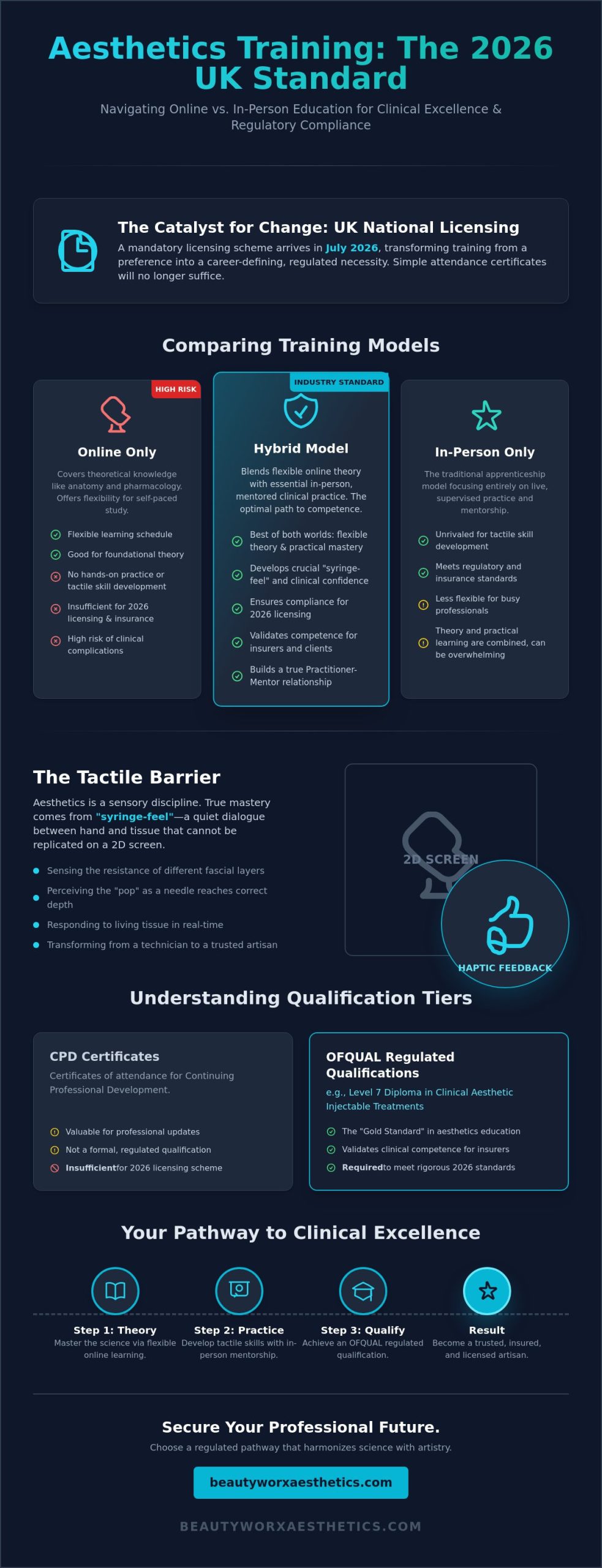
The 2026 landscape of aesthetic education is undergoing a quiet, sophisticated revolution. As the field of Aesthetic medicine matures into a highly regulated specialty, practitioners must navigate a complex choice between convenience and clinical depth. The introduction of the UK’s national licensing scheme in July 2026 has transformed the debate surrounding online vs in-person aesthetics training from a mere preference into a career-defining decision. It’s no longer sufficient to simply hold a certificate of attendance; the modern practitioner needs a foundation built on regulated excellence that satisfies both insurers and government standards.
Digital platforms have democratized access to the intricate science behind the needle, allowing aspiring artisans to study anatomy and pharmacology from the comfort of a private study. This shift has created a clear distinction between CPD-accredited certificates, which serve as valuable updates for existing professionals, and OFQUAL regulated qualifications, such as the Level 7 Diploma. When evaluating online vs in-person aesthetics training, the choice often reflects one’s commitment to the craft. A truly professional journey requires a delicate balance between digital theory and the physical nuances of the clinic. The convenience of a screen can never replace the clarity found in a mentored, hands-on environment.
What is Online Aesthetics Training?
Virtual learning serves as the intellectual scaffolding of a successful career. It encompasses the vital study of facial anatomy, the pharmacology of toxins, and the legal frameworks of patient consent. For busy professionals, self-paced study offers a flexible way to absorb the science before stepping into the clinical environment. It’s essential to identify red flags during your research. Any course claiming to teach injecting techniques solely through a screen is a significant risk. Safety and confidence are born from physical practice, not just digital observation. Use online platforms to master the “why” so that your in-person time can focus entirely on the “how.”
The Resurgence of In-Person Clinical Mentorship
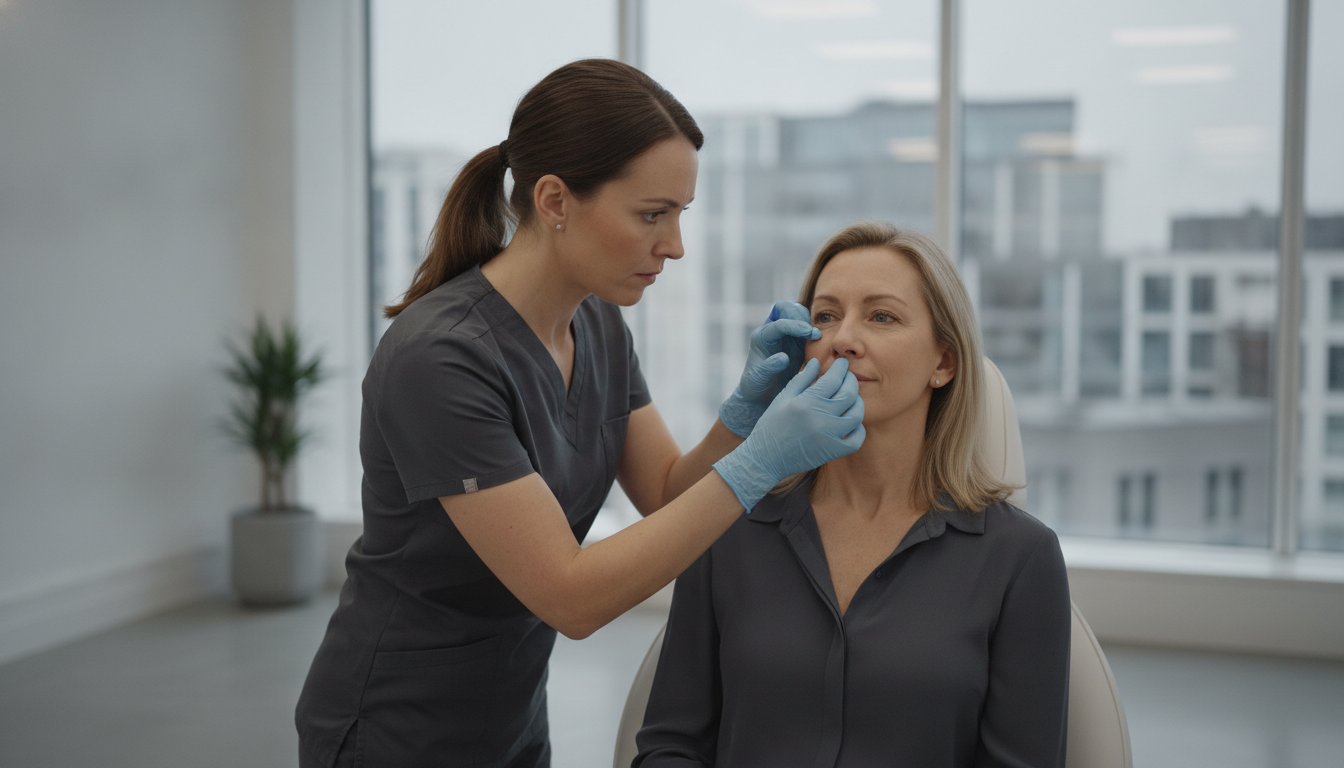
The industry is seeing a beautiful return to the apprenticeship model, where knowledge is passed from expert to student in a live setting. An authentic aesthetic training environment should mirror the luxury and precision of a high-end clinic. This in-person mentorship allows you to develop a “Practitioner-Mentor” relationship, which serves as a cornerstone for your long-term success. You’ll learn to read the subtle cues of patient tissue and manage the rhythm of a consultation. This tactile experience is what transforms a technician into a trusted artisan, ensuring your work remains discreet and your patients feel entirely safe and pampered.
The Tactile Barrier: Why Theory Alone Cannot Create an Artisan
Aesthetics is a sensory discipline that requires a mastery of sight, sound, and touch. While a digital curriculum can provide the intellectual framework of anatomy, it cannot replicate the haptic feedback essential for clinical safety. The “syringe-feel” is a quiet dialogue between the practitioner’s hand and the patient’s unique anatomy. It’s the ability to sense the subtle resistance of different fascial layers or the delicate “pop” as a needle reaches the correct depth. These sensory nuances are lost behind a 2D screen, where depth perception is flattened and the topography of the human face is reduced to a static image. Mastery in this field is an artisanal craft, requiring a physical connection that transcends digital observation.
The psychological transition from a student who understands theory to a clinician who performs with poise happens at the bedside. In the debate of online vs in-person aesthetics training, the tactile barrier remains the most significant hurdle for digital-only learners. True excellence involves more than just identifying landmarks; it’s about responding to the living tissue in real time. Because standards for training and safety vary globally, much like the state-by-state aesthetic regulations seen in the US, practitioners must ensure their hands-on skills are validated by expert mentors in a controlled environment. This supervised practice is what ensures your results are consistently discreet and restorative.
Mastering Tissue Interaction
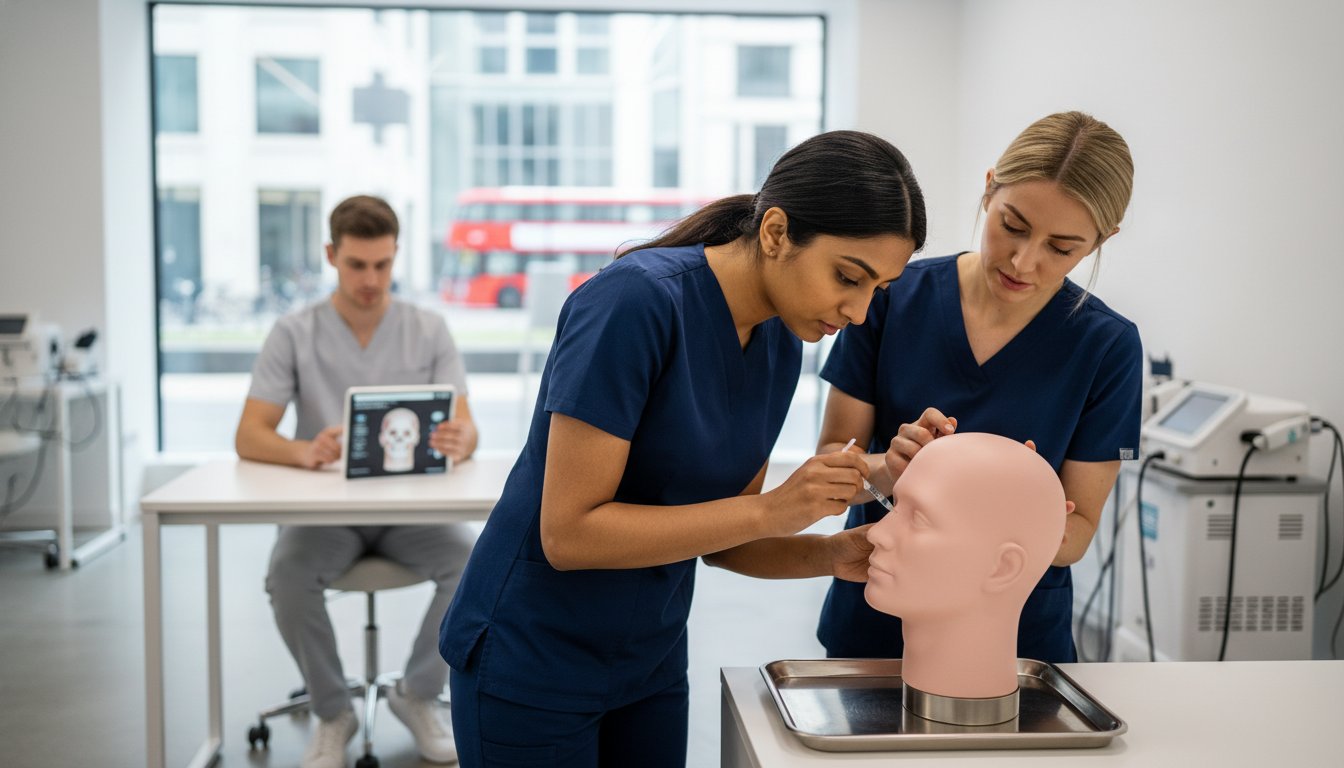
Injecting a mannequin provides a basic sense of placement, but a live patient presents a symphony of anatomic variation. No two faces match a textbook perfectly. During in-person sessions, you’ll learn to adjust your grip, angle, and aspiration technique based on the specific elasticity and thickness of the skin before you. This immediate, physical feedback loop is vital for preventing vascular events and ensuring the product sits perfectly within the intended plane. If you’re ready to move beyond the screen, you might consider exploring our range of clinical pathways to begin your hands-on journey.
Building Clinical Confidence
Managing the rush of adrenaline during your first live injection is a hurdle every artisan must clear. Expert supervision provides a safety net that allows you to focus on the “art” of facial aesthetics rather than just the mechanics. This environment allows for immediate correction, which is particularly critical when learning from a complications management course perspective. You’ll develop an “aesthetic eye” that prioritizes natural-looking results, learning exactly how much product is required to enhance a patient’s inherent features without over-correction. This confidence is what ultimately creates a pampering, secure experience for your future clients.
Comparing Online, In-Person, and Hybrid Training Models
Choosing an educational format is the first significant step toward clinical excellence. By 2026, the industry has moved away from viewing education as a simple binary choice. Instead, the focus has shifted toward a regulated progression that respects both the practitioner’s time and the patient’s safety. When evaluating online vs in-person aesthetics training, you must consider how each model impacts your “Time-to-Clinic” metric. This is the duration it takes to transition from a student to a safe, insured, and confident injector. While a purely digital route might seem faster, the long-term earning potential is often hampered by a lack of clinical confidence and the inability to secure insurance for high-risk procedures.
The investment you make today should secure your career for the next decade. A low-cost, theory-only certificate often becomes a “false economy” when you discover it doesn’t meet the rigorous standards of the latest UK licensing requirements. True clinical mastery requires a delivery method that builds upon itself. You need a foundation of science that is then tested through supervised, physical practice. This ensures that when you finally treat a patient in your own upscale setting, the experience is restorative for them and stress-free for you.
The Hybrid Gold Standard
The hybrid model has emerged as the preferred route for those pursuing an OFQUAL regulated Level 7 Diploma. This approach utilizes sophisticated digital portals for pre-course theory, anatomy refreshers, and pharmacology. By completing the “head-knowledge” online, you maximize your precious in-clinic time for advanced techniques, such as perfecting lip augmentation filler procedures. This format also provides a digital mentorship bridge, allowing for ongoing post-course support as you begin your journey toward becoming a trusted artisan.
Format Comparison Table
| Feature | Online-Only | In-Person Intensive | Hybrid (Regulated) |
|---|---|---|---|
| Tactile Skill | None | High | Exceptional |
| Flexibility | Highest | Low | Balanced |
| Insurance Acceptance | Very Low | High | Guaranteed (OFQUAL) |
| Regulatory Future | At Risk | Compliant | Future-Proof |
For non-medical students, the structured pathway of a hybrid model is particularly advantageous. It provides the necessary academic rigor while ensuring the physical skills are developed under the watchful eye of an expert mentor. This creates a sense of reliability and transparency that is crucial when you are building a reputation in the luxury service industry.
Regulation and Risk: Ensuring Your Qualification is Fit for Purpose
The introduction of the national licensing scheme in July 2026 has fundamentally altered the requirements for practitioners in England. It’s a pivotal moment where the distinction between a simple “certificate of attendance” and a regulated qualification becomes a matter of legal compliance. When practitioners weigh online vs in-person aesthetics training, they must look beyond the immediate convenience of a digital portal. A certificate earned through a screen often lacks the clinical weight required to join government-approved registers. By contrast, in-person assessments provide the rigorous validation that insurers and regulatory bodies now demand to ensure public safety.
The role of OFQUAL in this new era is to act as a guardian for both the practitioner and the public. Regulated qualifications provide a transparent benchmark of excellence, ensuring that your training meets high national standards. You might wonder if the higher investment of a regulated, in-person course is truly worth it. When you consider the long-term stability of your career, the answer is clear. A regulated path doesn’t just teach you how to inject; it protects your right to practice in an increasingly scrutinized industry. It’s the difference between a temporary hobby and a lifelong profession.
Future-Proofing Your Career
Professional indemnity insurance is the silent partner in every successful clinic. Insurers are becoming increasingly selective, often refusing to cover those who have only completed “fast-track” online courses. These digital-only certificates can lead to clinical and legal dead-ends, leaving you unable to practice or grow your business. Building a luxury brand requires a foundation of safety and high-level credentials. Clients who seek restorative, natural-looking results are looking for an artisan they can trust. Your qualifications are the first affirmation of that trust, serving as a guarantee of your meticulous standards.
The Safety Net of Supervised Practice
The complexities of complications management simply cannot be mastered through a screen. True clinical excellence requires you to observe real-time skin reactions and patient responses in a controlled, mentored environment. In-person training allows you to develop the ethical judgment needed for advanced injectable treatments, such as knowing when to suggest a subtle enhancement and when to advise against a procedure. This supervised practice acts as a safety net, giving you the quiet confidence to handle any clinical scenario with grace and professionalism. It ensures that every patient journey ends with a subtle, authentic result.
If you’re ready to secure your professional future with a qualification that meets the highest standards, explore our Level 7 Diploma in Clinical Aesthetic Injectable Treatments today.
Elevating Your Career with Beauty Worx: Where Science Meets Artistry
The journey toward becoming a distinguished practitioner requires more than just technical proficiency; it demands a philosophy that views every treatment as a unique piece of art. Beauty Worx Aesthetics bridges the gap between clinical theory and luxury practice by providing an environment where your professional evolution is nurtured with meticulous care. We understand that the debate of online vs in-person aesthetics training often leaves practitioners feeling torn between flexibility and depth. Our approach resolves this tension by integrating the highest academic standards with the warm, welcoming atmosphere of an upscale clinical setting.
Choosing Beauty Worx means joining a community of expert artisans dedicated to the preservation of inherent beauty. We don’t just teach the science of injectable treatments; we mentor you in the art of the consultation and the long-term partnership of patient care. Our hybrid model is designed to respect your professional time, allowing you to absorb the rigorous OFQUAL theory at your own pace before stepping into our facilities for intensive, hands-on mastery. This ensures your transition into the clinical world is fluid, steady, and grounded in absolute confidence.
A Bespoke Learning Journey
Every practitioner brings a unique background to their training, and we provide tailored support for both medical and non-medical students. Our facilities are equipped with state-of-the-art technology, offering you access to a diverse range of live models to ensure your tactile skills are truly comprehensive. When you practice at Beauty Worx, you’re learning the signature techniques that guarantee subtle, natural-looking results for your future clients. This focus on individualized improvement and discreet enhancement is what sets our graduates apart in a crowded market. It’s an empowering experience that prioritizes your emotional journey toward becoming a specialist.
Your Clinical Future Starts Here
Your path to excellence is clearly defined through our range of regulated aesthetic courses. Whether you are beginning with a Foundation Anti-Wrinkle Injections Course or seeking the prestigious Level 7 Diploma in Clinical Aesthetic Injectable Treatments, we provide the roadmap for your success. Our curriculum also includes specialized masterclasses, such as our Lip Masterclass and Advanced Dermal Filler Course, to help you refine your artisanal discernment. We invite you to move beyond the limitations of online vs in-person aesthetics training and embrace a holistic education that prepares you for the 2026 regulatory landscape.
The next step in your career is a conversation away. We encourage you to book a consultation with our expert team to discuss your specific career goals and determine which pathway best aligns with your ambitions. Let us help you navigate your options without pressure, acting as your knowledgeable guide in this ongoing partnership of professional growth.
View our full range of accredited training courses and begin your journey toward clinical excellence today.
Defining Your Future in Clinical Aesthetics
The choice between online vs in-person aesthetics training is fundamentally a decision about the kind of practitioner you wish to become. While digital platforms provide an essential scientific foundation, it’s the tactile experience of supervised clinical practice that transforms technical knowledge into true artistry. As the 2026 regulatory landscape approaches, securing a qualification that is both respected by insurers and grounded in real-world competence is the only way to ensure long-term career stability. You have the opportunity to build a practice defined by safety, transparency, and the pursuit of subtle, restorative results.
By choosing a path that prioritizes expert-led clinical mentorship and OFQUAL regulated qualifications, you’re investing in a future where your skills are as refined as the luxury environment you create for your clients. With over 25 CPD accredited courses and a commitment to meticulous standards, we are here to support your evolution from student to specialist. Your journey toward mastery deserves a guide that values precision as much as you do. Your clinical excellence starts with a single, confident step toward professional distinction.
Begin your journey to clinical excellence with Beauty Worx Aesthetics
Frequently Asked Questions
Can I get insurance if I only complete an online aesthetics course?
Obtaining professional indemnity insurance usually requires proof of supervised, hands-on clinical practice. Most reputable insurers view online-only certificates as insufficient for high-risk procedures like injectables. When comparing online vs in-person aesthetics training, practitioners often find that in-person validation is the key to securing the coverage necessary for a safe and stable practice. It’s essential to verify requirements with your specific provider before committing to a curriculum.
How much of the Level 7 Diploma can be completed online?
The theoretical foundations of the Level 7 Diploma, including facial anatomy and pharmacology, are perfectly suited for digital learning. Our sophisticated portals allow you to absorb these complex subjects at your own pace. However, the clinical mentoring and final practical assessments must be conducted within our professional facilities. This hybrid approach ensures you possess both the intellectual depth and the physical mastery required for true clinical excellence.
Is hands-on training with live models included in all Beauty Worx courses?
Yes, every clinical course we offer prioritizes supervised practice on live models to ensure you develop genuine confidence. We believe that mastery is an artisanal craft that can’t be learned through a screen alone. By working with a diverse range of models, you’ll learn to adapt your technique to unique anatomic variations. This physical experience is what ultimately guarantees the subtle, natural-looking results your future clients will expect.
What is the difference between a CPD certificate and an OFQUAL regulated qualification?
A CPD certificate documents your commitment to ongoing learning, while an OFQUAL regulated qualification represents a nationally recognized standard of excellence. Regulated qualifications, such as the Level 7 Diploma, are mapped to strict educational benchmarks that insurers and regulatory bodies prioritize. Choosing a regulated path provides a more robust framework for your career, especially as the UK moves toward stricter licensing requirements for all practitioners in July 2026.
How long does it typically take to transition from online theory to in-person injecting?
Most students move from their digital pre-course modules to the clinical environment within two to four weeks. This timeline allows you to thoroughly digest the science of aesthetic medicine before applying it in a mentored setting. The rhythm of this transition is designed to be steady and fluid, ensuring you never feel rushed. This logical progression builds a sense of reliability and transparency throughout your entire educational journey.
Do I need a medical background to attend in-person aesthetics training?
We provide inclusive pathways for both medical professionals and dedicated non-medical students seeking a career in aesthetics. Our structured curriculum, starting with Level 4 and Level 5 certificates, creates a clear route toward the Level 7 Diploma. This ensures that every student, regardless of their starting point, reaches a high level of clinical competence. We act as a knowledgeable guide to help you navigate the best entry point for your professional goals.
What happens if I encounter a complication during my in-person training?
Complications are managed in real-time under the direct, expert supervision of your clinical mentor. This hands-on guidance is a critical part of the learning process, allowing you to see exactly how to respond with poise and precision. You’ll learn the practical application of our complications management protocols in a safe, controlled environment. This experience provides a safety net that simply isn’t available when debating online vs in-person aesthetics training options.
Are online webinars as effective as live classroom demonstrations?
Webinars are an excellent tool for democratizing access to theory, but they lack the 3D depth perception of a live demonstration. In a classroom setting, you can observe the subtle nuances of needle depth and product flow from multiple angles. You also benefit from the immediate, rhythmic dialogue between the mentor and the student. This sensory interaction is vital for mastering the “art” of aesthetics and ensuring your work remains discreet and restorative.












 Reviews