
In 2026, the hallmark of an elite aesthetic artisan is no longer just their technique, but their unwavering commitment to clinical compliance. You likely feel a sense of unease as the industry shifts from self-regulation to a mandatory national licensing scheme, especially with the strict face-to-face consultation rules now firmly in place. It’s natural to worry that these legal hurdles could disrupt your workflow or that finding an ethical partner for prescribing for non-medical aestheticians uk might become an insurmountable challenge. We understand that your priority is providing restorative, subtle results while keeping your patients safe and your business protected.
This definitive guide promises to demystify the 2026 UK licensing framework, offering you a clear path to a secure and thriving practice. We’ll examine the specific requirements of the amber-light risk category, the legalities of managing complications, and the essential steps to securing a compliant prescribing partnership. By the end of this article, you’ll have the confidence to transition through this period of change with grace, ensuring your clinic remains a sanctuary of safety and artistic excellence.
Key Takeaways
- Distinguish between Prescription-Only Medications and medical devices to ensure your clinical inventory aligns with the sophisticated requirements of the 2026 framework.
- Navigate the mandatory face-to-face consultation rule to maintain a legally sound approach to prescribing for non-medical aestheticians uk while prioritizing patient safety.
- Identify the qualities of an ethical prescriber partnership, ensuring your collaborative clinical governance is both professional and transparent.
- Prepare for clinical emergencies by understanding the legal mandates for onsite emergency kits and the essential use of Hyaluronidase in complications management.
- Discover why the Level 7 Diploma in Clinical Aesthetic Injectable Treatments is the definitive educational pathway for practitioners seeking long-term security in a regulated market.
The 2026 Legal Framework: POMs and the Non-Medical Practitioner
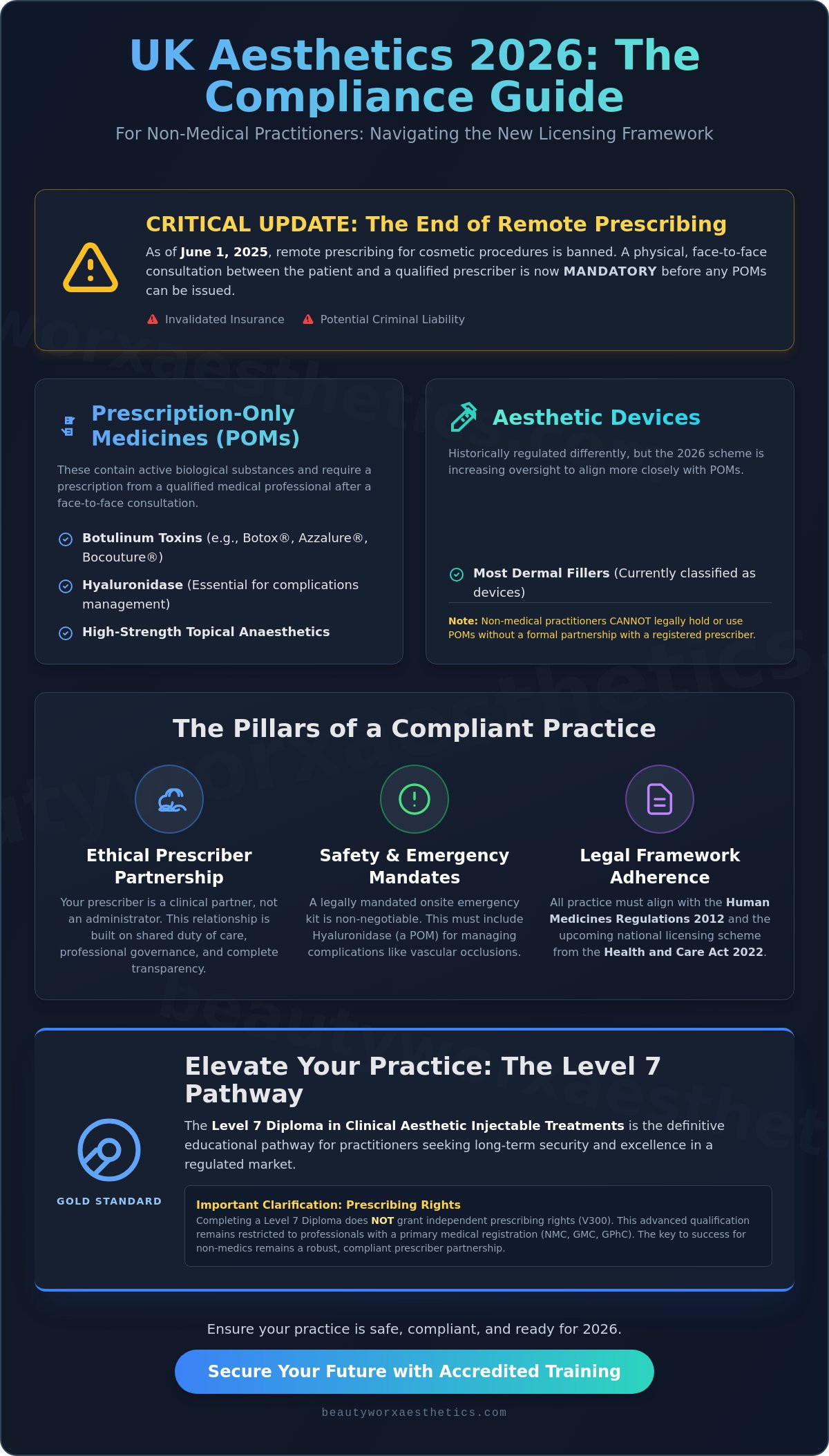
The evolution from traditional beauty therapy to the refined sphere of clinical aesthetics requires a deep understanding of the current regulatory landscape. In 2026, practitioners must align their work with the Human Medicines Regulations 2012, which serves as the foundational legal text for the industry. This shift isn’t just about technical skill; it’s about embracing a rigorous professional identity that prioritizes patient safety above all else. Legally, non-medical practitioners cannot prescribe or independently procure prescription-only medications; they must work under the direct oversight of a qualified prescriber who has conducted a mandatory face-to-face consultation. This ensures that every restorative treatment is backed by clinical necessity and expert discernment.
Prescription-Only Medications vs. Aesthetic Devices
The distinction between Prescription-Only Medicines (POMs) and medical devices is the cornerstone of safe, legal practice. Botulinum toxins, including well-known brands like Botox, Azzalure, and Bocouture, are classified as POMs because they contain active biological substances that require professional medical oversight. In contrast, most dermal fillers are currently classified as medical devices, though the 2026 licensing scheme is narrowing the gap in how these products are governed. It’s also vital to recognize that many high-strength topical anaesthetics used for client comfort are POMs. Even Hyaluronidase, the critical enzyme used for reversing vascular occlusions in complications management, is a prescription medication. You cannot legally hold or use these substances without a formal partnership with a registered prescriber.
The V300 Pathway: Why it remains restricted to Medical Professionals
There is often confusion regarding the Independent Prescribing (V300) qualification. This advanced certification allows healthcare professionals, such as nurses and pharmacists, to prescribe medications within their scope of practice. However, this pathway remains strictly restricted to those with a primary medical registration from bodies like the NMC, GMC, or GPhC. Even after completing a Level 7 Diploma, a non-medical practitioner cannot access the V300 or gain independent prescribing rights. This doesn’t limit your potential for success; rather, it highlights the importance of collaboration. You can bridge this gap and ensure your business is fully compliant by enrolling in accredited aesthetic courses that emphasize clinical oversight. Mastering the nuances of prescribing for non-medical aestheticians uk allows you to build a practice that is both legally secure and aspirational, providing your clients with the peace of mind they deserve.
The Face-to-Face Mandate: Navigating the End of Remote Prescribing
The era of digital shortcuts in aesthetics has concluded. As of June 1, 2025, the UK’s professional regulatory bodies, including the GMC and NMC, implemented a definitive ban on remote prescribing for non-surgical cosmetic procedures. This shift wasn’t merely a procedural update; it was a fundamental restoration of clinical standards. Every patient now requires a physical, face-to-face consultation with a qualified prescriber before any prescription-only medication can be issued. This mandate ensures that the person assuming the legal responsibility for the prescription has personally assessed the patient’s anatomy, medical history, and psychological suitability. Safety is the priority.
Mastering the requirements of prescribing for non-medical aestheticians uk means entering a shared duty of care. The prescriber isn’t just a distant administrative figure; they are your clinical partner. If a complication arises, both the prescriber and the administering practitioner are held accountable. Operating outside this framework carries severe risks. Most specialist insurance providers will immediately invalidate your cover if treatments are performed without a documented in-person consultation by the prescriber. Beyond financial ruin, practitioners could face criminal liability for the unlawful administration of medicines. It’s a risk that no professional artisan should take.
The 2026 Regulatory Landscape and Licensing Scheme
The national licensing scheme for England, established by the Health and Care Act 2022, has formalised these requirements. This framework categorises treatments like anti-wrinkle injections into an “amber” risk level, necessitating strict clinical oversight. The Joint Council for Cosmetic Practitioners (JCCP) has been a vocal advocate for these changes, ensuring that the licensing scheme creates a clear distinction between high-end professional clinics and unregulated operators. Your license is now intrinsically linked to your ability to demonstrate robust, compliant partnerships with registered medical professionals.
Adapting Your Clinic Workflow for Physical Consultations
Transitioning to this model requires thoughtful logistical planning. Many successful practitioners now host “Prescriber Days” once a week, where clients meet the medical professional for their initial assessment. While this adds a step to the patient journey, it also adds immense value. You can frame this two-step process as a premium safety feature of your practice. It’s an opportunity to build deep trust, showing your clients that their well-being is worth the extra time. To ensure your clinic is prepared for these high standards, consider refining your clinical governance with an advanced aesthetic training pathway that aligns with 2026 requirements. Detailed clinical records of these face-to-face sessions are no longer optional; they are the bedrock of your legal protection.
Cultivating a Sophisticated Prescriber Partnership
Selecting a prescribing partner is the most consequential decision you’ll make for your clinic’s longevity and professional standing. This alliance is far more than a simple transaction; it’s a clinical partnership built on mutual trust and a shared vision for patient safety. When you seek a partner, you’re looking for a registered medical professional from the GMC, NMC, or GPhC who understands that aesthetics is as much an art as it is a science. This relationship must be formalised through a robust Service Level Agreement (SLA) that defines the prescriber-led model. Within this framework, the prescriber retains ultimate clinical responsibility for the patient, while you act as the expert artisan executing the bespoke treatment plan. Establishing these boundaries ensures that your approach to prescribing for non-medical aestheticians uk remains ethically sound and legally secure.
Vetting Your Prescribing Partner
Meticulous vetting is essential to protect both your reputation and your patients. Your partner should be a specialist who possesses a deep, practical understanding of the industry, rather than someone who only practices general medicine. A prescriber without specific aesthetic experience may lack the discernment required to support your facial aesthetics techniques or manage complex complications. Before committing, verify their registration status and ensure their insurance specifically covers the oversight of non-medical practitioners. Ask direct questions about their availability for emergency “shout-outs.” You must have total confidence that they’ll provide immediate clinical guidance and the necessary medications if an adverse event occurs.
The Financial and Logistical Reality
The financial architecture of your partnership should be transparent, reflecting the professional value the prescriber brings to your practice. Most arrangements involve either a flat-rate monthly retainer or a fee for every face-to-face consultation. While retainers offer predictable overheads, per-session fees often suit clinics that are still scaling their patient base. It’s vital to integrate these costs into your treatment pricing without sacrificing your competitive edge. This professionalised structure aligns with the NMC’s updated guidance on remote prescribing, which has successfully moved the industry toward a model of physical, high-standard oversight. By structuring your clinic calendar to maximise the prescriber’s time, you ensure that every patient journey is both efficient and impeccably compliant.
Safety, Ethics, and the Emergency Kit Mandate
Safety is the quiet foundation upon which all aesthetic beauty is built. In the sophisticated landscape of 2026, clinical ethics demand more than just technical precision; they require a robust safety net that protects both the practitioner and the patient. Central to this is the legal necessity of holding a prescription-ready emergency kit. This isn’t merely a recommendation. It’s a mandatory requirement for any professional clinic. You cannot simply purchase emergency medications from a wholesaler. Because substances like Hyaluronidase are Prescription-Only Medications, your registered prescriber must issue a specific prescription for the kit itself. This ensures that the legal ownership and clinical responsibility for these life-saving drugs remain within a governed medical framework, a core component of prescribing for non-medical aestheticians uk.
Hyaluronidase serves as the critical enzyme for reversing vascular occlusions, making it the most vital tool in your repertoire. However, the ethical obligation extends beyond just possessing the medication. You must have a “prescriber on call” during every high-risk procedure. This partnership ensures that if an adverse event occurs, you have immediate access to medical guidance and the legal authority to administer the necessary intervention. This level of oversight transforms your practice from a simple service into a trusted clinical environment where patient well-being is the ultimate priority.
Managing Complications Legally
Practitioners must follow a rigorous, step-by-step protocol to manage complications effectively. Enrolling in a complications management course provides the technical skill to recognize early signs of distress and act with calm authority. While traditional injectables carry inherent risks, many artisans are now incorporating polynucleotide treatment into their offerings. These treatments provide cellular skin rejuvenation with a different safety profile, acting as a sophisticated alternative or adjunct to traditional fillers. Regardless of the treatment chosen, your prescriber remains legally accountable for the emergency protocols they have authorized within your clinic.
Informed Consent and Clinical Records
Your informed consent process must be a transparent dialogue that reflects 2026 standards. Consent forms should explicitly name your prescribing partner and detail their role in your clinical governance. This clarity builds immense trust, showing patients that their journey is supported by a multi-disciplinary team. Furthermore, digital record-keeping has become the benchmark for professional practice. Meticulous, GDPR-compliant records that include high-resolution imagery and detailed treatment notes are your primary shield. In the rare event of a legal challenge, a clear chronological record of every consultation and prescription is your most powerful defense. Ensure your clinic meets these elite standards by joining our Complications Management Course to master the art of clinical safety.
Elevating Your Practice: The Level 7 Pathway for Non-Medics
The journey toward clinical mastery culminates in the pursuit of the highest educational standards. In the current climate, the Level 7 Diploma in Clinical Aesthetic Injectable Treatments stands as the definitive gold standard for those who view their work as both a science and a high-end art form. This qualification does more than refine your technical hand. It fundamentally alters your professional standing. By achieving an OFQUAL-regulated Level 7 status, you distinguish yourself from those holding only short-term CPD certificates. You signal to the industry that you possess the academic rigour and clinical depth required to operate a medically-oversighted establishment with absolute confidence.
When establishing the framework for prescribing for non-medical aestheticians uk, your educational background is your most persuasive asset. A qualified prescriber assumes significant legal risk when they partner with a practitioner. They are far more likely to collaborate with someone who has demonstrated their competence through a regulated diploma. This advanced qualification makes you an “insurable” and “prescribable” professional, providing the peace of mind your clinical partners require to offer their support. It transforms your clinic from a beauty space into a sophisticated medical environment where safety and luxury coexist seamlessly.
Why Level 7 Matters for Prescribing Partnerships
A Level 7 qualification is the most reliable way to demonstrate your clinical discernment to a prospective partner. As the 2026 licensing scheme becomes fully operational, the JCCP and other regulatory bodies are increasingly looking for practitioners who have moved beyond foundational tasks. While many begin their journey perfecting lip augmentation filler techniques, the Level 7 pathway prepares you for full-face clinical rejuvenation. This holistic understanding of facial anatomy is exactly what a prescriber needs to see before they authorise the use of prescription-only medications in your practice. It proves you can manage the entire patient journey, from initial assessment to complex complications, with expert precision.
Your Next Steps with Beauty Worx Aesthetics
Securing your future in this regulated industry requires a partnership with a training provider that understands the nuances of the 2026 regulatory environment surrounding prescribing for non-medical aestheticians uk. Our mentorship program is specifically designed to help non-medics bridge the gap between training and compliant practice. We provide a luxury clinical environment where you can learn the intricacies of prescribing partnerships under the guidance of seasoned experts. This isn’t just about a certificate; it’s about building a career defined by professional pride and long-term security. Explore our Level 7 Diploma and secure your professional future today, ensuring your practice remains a sanctuary of excellence for years to come.
Mastering the Future of Clinical Excellence
The transition toward a regulated industry marks a pivotal moment for your practice. By embracing the face-to-face mandate and establishing robust, ethical partnerships, you elevate your clinic into a sanctuary of safety and artistic discernment. We’ve explored how the 2026 framework demands a shift from simple administration to a holistic, medically-oversighted model. Understanding the nuances of prescribing for non-medical aestheticians uk isn’t just about legal adherence; it’s about claiming your place as a trusted specialist in a thriving market. Your commitment to clinical governance and emergency preparedness serves as a powerful affirmation of your dedication to patient well-being.
As you navigate this transition, remember that your education is your most enduring asset. Choosing a pathway that prioritizes OFQUAL Regulated Qualifications and Expert Mentorship for Non-Medics ensures you remain at the forefront of the industry. We invite you to continue your professional evolution in a Sophisticated Clinical Training Environment that mirrors the high-end results you strive to achieve for your clients.
Join the Elite: Secure Your Career with Our Level 7 Aesthetics Diploma
Your journey toward becoming a master artisan is a partnership in excellence. With the right knowledge and support, you’ll build a legacy of confidence and authentic beauty that stands the test of time.
Common Questions Regarding Aesthetic Prescribing
Can a non-medic legally prescribe Botox in the UK in 2026?
No, a non-medic cannot legally prescribe Botox or any other Prescription-Only Medication (POM) in the UK. The legal authority to prescribe remains exclusively with registered healthcare professionals who hold a prescribing qualification, such as doctors, dentists, or nurse prescribers. As a non-medical practitioner, you act as the administering professional under the clinical oversight of your prescribing partner, ensuring every restorative treatment is backed by expert medical necessity.
How do I find a prescribing partner for my aesthetics clinic?
Finding a reliable partner involves vetting professionals registered with the GMC, NMC, or GPhC who possess specific experience in aesthetics. You should prioritize individuals who offer clinical mentorship and are available for emergency support rather than those who only provide administrative signatures. Many practitioners find ethical partners through professional networks or reputable training academies that emphasize the importance of prescribing for non-medical aestheticians uk within a safe, regulated framework.
What is the “face-to-face” consultation rule for aesthetics?
The face-to-face rule mandates that a prescriber must physically assess a patient in person before issuing a prescription for any POM. This requirement ensures the prescriber can accurately evaluate the patient’s anatomy, medical history, and psychological suitability for treatment. Digital or video consultations are no longer permitted for treatments like anti-wrinkle injections, as a physical presence is essential for maintaining the highest standards of clinical safety and patient care.
Do I need a Level 7 qualification to work with a prescriber?
While not a strict legal requirement for every procedure, a Level 7 qualification is increasingly essential for securing a professional prescribing partnership. Most ethical prescribers require this level of training to ensure you possess the clinical discernment and technical skill needed for safe practice. Holding a regulated diploma demonstrates your commitment to elite standards, making you a significantly more attractive and lower-risk partner for medical professionals in the 2026 landscape.
Can I use a remote prescribing service for anti-wrinkle injections?
You cannot use remote prescribing services for anti-wrinkle injections or any other POM in 2026. This practice was prohibited by UK regulatory bodies to ensure that every patient receives a comprehensive physical assessment by the person assuming legal responsibility for the medication. Adhering to this mandate is vital for maintaining your professional insurance coverage and demonstrating your commitment to robust clinical governance within your practice.
What medications must be in an aesthetics emergency kit?
An aesthetics emergency kit must contain specific medications to manage rare but serious adverse events effectively. Essential items include Hyaluronidase for reversing vascular occlusions, Adrenaline for treating anaphylaxis, and high-dose Aspirin. Because these substances are prescription medications, your partner must provide the necessary prescriptions to ensure your kit is legally stocked. Having these items on hand is a hallmark of a professional, safety-conscious clinical environment.
Is it legal for a non-medic to administer dermal fillers without a prescription?
It’s currently legal to administer dermal fillers without a prescription because most fillers are classified as medical devices rather than medications. However, the 2026 licensing scheme places these treatments in the amber category, requiring formal training and clinical oversight for practitioner licensing. Crucially, you still need a prescribing partner to provide the Hyaluronidase required to manage potential complications safely, as this reversal agent is a prescription-only medication.
How will the 2026 licensing scheme affect non-medical aestheticians?
The 2026 licensing scheme introduces a risk-based “traffic light” system that formalizes practitioner requirements across England. Non-medical aestheticians will need to meet specific educational benchmarks, such as an OFQUAL-regulated qualification, to perform amber-level procedures like injectables. This system creates a clearer distinction between professional artisans and unregulated operators, fostering a more transparent industry that prioritizes patient safety and rewards those who invest in high-level training.









 Reviews