
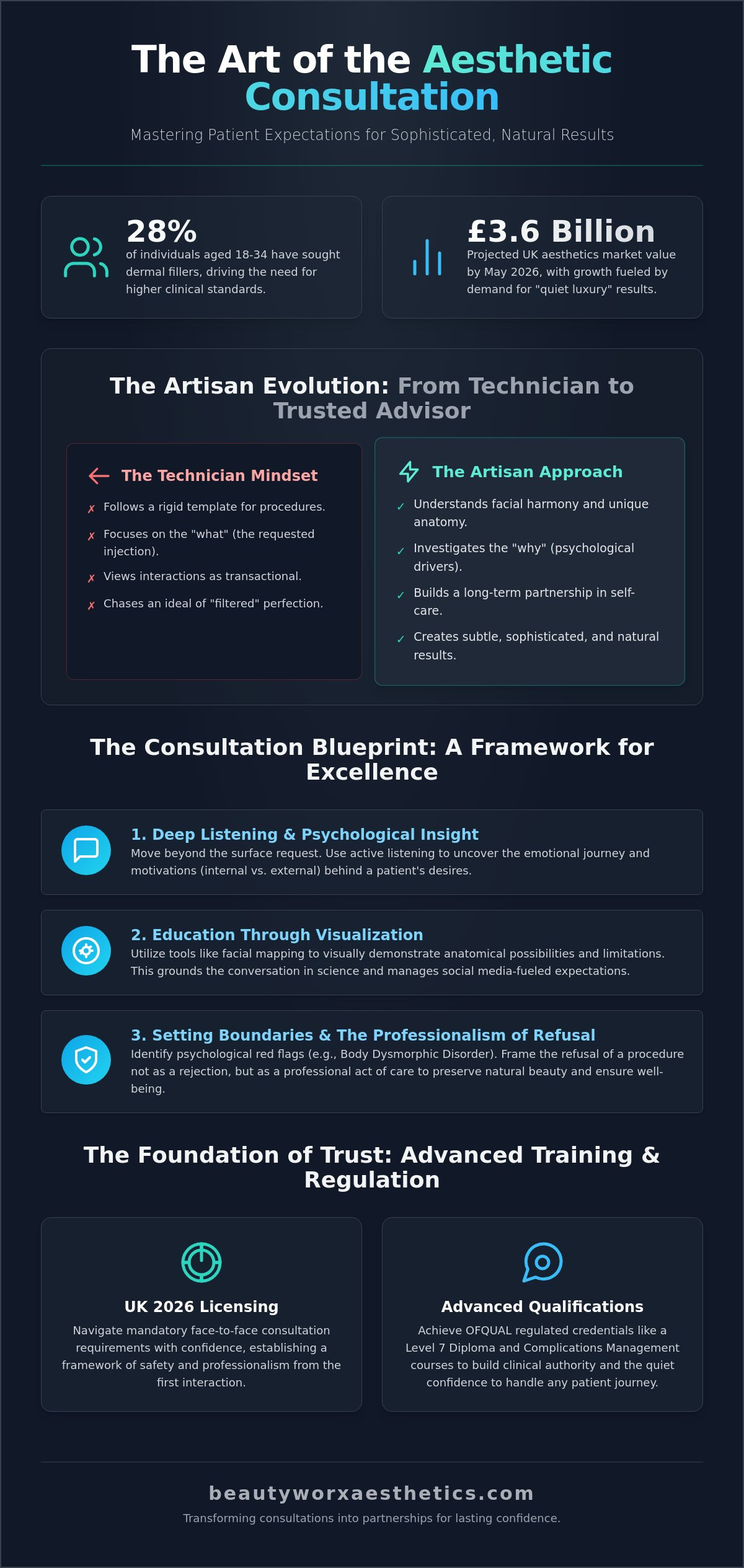
What if the secret to a flawless aesthetic outcome wasn’t found in the precision of an injection, but in the quiet clarity of the consultation? In an era where 28% of individuals aged 18 to 34 have already sought dermal fillers, the pressure to deliver “filtered” perfection is higher than ever. Successfully managing patient expectations in aesthetics is no longer just a defensive strategy to avoid complaints; it’s a sophisticated clinical skill that transforms a technician into a trusted artisan. You likely feel the weight of social media’s influence and the difficulty of saying “no” to unrealistic requests, yet these moments are where your professional integrity truly shines.
This article provides a roadmap to help you bridge the gap between a patient’s aspirational desires and the safe, clinical reality of their unique anatomy. You’ll learn how to navigate the 2026 UK licensing changes and the mandatory face-to-face consultation requirements with confidence. We’ll explore how to cultivate a partnership that prioritizes long-term self-care over quick fixes, ensuring your practice is defined by safety, satisfaction, and the subtle, natural-looking results your clients deserve. It’s time to master the communication rhythm that turns a first-time visitor into a lifelong advocate.
Key Takeaways
- Learn to transition from a technician to a trusted artisan by mastering the diagnostic power of the clinical consultation and understanding the psychological drivers behind every request.
- Discover how educational tools and anatomical visualization assist in managing patient expectations in aesthetics, creating realistic benchmarks for subtle and sophisticated results.
- Identify psychological red flags early and learn to frame the refusal of a procedure as a professional act of care that preserves the patient’s natural beauty.
- Explore how achieving OFQUAL regulated qualifications, such as a Level 7 Diploma, establishes a foundation of clinical authority and fosters deep patient trust.
- Understand why completing a complications management course is essential for building the quiet confidence required to handle complex patient journeys with poise and safety.
The Philosophy of Patient Expectations: Balancing Art and Science
At its core, managing patient expectations in aesthetics is the delicate art of aligning subjective beauty ideals with biological reality. It’s a transformative process. You aren’t just a technician following a template; you’re an expert artisan who understands that every face tells a unique story. In 2026, the industry has matured beyond the pursuit of artificial perfection. Success now lies in the ability to bridge the gap between what a patient sees in a filtered image and what can be achieved through clinical expertise. This alignment is the foundation of the modern patient journey, which we must view as an ongoing partnership in self-care rather than a series of isolated transactions.
The artisan mindset requires a deep understanding of facial harmony. By May 2026, the UK aesthetics market is projected to exceed £3.6 billion, and this growth is increasingly driven by a desire for “quiet luxury.” Patients are moving away from drastic changes, opting instead for subtle enhancements that whisper rather than shout. This shift demands a more sophisticated approach to consultation, where the practitioner acts as a knowledgeable guide. You’re helping them navigate their options without pressure, ensuring every decision supports their long-term confidence and graceful aging.
The Shift Toward Natural Aesthetics
The decline of the “over-filled” look is a welcome evolution in professional clinical circles. Today’s most discerning patients view subtle results as the ultimate premium choice. By positioning restorative treatments, such as a Microneedling Session or targeted skin boosters, as the primary path to vitality, you set a high standard for your practice. These methods focus on enhancing the skin’s inherent quality and preserving natural features. It’s about restoration. When you prioritize the health of the tissue over volume for volume’s sake, you build a reputation for sophisticated, authentic results that stand the test of time.
Why Management is a Clinical Necessity
Effective expectation management is more than a communication tool; it’s a vital safety protocol. There’s a direct link between poor alignment and the rise in aesthetic complications or patient dissatisfaction. It’s your responsibility to look beyond the physical request and identify the psychological drivers. This includes being vigilant for signs of Body Dysmorphic Disorder, which can lead to a cycle of never-ending procedures and unmet goals. Establishing clear boundaries isn’t a sign of weakness. Instead, it confirms your status as a high-end, expert practitioner. Framing a refusal as a protective measure—”I am preserving your natural balance”—builds immense trust and ensures the patient’s mental and physical well-being remains the priority.
The Clinical Consultation: Navigating Psychological Drivers
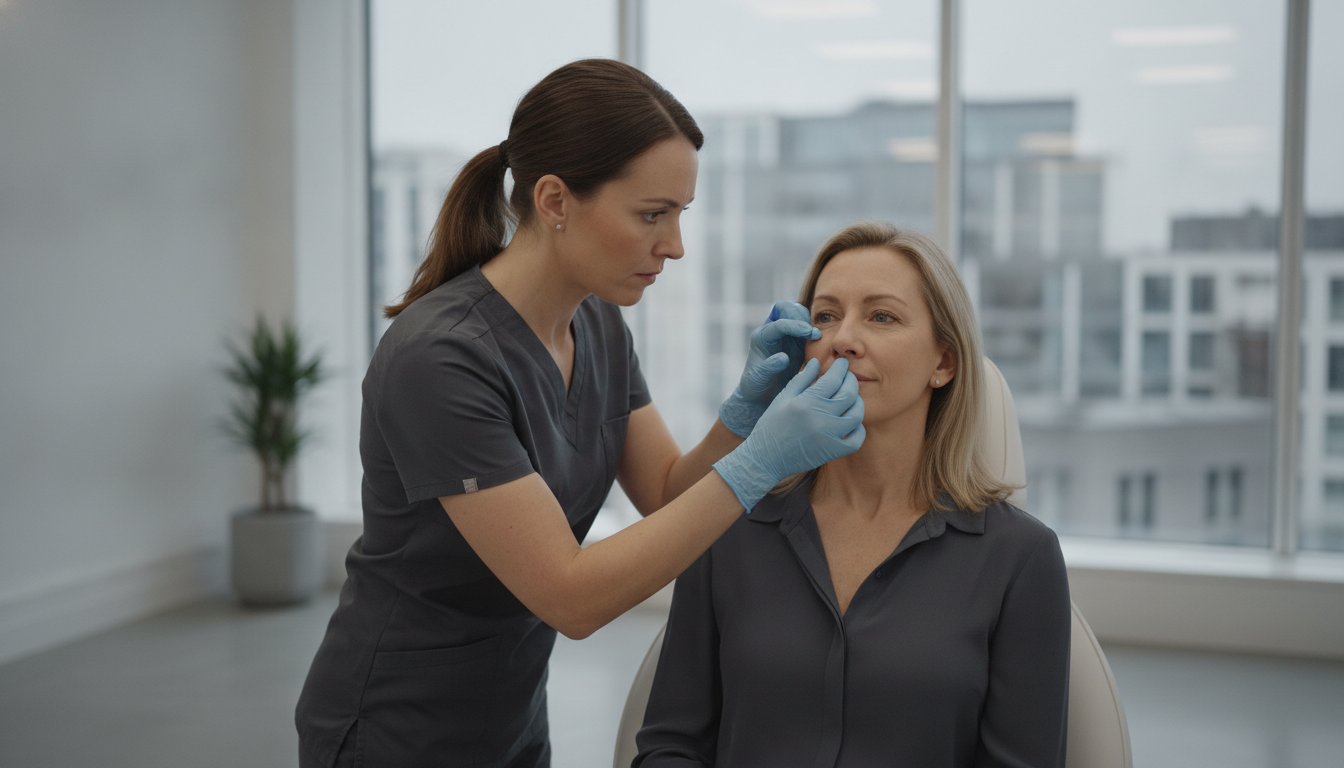
The consultation acts as the most critical diagnostic tool in your repertoire. It is here that you evaluate not just the physical canvas, but the psychological readiness of the individual sitting before you. Managing patient expectations in aesthetics begins with the tone you set: a blend of warm empathy and meticulous clinical professionalism. By utilizing facial mapping, you can physically demonstrate where biological structures limit certain outcomes. This visual education helps ground the conversation in science, gently steering the patient away from the impossible standards often found on social media. It’s a moment for contemplation and trust-building, mirroring the quiet, high-end environment of a prestige clinic.
Active listening is your greatest asset during this phase. Instead of simply noting a list of desired changes, seek to understand the emotional journey that brought them to your chair. This requires moving beyond “what” they want to “why” they want it. When you listen with intent, you transform from a service provider into a trusted guide, capable of navigating the complex intersection of self-image and clinical reality.
Identifying Motivations and Triggers
Distinguishing between internal and external motivations is vital for long-term satisfaction. Is the patient seeking a Lip Augmentation Treatment to feel more confident in their own skin, or are they reacting to social media pressure? The “Snapchat Dysmorphia” effect remains a significant challenge in 2026. Patients often arrive with digitally altered images, expecting clinical results to mirror pixel-perfect filters. Your role is to uncover deep-seated aesthetic anxieties using open-ended questions. By identifying these triggers early, you can manage the patient’s perspective, ensuring they value restoration over artificial transformation.
Screening for Psychological Suitability
Screening for psychological suitability is an ethical mandate, not a suggestion. You must be adept at recognizing the subtle signs of Body Dysmorphic Disorder (BDD), such as an obsessive focus on a minor or non-existent flaw. Upholding high Ethical Standards in Aesthetics means having the courage to refer a patient to mental health support when their goals are rooted in psychological distress. Every assessment should be documented within a robust clinical record, serving as both a legal safeguard and a testament to your commitment to patient welfare. For practitioners looking to refine these complex communication skills, pursuing a Level 7 Diploma in Clinical Aesthetic Injectable Treatments provides the advanced framework necessary to manage these delicate interactions with quiet confidence.
Bridging the Gap: Education, Visualization, and Informed Consent
Clarity is the cornerstone of a successful aesthetic partnership. When you introduce anatomical charts to explain how facial aesthetics work beneath the skin, you move the conversation from abstract desires to biological reality. It’s about showing, not just telling. By visualizing the underlying structures, fat pads, and muscle movements, you help patients understand why certain results are achievable while others remain outside the realm of clinical safety. This educational approach is a vital component of managing patient expectations in aesthetics, grounding their aspirations in the science of their own anatomy.
Your “Before and After” portfolio serves as a gallery of possibility rather than a menu of guarantees. It’s essential to present results that reflect the patient’s specific age, skin quality, and structural profile. This honesty dismantles the “Duration Myth.” Being transparent about how long results truly last, and the factors that influence longevity, builds a sense of reliability. It transforms the procedure from a one-off transaction into a chapter within a broader, long-term skin journey. Patients appreciate the artisan who values their long-term vitality over a temporary, artificial fix.
The Power of Visual Education
Modern visualization tools, such as 3D imaging or precise manual facial marking, allow you to map out the intended injection points during the consultation. This transparency is particularly crucial when discussing the “stacking” effect. For instance, achieving the perfect profile with lip augmentation filler often requires multiple sessions to build volume safely and naturally. By explaining this incremental process, you manage the desire for immediate, drastic change. You’re teaching the patient to value the “settling” phase, where swelling and minor bruising subside to reveal the true, sophisticated result.
Informed Consent as a Dialogue
Informed consent must never be reduced to a mere signature on a digital form. It is a rhythmic, ongoing dialogue that ensures the patient truly understands the risks and the recovery process. Discussing potential complications is not about creating fear; it’s about demonstrating your meticulous preparation and your commitment to their safety. In the 2026 regulatory environment, providing a “cooling-off period” for high-value treatments is a hallmark of a professional practitioner. This pause invites contemplation, ensuring the patient feels empowered and certain before proceeding. This level of transparency is exactly what separates a high-end, expert artisan from a high-volume technician.
Identifying Red Flags and the Professionalism of Refusal
True expertise is measured by the treatments a practitioner chooses not to perform. In 2026, where the pressure of digital perfection remains a constant, managing patient expectations in aesthetics involves recognizing when a request crosses the line from enhancement into distortion. Refusal is an act of care. It is the signature of a trusted artisan who prioritizes the preservation of natural beauty over a one-off transaction. By setting these boundaries, you protect the patient from outcomes that could lead to long-term dissatisfaction or regret.
You must resist the “fixer” complex. Dermal fillers and anti-wrinkle injections are sophisticated tools for refinement, but they aren’t solutions for complex emotional struggles. If a patient believes a cosmetic procedure will repair a relationship or resolve a deep-seated life crisis, the outcome will inevitably feel like a failure. In these instances, your role as a guide is to gently redirect them toward a more holistic path. Framing this as “artistic discernment” ensures the patient feels valued and protected rather than rejected.
Common Aesthetic Red Flags
Identifying red flags early in the consultation is essential for maintaining a high-end, professional practice. Be alert for the following warning signs:
- The “Vague” Patient: Those who feel “off” or “unhappy” with their appearance but cannot pinpoint specific areas for improvement.
- The “Obsessive” Patient: Individuals anchored to a version of themselves from decades ago, often bringing in photos of their younger selves as a literal blueprint for treatment.
- The “Practitioner Hopper”: A patient with a long history of being dissatisfied with every previous injector, suggesting the issue may lie in their internal expectations rather than clinical skill.
The Script for Professional Refusal
Refusal should always be rooted in clinical suitability rather than personal judgment. A single, polished sentence can maintain the relationship while upholding your standards: “Based on my clinical assessment of your unique facial harmony, I don’t believe this specific procedure is the right step for your long-term aesthetic goals today.” This approach shifts the focus to your expert discernment and the patient’s safety.
Instead of a hard “no,” offer alternative pathways that prioritize skin health. You might recommend a cooling-off period or suggest foundational skin-health-first treatments such as chemical peels or skin boosters. This keeps the door open for an ongoing partnership in self-care. To gain the clinical confidence required to navigate these high-stakes conversations with poise, consider enrolling in a complications management course to refine your professional boundaries.
Elevating Your Practice Through Advanced Training and Regulation
In the sophisticated landscape of 2026, the aesthetics industry has moved beyond the era of unregulated experimentation. With the UK’s mandatory licensing scheme now a reality, practitioners are finding that clinical authority is the only true currency of trust. Grounding your practice in OFQUAL regulated qualifications, specifically spanning Levels 4 through 7, provides more than just a certificate. These frameworks offer the deep anatomical knowledge and ethical grounding necessary for managing patient expectations in aesthetics. When you possess a granular understanding of facial layers and biological responses, your ability to guide a patient through their options becomes an act of expert artisanry. You aren’t just delivering a service; you’re providing a safe, educated journey toward self-confidence.
Higher-level education provides the precise vocabulary required to explain complex procedures to a discerning clientele. Instead of offering vague reassurances, you can articulate the “why” behind every clinical decision. This transparency fosters a sense of security, positioning your clinic as a center of excellence. Continuous professional development (CPD) ensures your skills remain at the vanguard of the industry, allowing you to offer the subtle, restorative results that modern patients crave. It’s about building a reputation for meticulous care and artistic discernment. Safety is the ultimate luxury.
The Level 7 Advantage
The Level 7 Diploma in Clinical Aesthetic Injectable Treatments is the gold standard for a reason. It integrates rigorous psychological assessment into the clinical workflow, ensuring you’re equipped to handle the emotional nuances of every consultation. This advanced training teaches you to look beyond the surface, identifying the subtle drivers behind a patient’s request. Mentorship plays a pivotal role here, providing the opportunity to observe and practice “difficult” conversations under expert guidance. For high-end clients, your Level 7 credentials serve as a powerful unique selling point. It signals that you value their well-being as much as their aesthetic outcome, creating a foundation for an ongoing partnership in graceful aging.
Safety as a Brand Identity
In 2026, patients are increasingly savvy about the risks associated with non-surgical procedures. By linking your aesthetic courses directly to your brand identity, you attract a demographic that values longevity and safety over low prices. Promoting a “Safety First” culture is a confident affirmation of your capabilities. A complications management course is an essential part of this identity. It demonstrates that you’re prepared for every eventuality, providing the quiet confidence that puts even the most anxious patient at ease. This commitment to professional standards and insurance compliance isn’t just about following rules. It’s about honoring the trust your patients place in your hands.
Cultivating the Future of Aesthetic Excellence
The transition from a clinical technician to a trusted aesthetic artisan requires more than technical precision; it demands the emotional intelligence to navigate the complex landscape of human desire. By prioritizing transparent education and recognizing the psychological drivers behind every consultation, you ensure that your practice remains a sanctuary of safety and sophistication. Mastering the art of managing patient expectations in aesthetics isn’t just about avoiding dissatisfaction. It’s about building a legacy of natural, authentic results that honor the unique features of every individual who walks through your door.
As the 2026 regulatory landscape evolves, your commitment to excellence is best reflected through rigorous, standardized education. We provide the foundation for this growth through our OFQUAL Regulated Qualifications and CPD Accredited Complications Management training, supported by expert mentorship for medics and non-medics alike. This path allows you to lead with quiet confidence and clinical authority. Explore our OFQUAL Regulated Level 7 Diploma and elevate your clinical standards today. We look forward to supporting your journey as you refine your craft and define the highest standards of patient care.
Frequently Asked Questions
How do I tell a patient their aesthetic goals are unrealistic?
You should decline unrealistic requests by focusing on the patient’s unique anatomy and long-term facial harmony. Explain that your role as an expert artisan is to preserve their inherent features rather than creating an artificial look that won’t age gracefully. Suggesting a gradual, restorative approach or a different treatment pathway often helps maintain the professional partnership without compromising your clinical standards or their safety.
What are the most common psychological drivers for seeking aesthetic treatments?
Patients typically seek aesthetic enhancements to align their external appearance with their internal sense of vitality and self-confidence. While many are driven by a genuine desire for restoration, others may be reacting to life transitions or social pressures. Identifying these underlying motivations is a key part of managing patient expectations in aesthetics, ensuring that the treatment plan supports their emotional journey toward self-assurance.
Is it legal to refuse an aesthetic treatment in the UK?
It’s entirely legal and often ethically necessary to refuse treatment if you believe the procedure isn’t in the patient’s best interest. Professional guidelines in 2026 encourage practitioners to prioritize patient safety and psychological well-being over commercial gain. Refusal should always be delivered with empathy and clarity, focusing on clinical suitability and the preservation of the patient’s natural, sophisticated balance.
How can I explain the risks of dermal fillers without scaring the patient?
You can explain risks by framing the conversation as a meticulous safety protocol designed to protect the patient’s well-being. Use clear, professional language to discuss potential outcomes like bruising or swelling as part of the natural settling phase. By demonstrating your expert knowledge and complications management protocols, you build deep trust and reassure the patient that they’re in the hands of a detail-oriented specialist.
What should I do if a patient is unhappy with their result despite it being technically perfect?
If a patient is dissatisfied with a technically successful result, you should offer a follow-up consultation to listen to their concerns with empathy. Revisit the initial goals and “before” images to identify where the perception gap lies. Often, a gentle conversation about the gradual nature of restoration and the time required for tissues to settle can resolve these feelings and reinforce the partnership.
How does social media affect patient expectations in 2026?
Social media continues to drive a high demand for “pre-juvenation” and filtered beauty standards, which often creates a disconnect between digital images and biological reality. With 28% of individuals aged 18 to 34 now seeking dermal fillers, the pressure for immediate perfection is significant. Your role is to act as a knowledgeable guide, helping patients navigate these trends while advocating for subtle, authentic results that respect their anatomy.
Why is a cooling-off period recommended in aesthetics?
A cooling-off period is recommended to allow patients time for quiet contemplation before committing to high-value or permanent treatments. This pause ensures that their decision is rooted in certainty rather than impulse, which is crucial for long-term satisfaction and trust. It mirrors the steady, fluid rhythm of a professional environment where transparency and patient safety are prioritized over rushed, one-off transactions.
Can a Level 7 qualification help with patient communication skills?
A Level 7 Diploma in Clinical Aesthetic Injectable Treatments significantly enhances your communication skills by integrating psychological assessment into the clinical workflow. It provides the advanced vocabulary and ethical framework needed to handle complex patient conversations with poise and authority. This higher-level education empowers you to master managing patient expectations in aesthetics with the quiet confidence of a true specialist.













 Reviews