
The era of the over-filled face has been replaced by a sophisticated demand for skin quality and deep cellular hydration. You’ve likely noticed that modern clients are no longer seeking to mask their features, but rather to enhance them with a luminous, lit-from-within glow. However, as the UK market becomes saturated with new brands and complex bio-remodelling protocols, choosing the right skin booster training can feel like a daunting task amidst a sea of technical jargon and safety concerns. It’s perfectly natural to feel a sense of hesitation when your professional reputation depends on achieving that delicate, harmonious balance between clinical precision and artistic flair.
This definitive guide promises to transform that uncertainty into mastery, helping you elevate your aesthetic practice through the science of injectable rejuvenation. You’ll gain the confidence to select the perfect product for bespoke client needs while perfecting advanced techniques that ensure safety and radiance. We’ll examine the latest 2026 industry standards, from the technical nuances of high-concentration hyaluronic acid to the essential accreditation steps required to secure professional insurance and thrive as a trusted artisan in your field.
Key Takeaways
- Embrace the evolution of injectable skincare by shifting your focus from traditional volumising to the art of restoring dermal health and a luminous, natural glow.
- Uncover the biological secrets of bio-remodelling and how targeted Hyaluronic Acid placement revitalises the skin’s matrix for a refreshed, harmonious appearance.
- Gain a sophisticated understanding of the UK’s leading brands, including Profhilo and Seventy Hyal, to offer bespoke, result-focused treatments tailored to each individual.
- Refine your clinical artistry through professional skin booster training, mastering precise injection protocols and anatomy to ensure every client journey is both safe and transformative.
- Elevate your professional standing by navigating the essential world of CPD-accredited and OFQUAL-regulated qualifications, securing your reputation as a trusted expert in the aesthetic market.
Understanding Skin Booster Training: The Evolution of Injectable Skincare
The aesthetic landscape has undergone a profound transformation as we move into 2026. Practitioners across the United Kingdom are witnessing a definitive shift away from the overfilled, frozen aesthetics of previous decades toward a more luminous, translucent finish. Professional skin booster training is now the cornerstone of a modern aesthetic practice, catering to a demographic that prioritises skin quality over structural modification. This evolution represents the “skinification” of injectables, where the objective isn’t to change how a face looks, but to improve how the skin behaves.
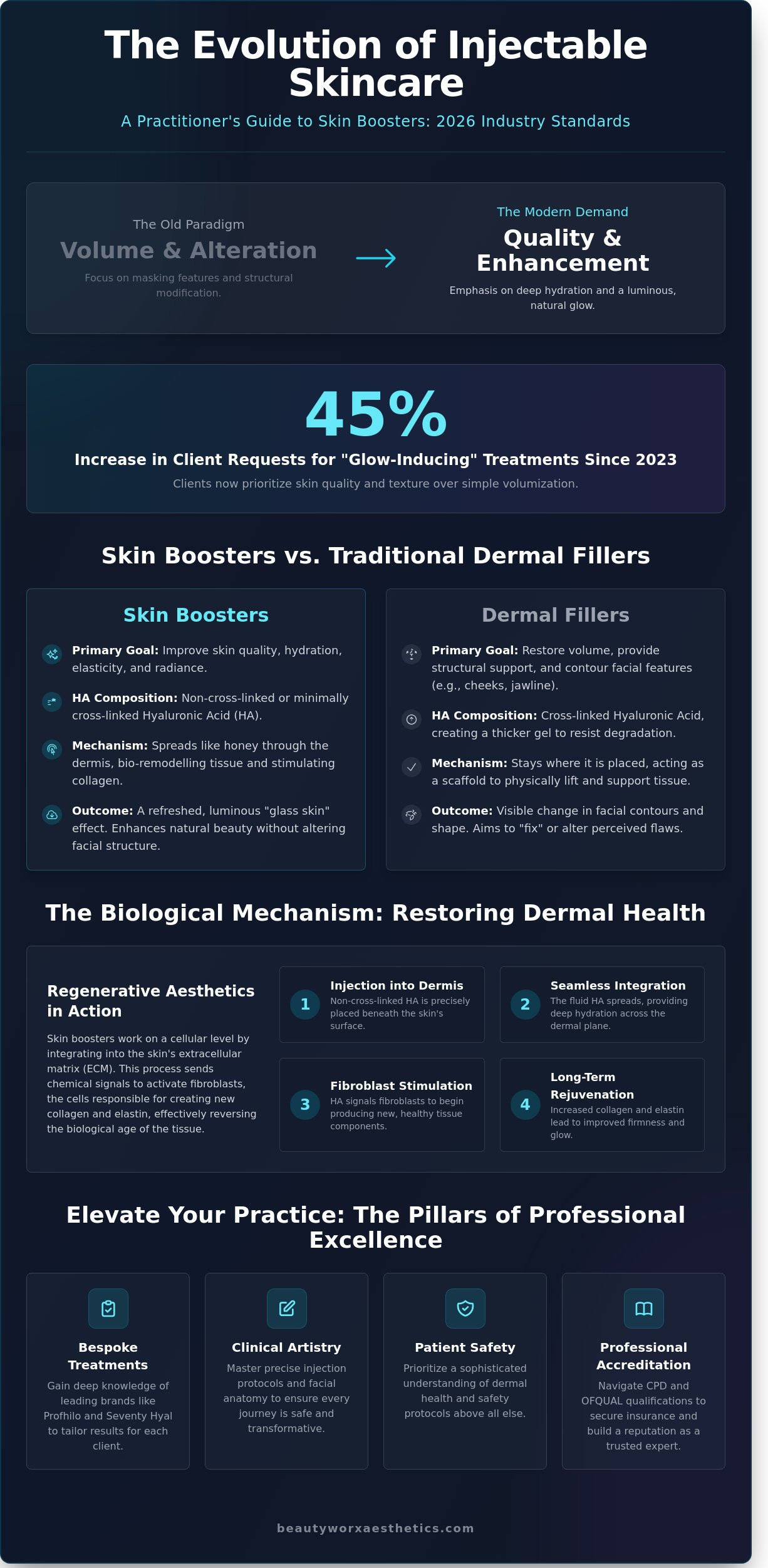
While traditional injectable fillers have long dominated the market, recent industry data indicates a 45 percent increase in requests for “glow-inducing” treatments since 2023. Clients are increasingly savvy; they understand that volume alone cannot mask poor skin texture or a lack of radiance. They seek the “glass skin” effect that top-tier topical serums promise but often fail to deliver at a cellular level. This demand has turned skin boosters from a niche add-on into a primary treatment modality that requires a sophisticated understanding of dermal health.
The Core Philosophy: Enhancement over Alteration
The philosophy behind these treatments aligns perfectly with the BeautyWorx Aesthetics promise of creating the “best version of you.” Clients often describe their journey as a desire to look refreshed rather than different. They want to look as though they’ve had a month of restorative sleep and impeccable hydration. This emotional driver requires a practitioner to shift their mindset from “fixing” a perceived flaw to “optimising” the biological canvas.
By focusing on enhancement, you build a relationship of trust. You’re acting as a knowledgeable guide in their long-term self-care journey. The result is a subtle, harmonious rejuvenation that feels both luxurious and authentic. It’s a bespoke approach where the artistry lies in the invisibility of the work, ensuring the client feels empowered and confident in their own skin.
Key Differences: Boosters vs. Traditional Dermal Fillers
Understanding the technical nuances is vital for any professional undertaking skin booster training. Traditional fillers are typically composed of cross-linked hyaluronic acid, designed to resist degradation and provide structural support or volume. They stay where they’re placed to lift a cheek or define a jawline. In contrast, skin boosters utilise a lower molecular weight and little to no cross-linking, which allows for incredible spreadability across the dermal plane. This fluid nature ensures the product integrates seamlessly into the tissue without creating lumps or artificial protrusions.
Skin boosters are non-cross-linked hyaluronic acid treatments that improve skin quality without altering facial contours.
Because these stabilised formulations are designed for honey-like flow, they provide deep, internal hydration that topical creams cannot reach. They trigger the body’s natural fibroblastic response, encouraging the production of fresh collagen and elastin. The outcome isn’t a change in shape, but a visible improvement in elasticity, firmness, and that coveted, light-reflecting radiance.
The Biological Mechanism: How Skin Boosters Restore Dermal Health
True skin health begins beneath the surface, far beyond the reach of topical serums. Skin boosters function by integrating into the extracellular matrix (ECM), the intricate scaffold that supports our skin cells. Unlike traditional dermal fillers designed to add structural volume to specific folds, boosters work globally to improve the biological age of the tissue. This nuance is a cornerstone of professional skin booster training. Practitioners must learn to facilitate cellular repair rather than simply camouflage static lines.
By 2026, the industry has shifted its focus toward “regenerative aesthetics.” This approach prioritises the stimulation of fibroblasts, the cells responsible for collagen production. When a booster is injected, it doesn’t just sit in the dermis; it sends chemical signals that wake up dormant cells. This process addresses the cellular signs of ageing, such as thinning skin and loss of elasticity, by restoring the skin’s natural ability to heal itself. It’s a sophisticated method of achieving a refreshed, luminous look that feels entirely authentic.
Hyaluronic Acid: The Powerhouse of Hydration
Hyaluronic Acid (HA) is the star molecule in most booster formulations. It’s a naturally occurring glycosaminoglycan that can hold 1,000 times its weight in water. High molecular weight HA provides immediate surface luminosity and an “internal moisturiser” effect. Low molecular weight HA acts as a messenger, reaching deeper layers to signal for long-term repair. Reviewing FDA information on dermal fillers helps clinicians understand the safety profiles and regulatory distinctions between these hydrating agents and traditional volumisers. Regular treatments don’t just provide a temporary glow; they cumulative improve skin elasticity by up to 30% over a six-month period.
Bio-remodelling and Tissue Regeneration
Bio-remodelling represents a significant paradigm shift in aesthetic medicine. Products like Profhilo don’t just hydrate; they flow through the tissues to stimulate the production of four distinct types of collagen (I, III, IV, and VII) and elastin. This creates a tightening effect that is subtle yet transformative. Many advanced practitioners now find a powerful synergy between boosters and polynucleotide treatment for deep cellular repair. While HA boosters provide the hydration and scaffold, polynucleotides focus on DNA-level repair to enhance the skin’s overall quality. Mastering these combinations through comprehensive skin booster training ensures you can offer the best version of bespoke care for every client’s unique journey.
Navigating the Market: A Comparative Analysis of Leading Booster Brands
Practitioners often fall into the trap of strict brand loyalty, yet the most successful aesthetic clinics in 2026 are those that adopt a result-focused philosophy. Your choice of product shouldn’t be a marketing preference; it’s a clinical decision based on the patient’s unique tissue quality and aesthetic goals. Comprehensive skin booster training empowers you to look beyond the packaging and understand the rheology of the substances you inject. While selecting your kit, always adhere to FDA safety guidelines for dermal fillers and similar injectables to ensure you’re meeting the highest professional standards of patient care. A bespoke treatment menu allows you to treat a 25-year-old seeking a luminous glow and a 60-year-old requiring structural support with equal precision.
Profhilo: The Gold Standard for Bio-remodelling
Profhilo remains a cornerstone of regenerative medicine because it doesn’t just hydrate; it transforms. By utilising the Bio Aesthetic Points (BAP) technique, you deliver high concentrations of Hyaluronic Acid across ten strategic injection sites. This method minimises discomfort and reduces the risk of bruising, making it a favourite for the time-poor professional. It’s the ideal choice for addressing skin laxity in the lower face and neck. Unlike traditional fillers, Profhilo stimulates four different types of collagen and elastin, creating a visible “remodelling” effect that restores the skin’s natural bounce and firmness. It’s the “quiet luxury” of injectables, providing a refreshed look that’s felt rather than seen.
Seventy Hyal and Jalupro: Targeted Hydration and Bio-stimulation
Seventy Hyal 2000 has carved a niche as the “next generation” booster for those seeking immediate radiance. It’s particularly effective for younger demographics or as a “red carpet” treatment due to its high molecular weight HA, which provides an instant surge of moisture. Conversely, Jalupro focuses on the skin’s structural integrity. Its unique blend of amino acids, including Glycine, L-Proline, and L-Lysine, acts as a nutrient cocktail for fibroblasts. This supports the production of new collagen over a longer period, making it excellent for treating fine lines and dark circles.
To elevate your clinical outcomes, consider a multi-modality approach. Many practitioners now combine their injectable skin booster training with professional chemical peel training to address both the surface texture and the deep dermal health. This dual-layered strategy ensures the skin is as smooth and clear on the surface as it is hydrated and firm underneath. By curating a menu that includes these “Big Three” brands, you can offer a truly tailored experience that respects the individual journey of every client who walks through your door.
Clinical Excellence: Mastering Injection Techniques and Patient Safety
Mastery in skin booster training isn’t just about the product; it’s about the precision of delivery and a profound respect for the canvas. While these treatments are injected into the superficial layers, you must maintain a deep understanding of facial anatomy to avoid critical vascular structures and nerves. Even at depths of 1mm to 2mm, a lack of anatomical awareness can lead to unwanted swelling or bruising. Practitioners who treat aesthetic medicine as a science ensure that every needle entry is intentional and safe.
Injection protocols vary significantly depending on the desired outcome and the specific product rheology. The Bio Aesthetic Points (BAP) technique, frequently utilised for high-concentration hyaluronic acid, involves 5 specific injection points per side to maximise the product’s spread. In contrast, micro-droplet ‘meso’ styles are better suited for fine lines around the eyes or mouth. While these boosters are often non-cross-linked, they remain medical procedures. The JCCP 2024 annual report highlighted that patient safety hinges on clinical oversight, as 84% of aesthetic complications stem from inadequate training or non-medical environments.
The Art of Placement: Achieving the ‘Refreshed’ Look
Bespoke mapping is what separates a technician from an artisan. Instead of following a rigid, one-size-fits-all template, you’ll learn to assess the individual’s facial architecture to determine where hydration is most needed. Precise needle depth is the most critical factor in ensuring skin boosters integrate seamlessly into the dermis without causing visible papules. This meticulous approach ensures an even distribution, resulting in a harmonious and subtle rejuvenation that looks entirely natural.
Consultation and Aftercare: The Practitioner’s Responsibility
Managing your client’s expectations is a clinical skill that begins during the initial skin analysis. It’s vital to educate clients on the cumulative nature of skin quality improvements; while a subtle glow may appear within 48 hours, the true transformation peaks at the 30-day mark. Data suggests that 92% of patients report higher satisfaction when they complete a structured course of two to three sessions rather than a single appointment.
Your responsibility extends to the post-treatment journey to ensure a luminous, complication-free outcome:
- Advise clients to avoid strenuous exercise or extreme heat for 48 hours to minimise the risk of bruising.
- Recommend high-quality, clinical-grade SPF 50 to protect the skin as it undergoes cellular renewal.
- Monitor the injection sites through a scheduled follow-up to track the progress of the ‘glow’ timeline.
Master the art of the glow and enhance your clinical repertoire through our comprehensive skin booster training.
Elevating Your Career: Why Professional Accreditation is Non-Negotiable
In the evolving landscape of UK aesthetics, a simple certificate of attendance no longer suffices for practitioners aiming for longevity. As the industry moves toward stricter licensing frameworks expected by late 2026, the distinction between a basic course and an OFQUAL-regulated or CPD-accredited qualification is vital. Understanding the difference between an aesthetician and an aesthetic practitioner becomes crucial as the UK government’s licensing scheme will render casual use of professional titles potentially unlawful. Choosing the right skin booster training isn’t just about learning a technique; it’s about securing your professional future. Accredited courses ensure you can obtain comprehensive indemnity insurance, which protects your assets and your reputation. Without this, you risk being unable to practice legally as the government tightens oversight on non-surgical cosmetic procedures. It’s a shift from being a technician to becoming a qualified clinician.
At Beauty Worx, our methodology prioritises safety and artistry in equal measure. We move beyond the theory by providing a structured environment where you can flourish. Our approach includes:
- Small, intimate training groups to ensure you receive personalised, one-to-one feedback.
- Hands-on practice with live models provided by us, allowing you to experience real tissue interaction.
- Ongoing mentorship that extends far beyond the classroom, giving you a safety net as you launch your services.
This foundational excellence allows you to map a clear career trajectory. Many of our students use this as a stepping stone, eventually progressing toward a Level 7 Diploma. This is the gold standard for aesthetic practitioners in the UK, and starting with high-calibre skin booster training ensures your fundamentals are flawless before you tackle more complex injectables.
The Value of Expert Mentorship
Online-only ‘fast-track’ courses often fail to convey the nuance required for high-end results. Learning from seasoned practitioners allows you to master the ’boutique’ aesthetic, avoiding the overfilled, sterile look that clients now actively avoid. You’ll gain the confidence to treat diverse skin types and manage complex cases with poise. Our mentors share the subtle secrets of needle depth and product placement that transform a standard treatment into a bespoke experience. It’s about developing an artistic eye that sees the face as a canvas, not just a series of injection points.
Building a Multi-Modality Practice
Refining Your Artistry for the 2026 Aesthetic Landscape
The UK aesthetics sector is currently experiencing a sophisticated shift toward regenerative medicine, with the market projected to reach £3.6 billion by 2025 according to Mintel. Mastering the nuances of dermal hydration and cellular restoration is no longer optional for practitioners who seek to deliver truly harmonious, natural looking results. You’ve gained a deeper understanding of brand pharmacology and the precise injection techniques required to ensure patient safety remains paramount. Professional skin booster training acts as the bridge between foundational knowledge and the expert discernment needed to curate bespoke treatment plans. At BeautyWorx Aesthetics, we operate as an OFQUAL Regulated Training Centre, offering over 25 CPD accredited courses designed to elevate your clinical profile. You’ll receive direct, expert mentorship from lead practitioners who view aesthetic medicine as both a rigorous science and a delicate art form. It’s time to invest in your professional journey and become the knowledgeable guide your clients trust.
Secure your place on our next CPD accredited Skin Booster Training course
We look forward to supporting your transition into a new era of injectable excellence and helping you reveal the best version of every client who enters your clinic.
Frequently Asked Questions
What is the difference between skin boosters and dermal fillers?
Is skin booster training suitable for non-medics in the UK?
Non-medics can currently access skin booster training in the UK if they meet specific entry requirements, such as an NVQ Level 3 in Beauty Therapy or equivalent experience. However, the Department of Health and Social Care is developing a national licensing scheme expected to be fully implemented by 2026. This means practitioners should ensure their training provider is accredited by bodies like the CPD Certification Service to remain compliant with evolving safety standards.
How many sessions are typically required to see results from skin boosters?
Most clients require two to three initial sessions spaced precisely four weeks apart to achieve optimal radiance. While some see a refreshed look after the first treatment, the full bio-remodelling effect usually peaks eight weeks after the second injection. To maintain these results, we recommend a single maintenance session every six months. This protocol ensures the skin stays hydrated and supple throughout the year.
Which skin booster brand is the best for beginners to learn first?
Seventy Hyal 2000 is often considered the best entry point for those beginning their skin booster training due to its versatile injection techniques and immediate visible hydration. It offers a high molecular weight hyaluronic acid that is forgiving for students to master. Alternatively, Profhilo is excellent for learning the Bio Aesthetic Points technique, which uses just five injection points per side to reduce the risk of bruising.
Can I combine skin boosters with other treatments like anti-wrinkle injections?
You can safely combine skin boosters with anti-wrinkle injections to create a bespoke, multi-layered rejuvenation plan. While botulinum toxin relaxes the muscles to smooth expression lines, boosters work on the skin surface to restore a healthy glow. Many clinicians perform these treatments in the same appointment, injecting them into different layers of the dermis to provide a harmonious, youthful result that one treatment alone cannot achieve.
What are the most common complications associated with skin boosters?
The most common side effects include localised swelling and minor bruising at the injection sites, which typically resolve within 24 to 48 hours. More serious complications like vascular occlusion are rare with skin boosters because the product is not as viscous as a filler. However, 1 in 1,000 patients might experience delayed inflammatory nodules. Professional training ensures you can identify these risks early and manage them with clinical confidence and care.
How much can I charge for skin booster treatments in my clinic?
Practitioners in the UK typically charge between £200 and £450 per individual session depending on the product used and the clinic location. A course of two treatments is often packaged at a premium rate of £400 to £800. According to 2024 industry benchmarks, these prices reflect the cost of high-quality consumables and the practitioner’s expertise. Offering bespoke packages helps build long-term relationships with clients seeking a sustained aesthetic journey.
Do I need a specific qualification to get insurance for skin boosters?
You must hold a certificate of competence from a recognised training provider to secure professional indemnity insurance for skin boosters. Insurers like Hamilton Fraser or Cosmetic Insure require proof that your course included both theoretical knowledge and supervised practical experience. Without this specific qualification, you won’t be covered for potential claims or complications. It’s the most critical step in protecting your business and your clients’ safety.













 Reviews