By 2026, the UK government’s licensing scheme for non-surgical cosmetic procedures will render the casual use of professional titles not just confusing, but potentially unlawful. You likely feel overwhelmed by the blurred lines between a high-street aesthetician and a clinical practitioner. It’s unsettling to realise that a title doesn’t always guarantee a specific level of medical oversight or insurance coverage. We understand that your journey toward self-confidence requires absolute transparency and safety.
This guide clarifies the precise distinctions between these roles, ensuring you can choose the most luminous path for your skin or the most secure foundation for your career. We’ll examine the OFQUAL-regulated pathways and the specific clinical competencies that define excellence in the modern British aesthetic market. This clarity empowers you to navigate your options with the quiet confidence of a specialist, helping you find the best version of yourself with total peace of mind.
Key Takeaways
- Define the precise boundaries between skin health specialists and clinical practitioners to choose the most effective path for your personal transformation or professional growth.
- Learn how the modern aesthetician has transitioned from traditional beauty therapy to mastering advanced, cellular-level skin rejuvenation.
- Navigate the critical shift in the UK’s 2026 regulatory landscape, where mandatory licensing and formal qualifications are now the benchmarks for safety and excellence.
- Identify which treatments—from bio-stimulators to clinical interventions—best address specific layers of facial anatomy for subtle, long-lasting results.
- Gain insight into why bespoke, long-term education at a clinical academy is essential for crafting a career defined by artistic discernment and professional integrity.
What is an Aesthetician? Defining the Modern Skin Artisan
True radiance begins beneath the surface. An aesthetician is a modern skin artisan dedicated to the health, restoration, and rejuvenation of the epidermis. While the term is frequently used on the UK high street, its true definition lies in the mastery of cellular turnover and non-invasive enhancements. When asking What is an Aesthetician?, it’s helpful to view them as specialists who focus on the physiological health of the skin rather than just its surface appearance. They operate at the intersection of luxury and clinical science; providing treatments that are as effective as they are indulgent.
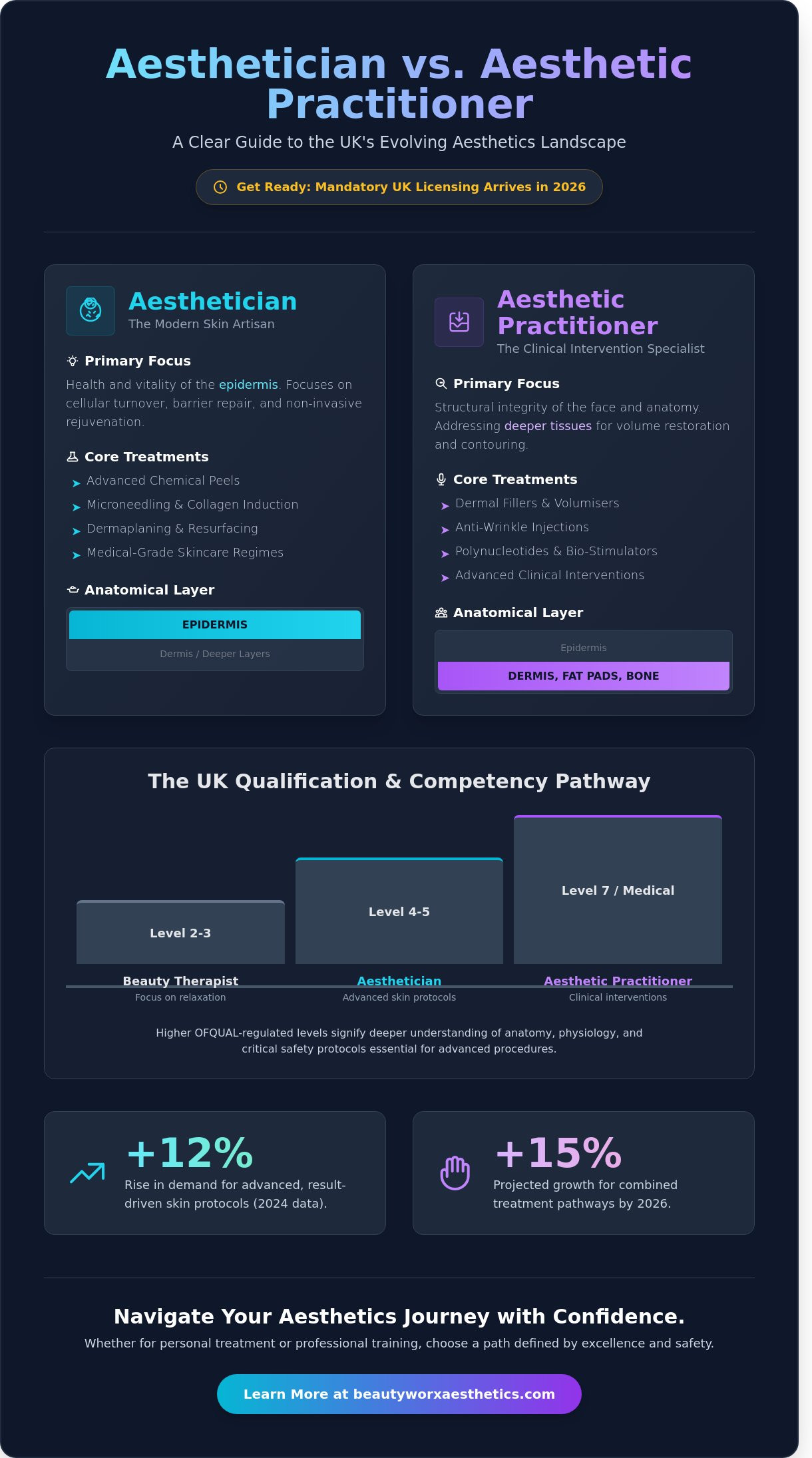
The UK market has seen a significant shift. In 2024, industry reports indicated a 12% rise in demand for advanced skin protocols over traditional pampering sessions. This evolution has led to some confusion. Many high street salons label staff as aestheticians despite them holding only basic Level 2 beauty qualifications. A professional aesthetician typically holds a Level 4 or Level 5 qualification, allowing them to perform deeper resurfacing and use active ingredients that change the skin’s behaviour. They are the guardians of your skin barrier, ensuring every treatment supports long-term vitality.
The Daily Role of a Professional Aesthetician
The journey to luminous skin starts with a bespoke consultation. An aesthetician doesn’t just apply products; they conduct a forensic analysis of your skin’s unique architecture. Their daily repertoire includes:
- Performing advanced extractions and manual resurfacing techniques that accelerate cell renewal.
- Designing bespoke chemical peel protocols tailored to specific skin concerns.
- Prescribing medical-grade skincare regimes for home use.
These home-use protocols often contain higher concentrations of active ingredients like encapsulated retinol or stabilised vitamin C compared to over-the-counter options. This ensures your glow remains consistent between clinic visits.
Aesthetician vs Beauty Therapist: The Key Distinctions
The primary difference between a beauty therapist and an aesthetician is the objective of the treatment. Beauty therapy often prioritises the sensory experience and relaxation. In contrast, an aesthetician focuses on result-driven clinical protocols designed to treat specific pathologies like persistent acne, hyperpigmentation, or premature ageing. This requires a profound understanding of skin physiology and wound healing. While a beauty therapist might work within Level 2 or 3 frameworks, an aesthetician operates at Level 4 or above. This advanced training covers complex chemical peels and collagen induction therapies that require meticulous precision and clinical oversight. It’s a shift from feeling good to seeing visible, structural change.
Aesthetician vs Aesthetic Practitioner: A Strategic Comparison
Understanding the distinction between an aesthetician and an aesthetic practitioner is essential for anyone seeking a refined, natural result. While their paths often intersect, the practitioner operates at a deeper clinical level, focusing on the structural integrity of the face. This transition from surface-level care to medical intervention marks the crossover point where skincare meets science. A practitioner’s role relies heavily on anatomical mastery. They must understand the complex network of nerves, vessels, and muscles to ensure every treatment is as safe as it is beautiful.
The British College of Aesthetic Medicine highlights that medical training provides the foundation for managing the complexities of injectable treatments. This expertise allows for a nuanced approach to rejuvenation that goes beyond the epidermis. By 2026, the industry expects a 15% increase in demand for these combined clinical and holistic pathways. It’s about creating a harmonious balance between a healthy glow and restored volume.
Scope of Practice and Treatment Hierarchies
An aesthetician focuses on the skin’s surface and health. Their expertise includes advanced chemical peels, dermaplaning, and microneedling to refine texture and tone. In contrast, the practitioner’s scope extends to dermal fillers, anti-wrinkle injections, and innovative polynucleotides. These treatments address deeper concerns like bone resorption and fat pad migration. A multidisciplinary approach ensures the best version of the client. It pairs the practitioner’s structural restoration with the professional dedication to skin vitality. This synergy creates a luminous, youthful result that feels entirely authentic.
The Professional Environment
The UK Training Landscape: Navigating Qualifications in 2026
The aesthetics sector has undergone a profound transformation, moving away from the era of unregulated “fast-track” certificates. By 2026, the UK government’s licensing scheme, born from the Health and Care Act 2022, has firmly established that clinical excellence is non-negotiable. This shift ensures every aesthetician and practitioner operates within a framework that prioritises patient safety above all else. The industry’s departure from one-day short courses toward long-term, structured education reflects a commitment to the artistry and science of skin health. Practitioners now view their training as a career-long journey rather than a single destination.
The OFQUAL framework provides the necessary structure for this professional evolution. Levels 4 through 7 act as a roadmap for skill acquisition, starting with foundational skin health and culminating in advanced clinical procedures. Relying on unaccredited training is a significant risk in the current market. Without regulated qualifications, practitioners often find it impossible to secure professional indemnity insurance. More importantly, it leaves clients vulnerable to complications that a properly trained specialist would have the expertise to prevent or manage. Safety is the ultimate luxury, and it begins with rigorous education.
OFQUAL Regulated vs CPD Accredited: What You Must Know
OFQUAL remains the gold standard for educational excellence in the United Kingdom. While Continuing Professional Development (CPD) is valuable for refreshing specific skills, it doesn’t offer the same depth or regulatory oversight as a formal qualification. When you are researching aesthetic courses, it’s vital to choose programmes that carry OFQUAL accreditation. A Level 7 Diploma in Clinical Aesthetic Injectable Treatments represents the pinnacle of training. It provides the technical precision required for harmonious results and the medical-grade knowledge necessary to navigate complex facial anatomy safely.
The Pathway for Non-Medics and Medics Alike
The transition from a beginner to a trusted specialist requires a blend of theoretical knowledge and hands-on artistry. This pathway is now more defined than ever, ensuring that both medics and non-medics can practice safely if they follow the regulated route. Success in this field isn’t achieved through textbooks alone; it requires extensive live model practice and hundreds of supervised clinical hours. Recent updates to UK aesthetics industry regulation highlight that the learning experience must be immersive. Choosing an academy that offers ongoing mentorship is essential. This supportive partnership acts as a guide, helping you refine your skills and build the confidence to deliver bespoke, natural-looking enhancements for every client.
Core Treatments: From Rejuvenation to Restoration
Modern aesthetic medicine treats the face as a living, multi-layered canvas. It’s no longer enough to simply address a single wrinkle; instead, professionals look at how light hits the cheekbones and how the skin reflects health from within. While an aesthetician primarily refines the skin’s surface, practitioners often address the structural foundations that lie beneath the dermis. This synergy ensures that every layer, from the protective epidermis to the deep fat pads, receives targeted attention for a harmonious result.
Specialists in this field must balance the desire for immediate changes with the necessity of long-term skin health. The 2024 Aesthetic Medicine report highlighted a 35% increase in demand for regenerative treatments, suggesting that clients are moving away from “frozen” looks. They want results that feel authentic. Achieving this requires a deep understanding of how different modalities interact over time.
Advanced Skincare and Resurfacing
Professional skin health begins with texture and clarity. Many specialists are now integrating chemical peel training into their practice to treat hyperpigmentation and fine lines with clinical precision. These treatments remove damaged outer layers to reveal luminous, fresh skin underneath. Dermaplaning has also seen a surge in popularity, often used as a preparatory step. It removes vellus hair and dead cells, which can increase the absorption of active serums by up to 60%.
For those seeking deeper structural changes without surgery, collagen induction therapy remains a cornerstone. Microneedling creates controlled micro-injuries that trigger the body’s natural healing response. It’s a powerful tool for an aesthetician looking to improve scarring or skin laxity. This process doesn’t just mask imperfections; it encourages the skin to rebuild its own support network of collagen and elastin fibres.
Injectable Artistry and Cellular Health
The industry is shifting toward a “tweakment” philosophy where less is often more. Dermal fillers are now used for sophisticated facial contouring, restoring lost volume in the mid-face or defining a soft jawline. The goal is a refreshed appearance that looks entirely natural. Alongside these traditional methods, polynucleotide treatment has emerged as the new frontier of skin repair. These bio-stimulators use DNA fragments to signal cells to regenerate, offering a level of repair that fillers cannot achieve alone.
Anti-wrinkle injections continue to be the most requested preventative measure. Precision is vital here. A skilled practitioner ensures safety while maintaining a client’s ability to express emotion. It’s about softening the “angry” or “tired” look rather than erasing all movement. Managing client expectations is the most critical part of this journey. A trusted professional will always prioritise the “bespoke” nature of the service, ensuring the treatment plan aligns with the client’s unique anatomy and ageing process.
Ready to begin your personal skin transformation? Book a bespoke consultation with our expert team today.
Building Your Future with Beauty Worx Aesthetics Academy
Transitioning into the world of medical aesthetics requires more than a simple certificate; it demands a commitment to clinical excellence and a refined eye for detail. At Beauty Worx Aesthetics Academy, we provide a sophisticated training environment where students evolve into high-level practitioners. We focus on creating artisans who understand the delicate balance of facial harmony and anatomical safety. Our bespoke approach ensures you aren’t just following a manual. Instead, you’re learning to curate results that look natural, refreshed, and harmonious. We believe that aesthetic medicine is a science, but its application is an art form. This philosophy permeates every lecture and practical session, ensuring our graduates stand out in a competitive market.
Why Training with Us is a Career Investment
Our state-of-the-art centre serves as a sanctuary for professional growth. You’ll learn alongside expert practitioners who bring years of clinical experience to every session. For any developing aesthetician, the journey often begins with mastering the foundations of skin health. We recommend starting with dermaplaning training to build the manual precision and skin analysis skills necessary for more complex clinical work. We prioritise safety above all else, which is why we offer:
- Access to over 25 CPD accredited and OFQUAL regulated courses.
- Dedicated modules on complications management and emergency protocols.
- Hands-on experience in a luxury clinic setting that mirrors a real-world boutique environment.
- Mentorship from specialists who view aesthetics as a lifelong craft.
Your Next Steps Toward Professional Certification
Securing your place in the 2026 market means looking ahead at upcoming regulatory changes. As an ambitious aesthetician, your progression depends on choosing the right academic partner. Your first step is a thorough evaluation of your current qualifications. We help you identify your specific goals, whether you want to offer subtle skin rejuvenations or advanced injectable treatments. Enrolling in our Level 5 or Level 7 pathways offers the highest level of career security available in the United Kingdom. These regulated qualifications act as a hallmark of quality, reassuring your future clients that they’re in safe, expert hands. Your journey from student to clinic owner is a partnership we take seriously. We invite you to contact our team for a personal career consultation today. Let’s design a bespoke roadmap that reflects your ambitions and helps you build a luminous professional future.
Defining Your Path in Advanced Skin Artistry
The distinction between an aesthetician and an aesthetic practitioner has never been more vital as the UK industry moves toward stricter 2026 licensing frameworks. Success in this evolving market requires a blend of clinical precision and artistic intuition. You’ve seen how the right qualifications bridge the gap between traditional beauty and advanced medical restoration, ensuring every client leaves feeling like the most luminous version of themselves. It’s about more than just treatments; it’s about a commitment to safety and bespoke care.
Navigating this professional journey requires a partner who understands the nuances of the British aesthetics sector. At Beauty Worx Aesthetics Academy, we provide the foundation for your clinical excellence. As an OFQUAL Regulated Training Provider, we offer over 25 CPD Accredited Courses designed to refine your skills. Our Advanced Clinical Mentorship ensures you gain the quiet confidence needed to deliver natural, harmonious results that your clients will trust for years to come.
Your future in high-end aesthetics starts with a single, purposeful step toward mastery. Explore Our OFQUAL Regulated Aesthetics Qualifications and begin your journey toward becoming a trusted expert in this sophisticated industry today.
Frequently Asked Questions
Is an aesthetician the same as a dermatologist?
No, an aesthetician is not a dermatologist. A dermatologist is a medical doctor who has completed at least 10 years of clinical training to specialise in skin pathology and disease. In contrast, an aesthetician focuses on the artistry of skin health through advanced facials and non-invasive procedures. While both roles support skin health, only a dermatologist can diagnose medical conditions or prescribe pharmaceutical-grade medications for chronic skin disorders.
What qualifications do I need to be an aesthetician in the UK?
You typically require an NVQ Level 2 and Level 3 in Beauty Therapy to practice as a professional aesthetician. For those wishing to provide advanced clinical treatments, a Level 4 qualification in skin peeling or microneedling is increasingly essential. By 2026, the UK government’s licensing scheme under the Health and Care Act 2022 will likely mandate specific regulated standards for all practitioners to ensure client safety across the luxury beauty sector.
Can an aesthetician perform Botox and dermal fillers?
Non-medical practitioners can currently perform these treatments, though they must work with a qualified prescriber for Botox because it’s a prescription-only medicine. The UK government is introducing a new licensing scheme in 2026 that will strictly categorise who can perform high-risk injectable procedures. This shift ensures every client receives a harmonious and safe result, prioritising clinical oversight alongside the practitioner’s artistic skill for these delicate, bespoke enhancements.
How much does an aesthetician earn in the UK in 2026?
A qualified professional in this field can expect an average annual salary between £22,000 and £35,000 depending on their specific location and experience. Senior practitioners or those working in luxury London clinics often see earnings exceed £50,000 when including performance-related bonuses. According to 2024 industry reports from Talent.com, entry-level positions start near £21,500, while the top 10% of specialists command significantly higher fees for their meticulous expertise.
Is it better to have a CPD certificate or an OFQUAL qualification?
An OFQUAL-regulated qualification is superior to a CPD certificate for long-term career security and professional recognition. While CPD points demonstrate ongoing learning, OFQUAL-regulated levels 4 through 7 provide a standardised benchmark of competence that insurers and local authorities increasingly demand. Choosing a regulated path ensures your education meets the rigorous criteria set by the 2022 Health and Care Act, protecting your career as the industry moves toward mandatory licensing.
What is the difference between medical and non-medical aesthetics?
The primary distinction lies in the professional background of the practitioner and the depth of treatments they provide. Medical aesthetics is performed by healthcare professionals like nurses or doctors who use clinical training to manage complex complications. Non-medical aesthetics focuses on skin rejuvenation and maintenance using advanced technology. Both paths aim to enhance your natural beauty, but medical practitioners have the authority to prescribe medications and perform higher-risk clinical interventions.
How long does it take to become a Level 7 aesthetic practitioner?
It generally takes between 12 and 18 months to complete a Level 7 Diploma in Clinical Aesthetic Injectable Treatments. This postgraduate-level qualification requires a significant commitment to both theoretical study and supervised clinical practice. Because it mirrors the complexity of a master’s degree, students must complete 277 hours of total qualification time. This ensures they possess the meticulous skill required to deliver subtle, luminous results that respect the unique anatomy of every client.
Can I start an aesthetics career with no prior beauty experience?
Yes, you can enter the industry without prior experience by enrolling in a foundation pathway that covers essential anatomy and physiology. Most reputable academies require you to complete Level 2 and Level 3 Beauty Therapy before progressing to advanced injectables. This foundational knowledge is crucial for understanding skin health. It provides the steady, confident base needed to guide clients through their personal journey toward self-confidence and radiant, youthful skin.











 Reviews