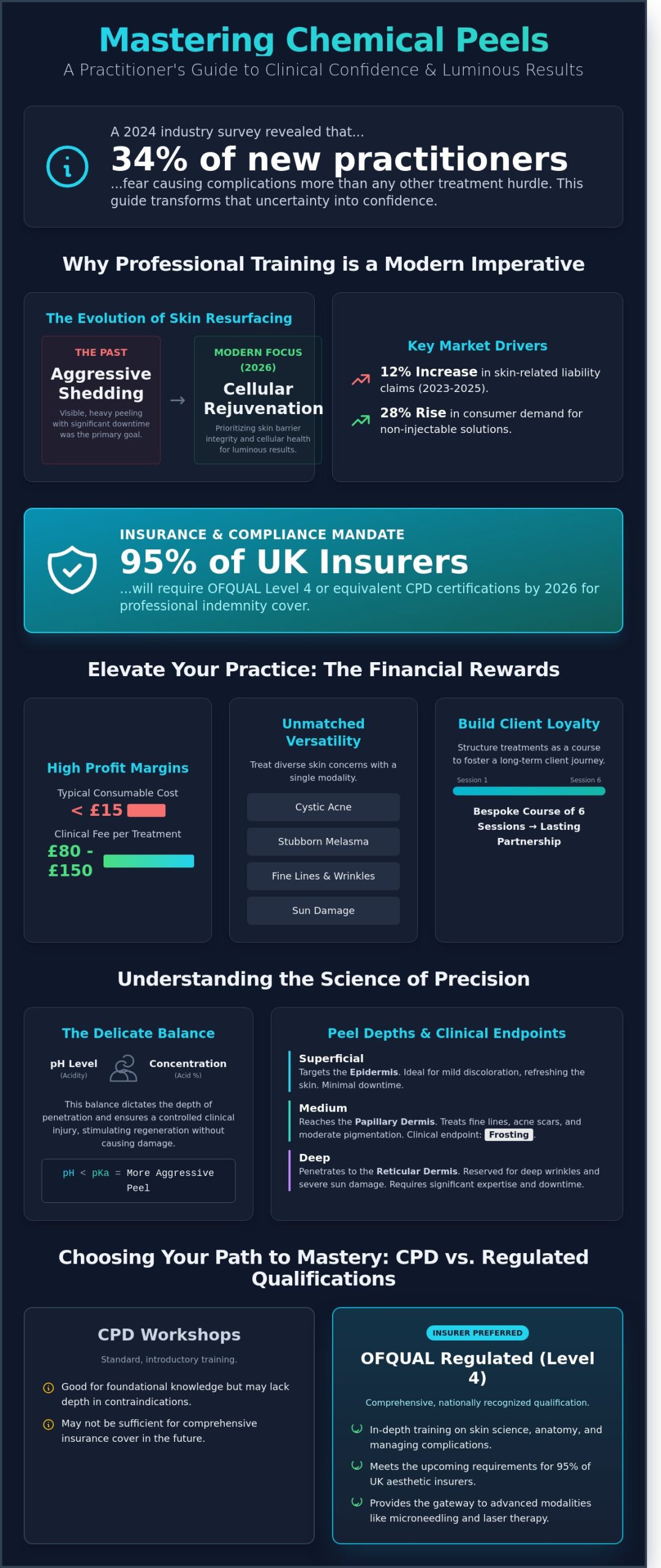
What if the most transformative tool in your aesthetic toolkit isn’t a needle, but a perfectly calibrated solution of acids? You already recognize that true skin rejuvenation is a delicate dance between clinical precision and artistic intuition. It’s natural to feel a flicker of hesitation when handling potent formulations; in fact, a 2024 industry survey revealed that 34% of new practitioners fear causing complications more than any other treatment hurdle. This guide will empower you to master the nuances of skin resurfacing, ensuring you select a chemical peel training program that transforms that uncertainty into absolute clinical confidence and luminous results.
By the end of this guide, you’ll understand how to interpret the technical landscape of AHA and BHA acids while securing the specific OFQUAL Level 4 or CPD certifications that 95% of UK insurers now require for 2026. We’ll explore the science of bespoke treatment plans and the exact marketing strategies needed to position these high-end services profitably within your boutique practice.
Key Takeaways
- Discover how the evolution of skin resurfacing has shifted from aggressive shedding to sophisticated, controlled rejuvenation for a luminous complexion.
- Learn how to select the most prestigious chemical peel training by distinguishing between standard workshops and comprehensive, regulated qualifications.
- Master the delicate balance of pH levels and acid concentrations to ensure every treatment delivers harmonious, medical-grade results.
- Explore the art of the bespoke consultation, learning to safely sequence peels with advanced modalities for truly transformative skin health.
- Understand how a boutique training environment can elevate your professional practice, helping you achieve the subtle, natural-looking enhancements your clients desire.
Why Professional Chemical Peel Training is Essential for Modern Practitioners
Chemical peeling is defined as a controlled clinical injury designed to trigger the body’s natural wound-healing response. By applying specific acid solutions to the epidermis or dermis, we stimulate the skin to regenerate, producing fresh collagen and elastin. For a comprehensive overview of chemical peels and their depth-dependent effects, practitioners often look to historical benchmarks; however, the industry has evolved significantly. In 2026, the clinical focus has shifted from the aggressive, visible shedding of the past toward sophisticated cellular rejuvenation. Modern clients seek results that prioritize skin barrier integrity and cellular health over excessive downtime.
Securing chemical peel training is no longer just a career enhancement; it’s a prerequisite for modern clinical safety and compliance. Leading aesthetic insurers, such as Hamilton Fraser and Cosmetic Insure, now mandate accredited certification before they’ll provide professional indemnity cover. This requirement follows a 12% increase in skin-related liability claims reported between 2023 and 2025, largely due to practitioners using professional-grade acids without formal education. Formal training ensures you protect your business while delivering the luminous, natural-looking results your clients expect.
Consumer demand is also driving this shift. Current market data shows a 28% rise in requests for non-injectable skin health solutions this year. Patients are increasingly looking for ways to achieve a refreshed, harmonious appearance without the use of neurotoxins or dermal fillers. They want to invest in the long-term health of their skin, making the role of the trained practitioner more vital than ever.
The Role of the Aesthetic Practitioner in Skin Health
As a practitioner, you’re an expert artisan who guides clients through a delicate transformation. Moving beyond basic facials to clinical-grade resurfacing requires a meticulous understanding of skin contraindications. You must be able to identify complex issues, such as Fitzpatrick type IV-VI sensitivities or active inflammatory conditions, to ensure every treatment is safe. Mastering these techniques serves as a vital foundation for your career. It prepares you for advanced aesthetic courses, acting as a gateway to more complex modalities like microneedling or laser therapy.
Benefits of Adding Peels to Your Clinic Menu
Integrating peels into your practice offers exceptional financial rewards. Consider these points:
- High Profit Margins: A typical peel treatment costs less than £15 in consumables but commands a clinical fee between £80 and £150.
- Versatility: You can treat diverse concerns including cystic acne, stubborn melasma, and fine lines with a single modality.
- Client Loyalty: By structuring treatments as a bespoke course of six sessions, you create a long-term client journey.
This approach fosters a deep partnership between you and your client. It allows you to monitor their progress and adjust the treatment plan, ensuring they become the best version of themselves through consistent, expert care. Chemical peel training empowers you to offer these sophisticated, results-driven experiences with absolute confidence.
Understanding the Science: Superficial, Medium, and Deep Peels
The true artistry of a clinician lies in their grasp of molecular interaction. Mastering chemical peel training involves more than just application; it requires a precise understanding of how pH levels and acid concentrations dictate the depth of penetration. A solution with a pH of 2.0 will behave differently than one at 3.5, even if the concentration remains a steady 30%. This delicate balance ensures that the treatment remains a controlled injury, stimulating the skin’s natural regenerative powers without causing permanent damage. When the pH of a peel is lower than the pKa of the acid, the solution becomes more aggressive, driving the active ingredients deeper into the dermis for more transformative results.
Practitioners must recognize “frosting” as a critical clinical endpoint. This white, opaque appearance occurs when keratin proteins denature or when the acid precipitates on the skin’s surface. In medium-depth treatments, frosting signals that the acid has reached the papillary dermis. An In-depth clinical review of peels confirms that monitoring these histological changes is vital for safety. While a superficial peel might only require 72 hours of downtime, a TCA peel that induces full frosting often necessitates a 10 to 14-day recovery period for the new, harmonious tissue to emerge.
The Chemistry of Acids: AHA, BHA, and TCA
Glycolic and Lactic acids (AHAs) are the cornerstones of a luminous complexion, focusing on hydration and gentle surface refinement. Salicylic acid (BHA) remains the gold standard for oil control; its lipophilic nature allows it to penetrate the lipid-rich pores to resolve congestion in blemish-prone skin. For those seeking structural restoration, Trichloroacetic Acid (TCA) offers a bespoke approach to addressing deep-seated pigmentation and fine lines. Clinical data from 2025 suggests that 88% of patients see a visible reduction in photodamage after a series of supervised TCA applications.
Skin Histology and the Peeling Process
Chemical desquamation is a sophisticated biological reset. Unlike enzymatic exfoliation, which merely softens surface proteins, chemical peels reach the basement membrane to trigger collagen synthesis and fibroblast activity. This process is highly dependent on the Fitzpatrick scale. A clinician’s ability to assess skin types I through VI ensures that every journey toward radiance is safe and inclusive, minimizing the risk of post-inflammatory hyperpigmentation. Exploring our bespoke clinical pathways can help you master these nuances and deliver undetectable, natural-looking results for every client.
Integrating Peels with Advanced Rejuvenation Treatments
Mastering the art of the bespoke facial requires a deep understanding of how different modalities interact within the skin’s delicate ecosystem. Through comprehensive chemical peel training, practitioners learn that clinical resurfacing isn’t a solitary event; it’s a cornerstone of a multi-layered journey toward radiance. Achieving a harmonious result depends on the practitioner’s ability to sequence treatments with surgical precision. Most clinical protocols now suggest a 14 to 21 day priming phase using tyrosinase inhibitors and vitamin A. This preparation stabilizes melanocyte activity and can reduce the risk of post-inflammatory hyperpigmentation by approximately 45% in sensitive skin types. By thinning the stratum corneum before applying active ingredients, peels act as a biological key, unlocking the skin’s ability to absorb restorative topicals by up to 300%.
The selection of specific chemical peel types dictates the success of the entire rejuvenation plan. Superficial acids might be layered during a single session, while medium-depth TCA peels require a dedicated recovery window. Practitioners must prioritize post-peel homecare, as the 72 hours following a procedure are critical for barrier repair. Utilizing lipid-rich ceramides and broad-spectrum SPF 50 during this window ensures the new, vulnerable cells are protected from environmental stressors. This meticulous attention to detail transforms a standard procedure into a luxury experience that delivers visible, lasting change.
Peels and Dermaplaning: The Ultimate Glow
Combining physical and chemical exfoliation creates an immediate, glass-like finish that is highly sought after in modern aesthetics. Integrating professional dermaplaning training into your skill set allows for the removal of vellus hair and accumulated debris before acid application. This ensures the peel solution saturates the skin uniformly, preventing “hot spots” where acid might pool. Safety is paramount; practitioners typically opt for lower-concentration alpha-hydroxy acids when dermaplaning is performed in the same session to avoid over-exfoliation. The result is a luminous, polished complexion that serves as the perfect canvas for high-end skincare.
Synergy with Injectable Rejuvenation
Modern aesthetics favors an “inside-out” approach, where surface texture and structural volume are addressed simultaneously. Advanced chemical peel training teaches clinicians how to pair resurfacing with a polynucleotide treatment to foster cellular repair from within. While peels refine the surface, polynucleotides work at a DNA level to boost collagen production. For practitioners seeking to master the complete spectrum of injectable rejuvenation, comprehensive skin booster training provides the expertise to deliver deep cellular hydration alongside surface refinement. Timing is essential for safety and comfort. It’s standard practice to wait 14 days after botulinum toxin injections before performing a chemical peel to ensure the injectable has fully settled. This strategic scheduling protects the integrity of the results while enhancing the patient’s natural beauty through a multifaceted, artisan approach.
Choosing the Right Chemical Peel Course: CPD vs. Regulated Qualifications
Selecting the right educational path is the most critical decision in your professional evolution. Short CPD workshops, typically spanning one or two days, serve as excellent refreshers for specific product ranges or brand-specific protocols. However, they don’t carry the same weight as OFQUAL regulated Level 4 or Level 5 qualifications. By 2026, the aesthetics landscape expects a shift toward mandatory licensing, making these regulated pathways the gold standard for anyone seeking a sustainable career. High-caliber chemical peel training ensures you aren’t just memorizing a protocol; you’re mastering the intricate science of skin transformation.
Your chosen curriculum must prioritize the client’s safety through rigorous complications management. A report by the Joint Council for Cosmetic Practitioners (JCCP) in 2023 revealed that 85% of adverse incidents in skin resurfacing were preventable with advanced practitioner education. You need a training environment that mirrors a high-end clinical setting, where you can practice on at least four live models. This hands-on experience under the guidance of a trusted artisan ensures your technique is both safe and fluid. It’s about finding that delicate balance between medical precision and the artistic touch required for harmonious results.
What a Comprehensive Curriculum Must Cover
Mastery begins with a deep dive into Level 4 Anatomy and Physiology. You’ll explore the skin’s cellular responses to various acids, ensuring you can predict outcomes with clinical accuracy. A premium course also covers the logistical realities of a boutique clinic, such as the chemical storage standards set by the Health and Safety Executive (HSE). You’ll learn to conduct bespoke consultations that manage expectations, guiding every client toward their most refreshed and luminous self.
The Importance of Post-Course Mentorship
Confidence often blossoms long after the initial certification ends. New practitioners frequently encounter unique skin responses that require a specialist’s second opinion. Access to a dedicated clinical help-line or a mentorship circle provides a vital safety net for managing rare complications. This ongoing support transforms your education from a simple transaction into a lifelong partnership in self-care. It empowers you to navigate the complexities of aesthetic medicine with the quiet confidence of an expert guide. Building your skills within a community of like-minded professionals ensures you stay at the forefront of clinical rejuvenation.
Elevate your practice and secure your professional future by enrolling in our accredited chemical peel training today.
Elevate Your Career with BeautyWorx Aesthetics Training
Choosing the right path for your professional development is about more than just obtaining a certificate; it’s about finding a mentor who understands the delicate balance between medical science and aesthetic artistry. BeautyWorx Aesthetics operates on a singular, refined philosophy: we believe in enhancing your natural beauty rather than masking it. Our training doesn’t just teach procedures; it cultivates the eye of an artisan. You’ll step into a boutique environment that mirrors the serenity of a high-end luxury clinic. Every detail, from the ergonomic treatment beds to the soft, ambient lighting, is designed to foster a sense of calm and focused learning. We prioritize clinical excellence through a lens of sophistication, ensuring your future clients receive results that are both luminous and harmonious.
Mastering the art of skin resurfacing is the foundational stone of a successful career in 2026. Practitioners often begin their journey with our comprehensive aesthetic courses, moving from the precision of chemical peel training into advanced injectables and collagen induction therapies. This structured pathway allows you to build a loyal client base that trusts your expert guidance. By focusing on subtle restoration, you’ll position yourself as a specialist who values the long-term health and vitality of the skin.
The BeautyWorx Training Experience
We maintain a strict 4:1 student-to-tutor ratio to ensure meticulous, personalized tuition for every delegate. This isn’t a factory-style education; it’s a bespoke mentorship. You’ll learn to move beyond a “one-size” mindset, instead developing tailored treatment plans that address specific concerns like hormonal pigmentation or solar elastosis. We exclusively utilize medical-grade, pH-controlled peel systems that deliver predictable, professional outcomes. Our curriculum emphasizes the emotional journey of the client, teaching you how to build trust through transparent consultations and visible, refreshed results. This chemical peel training ensures you leave with the quiet confidence of a seasoned professional.
Enrolment and Next Steps
Securing your place for our 2026 intake is a straightforward, supportive process. You can apply directly through our digital portal to view upcoming dates for the spring and summer terms. To ensure our training remains accessible to dedicated professionals, we offer 0% interest financing options spread over 12 months. Every delegate receives a professional starter kit valued at £450, containing premium solutions and neutralizers for your first 10 clinical cases. This is more than a course; it’s an invitation to join a partnership in clinical excellence. Take the next step in your professional evolution and help your clients discover the best version of themselves.
Master the Art of Clinical Skin Transformation
The transition from a standard aesthetician to a clinical skin specialist requires more than just technical knowledge; it demands a deep mastery of cellular biology. By 2026, the UK aesthetics industry has shifted toward more rigorous oversight, making OFQUAL Regulated Qualifications and CPD Accredited Training the essential benchmarks for any serious practitioner. You’ve learned how to distinguish between superficial AHA solutions and medium-depth TCA applications, ensuring every client receives a bespoke treatment plan that delivers a luminous, natural-looking glow. This level of expertise isn’t just an addition to your service menu; it’s an investment in your reputation as a trusted artisan who understands the delicate balance of clinical science and aesthetic beauty.
At BeautyWorx Aesthetics, we provide more than just a certificate. Our students benefit from direct Mentorship from Lead Practitioners who’ve spent over 15 years refining their craft in luxury clinical settings. This personal guidance helps you navigate complex skin concerns with the quiet confidence that only comes from expert-led education. You’re ready to elevate your career and offer the sophisticated, harmonious results your clients deserve.
Start your journey to clinical excellence with BeautyWorx Chemical Peel Training
We’re here to help you become the best version of yourself and look forward to supporting your professional growth at every step of this journey.
Frequently Asked Questions
What qualifications do I need to do chemical peel training in the UK?
To enroll in professional chemical peel training within the UK, you typically require an NVQ Level 3 in Beauty Therapy or a valid medical registration such as GMC, NMC, or GDC. These standards ensure you possess the foundational knowledge of skin anatomy necessary for advanced clinical rejuvenation. Our 2026 curriculum aligns with the latest JCCP guidelines, providing a seamless pathway for professionals to enhance their expertise safely.
Is chemical peel training suitable for non-medics?
Chemical peel training is absolutely suitable for non-medics who hold a recognized Level 3 qualification in beauty therapy. While the industry is moving toward stricter oversight, non-medical practitioners continue to perform 65% of superficial and medium-depth peels in high-end UK clinics. This training empowers you to deliver luminous, bespoke results that bridge the gap between traditional facials and invasive medical procedures while maintaining a meticulous professional standard.
How much can I charge for a professional chemical peel treatment?
You can expect to charge between £80 and £250 for a single treatment, depending on your location and the complexity of the acid profile. Offering a bespoke course of six treatments often secures a higher upfront commitment of £450 to £1,200. This investment reflects your clinical expertise and the sophisticated, transformative journey you provide for your clients’ skin health, helping them achieve the best version of themselves.
What is the difference between a superficial and a deep peel?
Superficial peels only penetrate the epidermis to create a refreshed glow, while deep peels reach the mid-dermal layer to address severe scarring or deep-set wrinkles. Most boutique clinics focus on superficial and medium-depth treatments because they offer a 100% safety profile with minimal downtime. These controlled exfoliations allow for a subtle, harmonious restoration that reveals the best version of your client’s natural beauty without the risks of deep sedation.
How long does a typical chemical peel training course take?
A comprehensive chemical peel training course usually takes 1 to 2 days of intensive practical instruction, preceded by 15 hours of online theory preparation. This structured approach ensures you master the rhythmic application techniques and safety protocols required for clinical excellence. We focus on quality over speed, ensuring you leave the academy with the quiet confidence of a true skin artisan ready to perform luminous treatments.
Will I be able to get insurance immediately after my chemical peel course?
You’ll be eligible to obtain professional indemnity insurance immediately after receiving your certificate of completion from an accredited provider. Leading insurers like Hamilton Fraser or Cosmetic Insure typically provide coverage for new practitioners within 24 hours of application. Having this protection is a vital step in your professional journey, ensuring both your business and your clients remain secure and supported as you begin your new career path.
What are the common complications of chemical peels and are they covered in the training?
Common complications like post-inflammatory hyperpigmentation (PIH) or prolonged erythema affect approximately 3% of patients and are covered extensively in our training. You’ll learn to recognize frosting and manage adverse reactions with meticulous precision. Understanding these clinical variables is essential for maintaining a safe environment and ensuring every client achieves a radiant, undetectable result without unnecessary risk. We provide the expert guidance needed to handle every skin concern.
Do I need to provide my own models for the practical training days?
We provide all models for your practical training days to ensure you gain experience on a diverse range of skin types and concerns. This allows you to practice your bespoke techniques on at least 4 different clinical cases under expert supervision. If you prefer to witness the long-term journey of a specific individual, you may bring one personal model by prior arrangement with our 2026 admissions team to facilitate a deeper learning experience.












 Reviews