What if the difference between a luminous, natural result and a devastating vascular occlusion isn’t just your technique, but how clearly you can visualise the invisible map beneath the skin? Most dedicated practitioners recognise that the transition from a flat textbook diagram to the complex, three-dimensional reality of a patient’s face can feel daunting. It’s common to feel a flicker of hesitation when navigating the delicate mid-face; especially since a 2024 industry report by the Joint Council for Cosmetic Practitioners (JCCP) noted that 68% of aesthetic complications stem from a lack of anatomical precision. This technical mastery is the foundation of patient safety and professional confidence.
This guide helps you master the anatomy of facial layers to ensure your practice remains both precise and profoundly safe. You’ll gain the confidence to navigate high-risk areas while achieving the bespoke, subtle enhancements that define your reputation as a trusted artisan. We’ll explore the five distinct layers of soft tissue, identify critical vascular pathways for 2026, and demonstrate how structural awareness dictates the ultimate aesthetic outcome for every individual client. By the end of this article, you’ll possess a clearer perspective on how to blend clinical expertise with artistic discernment.
Key Takeaways
- Master the five-layer framework to approach the face as a multi-dimensional structure, ensuring every millimetre of treatment is delivered with absolute clinical precision.
- Develop a profound understanding of the anatomy of facial structures to navigate high-risk vascular zones safely, protecting your clients while achieving refreshed, luminous results.
- Explore how underlying osteology and myology dictate facial proportions, allowing you to create bespoke, harmonious enhancements that respect the skull’s natural foundation.
- Learn why anatomical mastery is your primary line of defence against adverse events, providing the scientific confidence needed to manage complex complications like vascular occlusion.
- Discover the path to professional excellence through hands-on training and the prestigious Level 7 Diploma, the gold standard for practitioners committed to the highest safety standards.
Understanding the Anatomy of Facial Layers: The 5-Layer Framework
To achieve a result that’s both luminous and natural, we must view the face as a multi-dimensional landscape rather than a flat surface. Every aesthetic intervention relies on a surgeon-like precision regarding depth. A difference of just two millimetres can be the deciding factor between a subtle, refreshed lift and an ineffective application. Mastering the anatomy of facial structures allows practitioners to navigate this complex terrain with confidence, ensuring safety and artistry are never compromised.
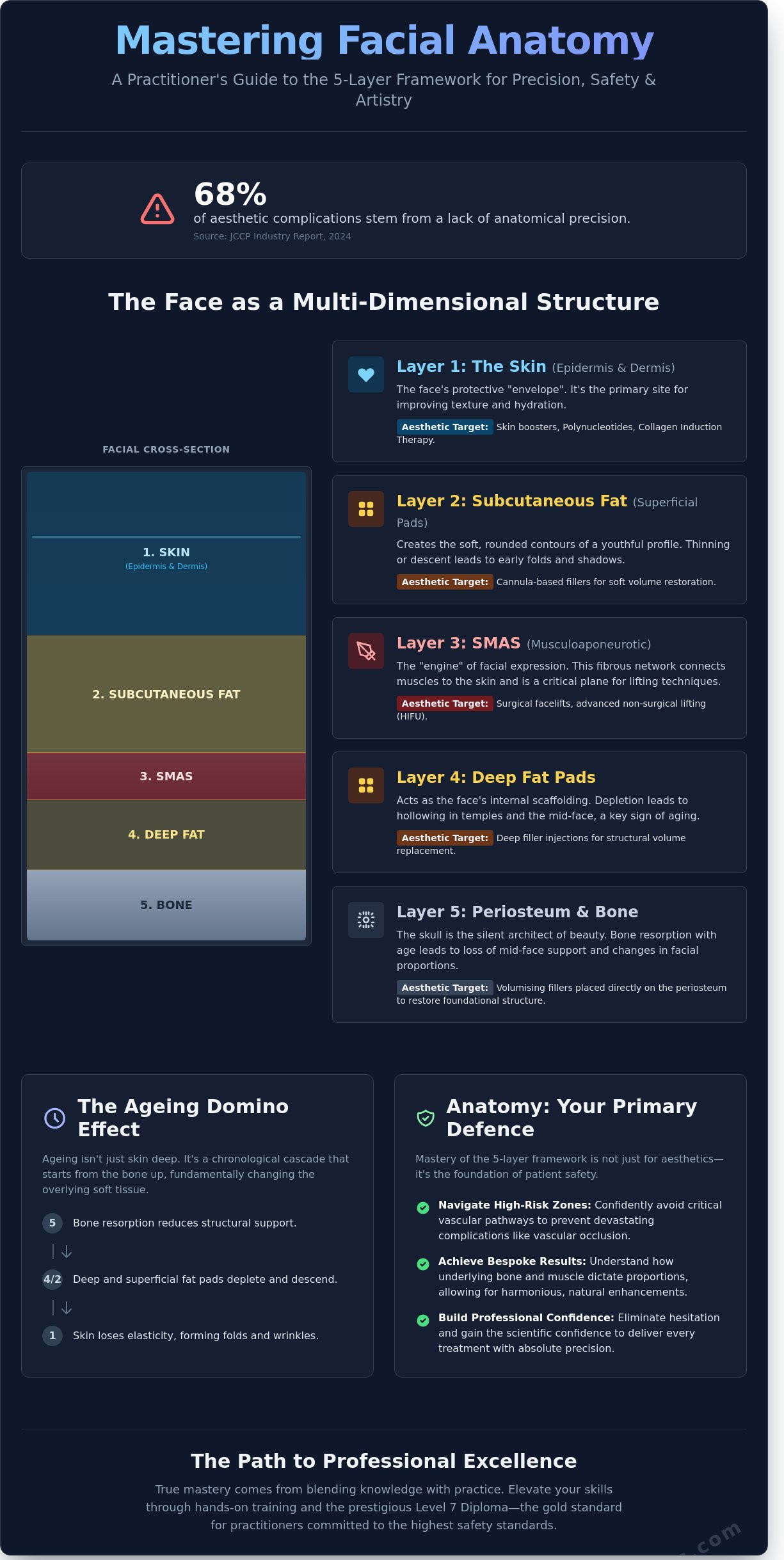
The face is organised into five distinct layers, each playing a unique role in your overall appearance:
- Layer 1: The Skin (Epidermis and Dermis)
- Layer 2: Subcutaneous Fat (Superficial fat pads)
- Layer 3: The Musculoaponeurotic layer (SMAS)
- Layer 4: Deep Fat Pads
- Layer 5: The Periosteum and Bone
Ageing affects these strata in a chronological domino effect. Bone resorption provides less structural support; research suggests facial bone density begins to decline as early as our late thirties, which fundamentally changes how the overlying soft tissue sits. Understanding the anatomy of facial ageing helps us determine whether a client needs surface-level skin rejuvenation or deep structural volume replacement.
Layer 1 & 2: The Envelope of the Face
The epidermis and dermis act as the face’s protective silk, where skin boosters and polynucleotides work to restore hydration and elasticity. The dermis is the primary site for collagen induction therapy. Just beneath this, superficial fat pads create the soft, rounded contours that define a youthful profile. When these pads thin or descend due to gravity, we lose that enviable radiance, leading to the formation of early folds and shadows.
Layer 3 & 4: The Engine and the Volume
Beneath the superficial fat lies the superficial muscular aponeurotic system (SMAS), a fibrous network that connects facial muscles to the skin. It’s the engine of facial expression and the critical plane for both surgical face-lifts and advanced non-surgical lifting techniques. Practitioners must respect this layer to avoid unnatural “frozen” looks.
Deep fat pads sit even further down, acting as the face’s internal scaffolding. Their depletion often leads to the hollowing seen in the temples or mid-face. There’s also a direct relationship between muscle movement in these layers and the formation of dynamic wrinkles. When muscles overwork without the cushioning of deep fat, lines become etched into the skin’s surface, requiring a bespoke approach to soften and harmonise the features.
Osteology and Myology: The Framework of Facial Expression
The skull serves as the silent architect of your beauty. Its contours, specifically the maxilla and mandible, dictate the proportions that define your unique profile. As we mature, bone resorption can alter these foundations. Research suggests that the maxillary angle can decrease by several degrees over decades, leading to a visible loss of mid-face support. Understanding the underlying anatomy of facial bones allows us to restore volume where the framework has shifted, ensuring your results look entirely natural and structural. To further explore how structural health supports the alignment of the head and neck, you can discover Upper Cervical Care through specialized practitioners.
Muscles provide the movement that brings your expressions to life. These are categorised as levators, which lift the features, and depressors, which pull them downwards. Achieving a harmonious balance requires an expert eye to assess your individual muscle strength. We don’t believe in a one-size-fits-all application. A bespoke assessment ensures that we soften lines without sacrificing your ability to convey emotion. It’s a delicate dance of “push” and “pull” that defines your facial character.
The Upper Face: Forehead and Periorbital Anatomy
The Frontalis is the sole muscle responsible for lifting your brows. It’s the primary cause of horizontal forehead lines. If an injector over-treats this area, it can lead to brow ptosis, a heavy sensation that makes the eyes appear tired. Surrounding the eyes is the Orbicularis Oculi. This delicate sphincter muscle controls squinting and contributes to “crow’s feet.” By precisely targeting specific fibres, we create a luminous, wide-awake appearance. Safety remains paramount during these procedures. Practitioners must be acutely aware of vascular danger zones to ensure every movement is as secure as it is aesthetic.
The Mid and Lower Face: Contouring and Support
Your smile is powered by the Zygomaticus major and minor. These muscles pull the corners of the mouth upwards and outwards. When we apply cheek filler, we place it to support these muscles rather than hinder them. This maintains the fluid, graceful movement of your natural smile. This anatomy of facial movement is what separates a stiff result from a radiant one.
- The Masseter: This powerful muscle is essential for chewing, but overactivity can lead to a widened jawline or teeth grinding. Softening it creates a slimmer, more refined contour.
- The Mentalis: A hyperactive chin muscle can cause a “pebbled” or dimpled texture.
- The DAO: The Depressor Anguli Oris pulls the mouth corners down. Precise injections here can transform a permanent “sad” look into a serene, neutral expression.
If you’re ready to explore how a tailored approach can enhance your features, you can book a professional consultation with our expert team. This ensures every treatment is a masterpiece of precision and artistry, designed specifically for your unique facial structure.
The Vascular System and Fat Pads: Navigating the Danger Zones
Achieving a luminous, natural result requires more than an artistic eye; it demands a surgeon-like grasp of the anatomy of facial vasculature. The facial artery acts as the primary vessel of concern, winding its way from the jawline toward the nose in a highly variable path. A 2020 study published in the Journal of Craniofacial Surgery highlighted that the facial artery’s position can vary by up to 5mm between individuals. This variability makes a “one size fits all” approach dangerous. Practitioners must treat every face as a unique map where the glabella, temples, and nasolabial folds represent high-risk “danger zones.”
Safe injecting relies on the distinction between superficial and deep planes. Placing product in the wrong layer doesn’t just look unnatural; it risks vascular occlusion. We prioritise deep placement on the bone in areas like the chin and cheeks to provide structural support, while reserving superficial injections for fine lines where the skin is thicker and vessels are fewer. This meticulous approach ensures your safety remains the foundation of your aesthetic journey.
Arterial Anatomy and Injection Safety
The angular artery represents the terminal branch of the facial artery, making the nose one of the most complex areas for dermal fillers. In the upper face, the supraorbital and supratrochlear arteries are critical. These vessels connect directly to the ophthalmic artery. An accidental intravascular injection here carries a risk of visual impairment, which is why we approach the forehead with extreme caution. To mitigate these risks, your practitioner often chooses a blunt-tipped cannula over a sharp needle. Cannulas are designed to glide past delicate vessels rather than piercing them. It’s a sophisticated choice that prioritises your well-being while ensuring a smooth, bruise-free recovery.
Fat Pad Dynamics and Volumisation
Youthful beauty is often defined by the “triangle of youth,” where volume is concentrated in the upper and mid-face. The malar fat pad is the star of this region, providing the “apple of the cheek” that reflects light for a refreshed look. As we age, these fat pads undergo a process of deflation and descent. This migration shifts the facial weight downwards, creating the “inverted triangle” of ageing characterised by jowls and deeper folds. This shift is a natural part of the anatomy of facial maturation, but it can be elegantly managed with bespoke treatments.
- The Malar Fat Pad: Restoring this area provides an instant lift to the lower face, softening the nasolabial folds without directly injecting them.
- The SOOF (Sub-orbicularis Oculi Fat): This deep fat pad sits beneath the eye. Precise, deep placement here addresses tear troughs with clinical accuracy, avoiding the bluish “Tyndall effect” caused by superficial injections.
- Fat Migration: Understanding how fat pads move allows us to treat the cause of sagging rather than just the symptoms, ensuring your results are harmonious and never overfilled.
By respecting these anatomical boundaries, we don’t just change how you look; we restore the structural integrity of your face. It’s a blend of medical science and high-end artistry designed to reveal the best version of you.
Clinical Relevance: Anatomy as the Key to Complications Management
Mastering the anatomy of facial structures serves as the primary safeguard against the risks inherent in aesthetic medicine. A practitioner’s ability to visualise the intricate layers beneath the skin transforms a routine procedure into a masterpiece of safety and precision. Every injection carries a responsibility to respect the delicate balance of vessels, nerves, and soft tissue that define an individual’s unique beauty. This deep understanding allows for a proactive approach, ensuring that every touch is both purposeful and protected.
Identifying and Managing Adverse Events
Recognising the early warning signs of a complication is a skill honed through rigorous study of the anatomy of facial vasculature. If a patient experiences unusual pain or skin blanching, it signals a potential emergency that requires a calm, clinical response. In these moments, the rapid administration of Hyaluronidase is essential to dissolve hyaluronic acid fillers and restore blood flow. Because these situations require split-second decision-making, enrolling in a comprehensive complications management course is a vital step for every professional committed to excellence in the UK aesthetic market.
Precision in Neurotoxins
Achieving a refreshed, luminous appearance with neurotoxins requires more than just basic technique; it demands an understanding of how products like Azzalure interact with specific muscle fibres to soften lines without sacrificing expression. Azzalure requires precise anatomical placement due to its specific diffusion profile. Mapping injection points accurately prevents the “frozen” look or unintended muscle paralysis, ensuring results remain harmonious and subtle. By tailoring the depth and location of each unit, clinicians provide a bespoke experience that enhances natural beauty while maintaining the fluid movement of the face.
Your journey toward a more confident, radiant version of yourself begins with a foundation of clinical safety. To explore our range of expert-led treatments, book a consultation with BeautyWorx Aesthetics today.
The Path to Professional Mastery: Training with Beauty Worx
Mastering the anatomy of facial structures is a lifelong pursuit that distinguishes a basic practitioner from a true clinical artisan. While textbooks provide the essential map, the nuances of dermal depth and muscular resistance can only be felt through guided, hands-on experience. Moving from theory to practice requires a transition that prioritises patient safety and aesthetic harmony. At Beauty Worx Aesthetics, we facilitate this growth by ensuring every student works directly with live models under expert supervision. This tactile learning environment transforms abstract diagrams into a physical intuition for tissue layers.
The Level 7 Diploma stands as the gold standard for clinical aesthetic injectable treatments in the United Kingdom. It represents a significant shift from the introductory courses often found in the industry, offering a comprehensive framework that aligns with the highest medical standards. Our curriculum doesn’t treat anatomy as a standalone subject; instead, we integrate deep anatomical study into every practical module. Whether you’re learning to restore volume in the mid-face or refine the jawline, the underlying vascular and nervous systems are always the primary focus. This approach supports your journey from a beginner to a sophisticated expert who treats with confidence and precision.
OFQUAL Regulated Qualifications
The difference between a short CPD course and a regulated Level 5 or 7 qualification is profound. While CPD sessions might last only a day or two, a regulated diploma provides the long-term security of a nationally recognised qualification. This formal certification is essential for securing comprehensive insurance and meeting the rigorous standards set by the Joint Council for Cosmetic Practitioners (JCCP). Our training centre organises small-group sessions, often maintaining a 4:1 student-to-tutor ratio, to ensure focused learning. This intimacy allows for detailed discussions on the anatomy of facial danger zones, ensuring you’re prepared for the complexities of real-world clinical practice. Practitioners who wish to build on this foundation will find that completing a dedicated aesthetic safety and complications management course further strengthens their ability to respond with confidence in high-pressure clinical situations.
Enrolment and Mentorship
Elevating Your Clinical Artistry for 2026
Mastering the intricate anatomy of facial structures is the bridge between a standard procedure and a transformative, safe aesthetic result. By respecting the 5-layer framework and navigating delicate vascular danger zones with precision, you protect your patients while ensuring harmonious, subtle outcomes. True expertise relies on understanding how osteology and fat pads interact to create the luminous, youthful contours clients desire. This deep knowledge reduces complication risks and builds the quiet confidence required of a specialist.
Excellence in this field requires a commitment to rigorous, evidence-based education. At Beauty Worx, our sophisticated training centre combines decades of combined clinical experience with a focus on natural-looking results that enhance a client’s unique beauty. We provide a clear professional pathway through our OFQUAL regulated Level 4, 5, and 7 qualifications, ensuring you meet the highest UK standards of safety and discernment.
Your journey toward becoming a trusted, expert artisan starts with a solid anatomical foundation. Master the art of aesthetics with our OFQUAL regulated Level 7 Diploma and join a community dedicated to the science of graceful aging. It’s the most reliable way to refine your skills and deliver the bespoke care your patients deserve.
Frequently Asked Questions
Why is the anatomy of facial structures so important for botox and fillers?
Understanding the anatomy of facial structures ensures every injection is both safe and effective by avoiding critical neurovascular bundles. A deep knowledge of these structures allows practitioners to place products in the correct tissue plane, which prevents complications like vascular occlusion or nerve damage. This expertise transforms a standard procedure into a bespoke treatment that enhances your natural beauty with clinical precision.
What are the “danger zones” in facial aesthetics that practitioners must avoid?
The primary danger zones include the glabella, the temples, and the nasolabial folds where major arteries reside. For instance, the angular artery near the nose and the supraorbital artery above the eyes are high-risk areas where accidental intravascular injection can lead to skin necrosis or vision loss. Practitioners must navigate these 10 high-risk regions with extreme caution to maintain the highest safety standards during every session.
How many layers of tissue are in the human face?
The human face consists of five distinct histological layers that dictate how products interact with your features. These layers include the skin, the subcutaneous fat, the superficial muscular aponeurotic system (SMAS), the deep fat pads, and the periosteum or bone. Precise placement within these five levels is essential for achieving the luminous, refreshed look that defines a high-end aesthetic result.
Can a non-medic learn facial anatomy for aesthetics training?
Non-medics in the United Kingdom can learn facial anatomy through accredited Level 4 to Level 7 pathways, provided they meet the Health and Safety Executive standards. While the industry is moving towards stricter regulation, currently around 30% of practitioners come from non-clinical backgrounds. It’s vital to choose a course that offers rigorous anatomical training to ensure you can provide the safe, harmonious results your clients expect.
What is the SMAS layer and why does it matter for non-surgical lifts?
The SMAS layer is a fibrous network of collagen and elastin that connects your facial muscles to the overlying skin. It acts as the structural scaffolding for the face, making it the primary target for non-surgical lifting treatments like HIFU or certain dermal filler techniques. By supporting this specific layer, practitioners can achieve a subtle yet transformative lifting effect without the need for invasive surgery.
What happens if a dermal filler is accidentally injected into a blood vessel?
An accidental injection into a blood vessel causes a vascular occlusion, which blocks blood flow to the surrounding tissue. If this occurs, the practitioner must immediately use Hyaluronidase to dissolve the filler and restore circulation. Statistics from the Aesthetic Complications Expert Group suggest that swift intervention within the first 60 minutes is crucial to prevent permanent tissue damage or scarring.
How does facial anatomy change as we age?
Facial anatomy undergoes significant changes as we age, including the loss of roughly 1% of collagen per year after the age of 25. Deep fat pads begin to shrink and descend; meanwhile, the underlying bone structure, particularly in the jaw and mid-face, gradually resorbs. These structural shifts lead to the hollows and sagging we often see, making a bespoke approach to restoration essential for a youthful, radiant appearance.
Is a Level 7 Diploma necessary for learning advanced facial anatomy?
While not a legal requirement in the UK yet, a Level 7 Diploma is the gold standard for mastering the complex anatomy of facial structures in a clinical setting. This qualification aligns with the Joint Council for Cosmetic Practitioners standards, providing 270 hours of postgraduate-level study. Investing in this level of education ensures you possess the deep expertise required to deliver safe, undetectable enhancements for every client.













 Reviews